Great Games of Thought
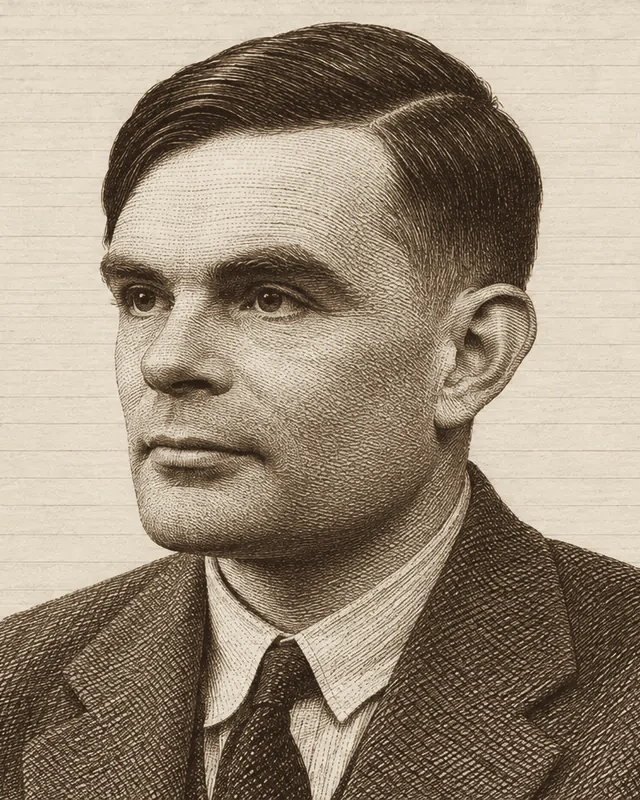
Turing — an imagined portraitAn imagined portrait

Alan Turing

1912–1954

Turing of the imitation game

Can machines think? I propose to consider this question.
Game 2 · Reconstruction · Record, Turing 1950 paper first sentence

Overview

Alan Turing was a British mathematician and logician, born in London in 1912. Record

In a 1936 paper he set out an imaginary machine that reads and writes symbols by following rules — what we now call a 'Turing machine' — and showed what computation is and where its limits lie. Record

During the Second World War he took part in breaking the German Enigma cipher at Bletchley Park and designed the codebreaking machine called the Bombe. Record

In a 1950 paper he proposed replacing the question 'Can machines think?' with an imitation game; this is what is now called the Turing test. Record

In 1952 he was convicted over a same-sex relationship, which British law then treated as a crime, and he died in 1954, aged 41. Record

Timeline

  1. 1912

    He was born on 23 June in Paddington, London. His father was a British civil servant working in India. Record

    MacTutor 'Alan Mathison Turing' / A. Hodges, entry in the Oxford Dictionary of Scientific Biography (1995, turing.org.uk)

  2. 1931–1935

    He entered King's College, Cambridge, in 1931, graduated with first-class honours in mathematics in 1934, and became a Fellow of King's College in 1935. Record

    King's College 'Alan Mathison Turing (1912-54)' / MacTutor

  3. 1936

    His paper 'On Computable Numbers' was received by the London Mathematical Society on 28 May 1936 (he was 23) and read to the Society on 12 November. The paper appeared in the Society's journal in two parts, on 30 November and 23 December 1936, and a correction was published in 1937. Record

    Turing, 'On Computable Numbers…', Proc. London Math. Soc. (2) 42, heading (Received 28 May, 1936.—Read 12 November, 1936) / MacTutor · Hodges (1995)

  4. 1936–1938

    He studied under Alonzo Church at Princeton University in the United States and received his doctorate in 1938 for a thesis on ordinal logics. Record

    MacTutor / Princeton University Press, 'Alan Turing's Systems of Logic: The Princeton Thesis'

  5. 1939

    When Britain declared war, he began working full-time at the Government Code and Cypher School (GC&CS) at Bletchley Park. Record

    MacTutor / Hodges (1995)

  6. 1940

    The first Bombe built to Turing's design, 'Victory', began running at Bletchley Park in March. The Bombe was based on the Polish bomba, and the diagonal board devised by Gordon Welchman was added later. Record

    TNMOC 'Enter Turing and Welchman' / Tony Sale, 'Virtual Wartime Bletchley Park — The Turing Bombe' · Hodges (1995)

  7. 1941

    Hut 8, led by Turing, began breaking German naval Enigma ('Dolphin') regularly from around the summer of 1941. Cipher material captured by the navy was also used in this work. Record

    Bletchley Park 'Sea' / Hodges (1995) · MacTutor

  8. 1946

    He was appointed OBE (Officer of the Order of the British Empire) for his wartime service. In the same year he presented the design for the ACE computer at the National Physical Laboratory (NPL). Record

    Turing Digital Archive 'About Alan Turing' · IEEE Computer Society 'Computer Pioneers' / MacTutor · Hodges (1995)

  9. 1947

    He finished fifth in the British AAA marathon championship, in 2 hours 46 minutes 3 seconds. Record

    MacTutor 'Turing as a runner' · MacTutor biography / NUTS 'Alan Turing' records

  10. 1948

    He moved to the University of Manchester and took charge of work in the computing laboratory. Record

    Hodges (1995) / MacTutor

  11. 1950

    He published 'Computing Machinery and Intelligence' in the philosophy journal Mind (vol. 59, no. 236). Record

    Mind LIX(236), 433–460, Oxford Academic / MacTutor

  12. 1951

    He was elected a Fellow of the Royal Society (FRS). Record

    MacTutor / Hodges (1995) · Turing Digital Archive

  13. 1952

    At his trial on 31 March he was convicted over a same-sex relationship and, instead of prison, accepted a year of female hormone injections. Record

    Hodges (1995) / MacTutor · GOV.UK 'Royal pardon for WW2 code-breaker Dr Alan Turing' (2013)

  14. 1954

    He died of cyanide poisoning at his home in Wilmslow on 7 June. The inquest ruled it suicide, but some researchers argue it may have been an accident. Debated

    Hodges (1995) · MacTutor · SEP 'Alan Turing' / History News Network (2012, Jack Copeland's argument)

  15. 2013

    He received a royal pardon on 24 December. Earlier, in 2009, Prime Minister Gordon Brown had apologized on behalf of the government for the way he was treated. Record

    GOV.UK 'Royal pardon…' (2013-12-24) · GOV.UK 'Thousands officially pardoned under Turing's Law' (2017) / MacTutor · University of Manchester (2009)
Key ideas

Breaking calculation into tiny steps

Turing broke down the process of a person calculating on paper into 'simple operations' that cannot be divided further. He then argued that a machine could be built to do exactly the same work. Turing himself wrote that such arguments must in the end appeal to intuition. When he wrote 'computer', he meant a person who computes. Record · Paraphrase

Turing (1936) §9 / MacTutor

One machine that imitates every computing machine

The 1936 paper showed a single machine that, given the description of another machine on its tape, carries out the computation that machine would perform: the universal machine. Hodges sees in it the core principle of the computer, which does many jobs simply by changing the program. Record · Paraphrase

Turing (1936) §6 'The universal computing machine' / Hodges (1995)

Some problems no machine can solve

In the same paper Turing showed that Hilbert's 'decision problem' has no solution. That is, there are problems whose answers no mechanical procedure can settle. Record · Paraphrase

Turing (1936) introduction · §11 / SEP 'Alan Turing' (Andrew Hodges)

An imitation game instead of 'does it think?'

In the 1950 paper Turing proposed that instead of arguing over the meaning of the words in 'Can machines think?', we replace it with an imitation game in which an interrogator asks questions in writing, receives answers, and tries to tell who is who. This proposal is now called the Turing test, and whether it counts as evidence of thinking is still debated. Record · Paraphrase

Turing (1950) §1 · §2 / SEP 'The Turing Test' (Graham Oppy, David Dowe)

Machines that learn

Turing proposed that rather than writing a program that imitates an adult mind, we write one that imitates a child's mind and then teach it. He also wrote that it would probably be wise to include a random element in a learning machine. Record · Paraphrase

Turing (1950) §7 'Learning Machines' / Oxford Academic article page

In their words

I propose to consider the question, "Can machines think?"
'Computing Machinery and Intelligence' §1, Mind 59(236), p. 433 (1950) Record · Quotation
it is usual to have the polite convention that everyone thinks.
'Computing Machinery and Intelligence' §6 (4), The Argument from Consciousness (1950) Record · Quotation
Machines take me by surprise with great frequency.
'Computing Machinery and Intelligence' §6 (6), Lady Lovelace's Objection (1950) Record · Quotation
We can only see a short distance ahead, but we can see plenty there that needs to be done.
'Computing Machinery and Intelligence', last sentence (1950) Record · Quotation

Times and influence

When Turing wrote his 1936 paper, mathematicians were working on the 'decision problem' posed by Hilbert. In the same year, Alonzo Church in the United States reached a similar conclusion by a different method. During the Second World War, Britain's Government Code and Cypher School broke German ciphers at Bletchley Park, and that work stayed secret for about thirty years after the war.

Scholars regard the Turing machine as the foundation of today's theory of computation, and Turing is sometimes called the founder of computer science. The Turing test is still discussed in debates about machine intelligence, and objections continue over whether it can tell whether something thinks. In 2017 Britain passed a law pardoning people convicted under now-abolished offences that criminalized sex between men; it is known as 'Turing's Law'. On 23 June 2021 a £50 note bearing his face was issued.

With people from other games

Common misconceptions

Books to read

Appears in