Great Games of Thought
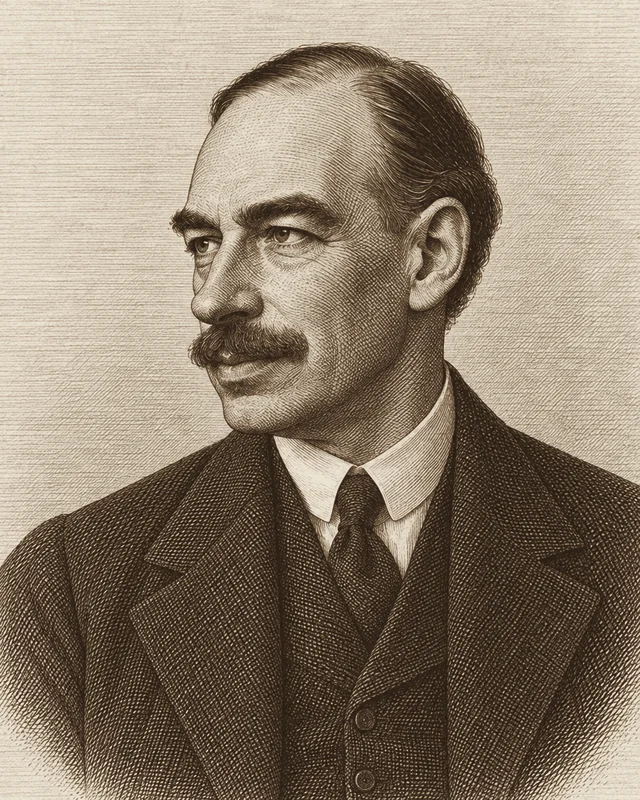
Keynes — an imagined portraitAn imagined portrait

John Maynard Keynes

1883–1946

Keynes, who saw capital

But those who own capital receive interest simply because capital is scarce.
Game 4 · Reconstruction; paraphrase; The General Theory (1936), ch. 24

Overview

John Maynard Keynes was an economist born in Cambridge, England, in 1883. Record

In 1919 he went to the Paris Peace Conference as the British Treasury's representative, resigned in opposition to the terms of German reparations, and wrote The Economic Consequences of the Peace. Record

In 1936 he published The General Theory of Employment, Interest and Money. The Concise Encyclopedia of Economics (Econlib) judges that the book popularized the idea of demand for the economy as a whole (aggregate demand) and showed (or claimed to show) that government spending is needed to maintain full employment. Interpretation · Econlib, The Concise Encyclopedia of Economics

From 1924 until his death he was First Bursar of King's College and managed the college's investments. In his personal investing he suffered heavy losses around 1920 and 1929 and then built up his wealth again. Record

At the Bretton Woods conference in 1944 he was one of the leading figures in creating the post-war international monetary system, including the International Monetary Fund (IMF). Record

Timeline

  1. 1883

    He was born in Cambridge on 5 June. His father, John Neville Keynes, was a scholar at the University of Cambridge. Record

    University of Cambridge ArchiveSearch (King's College Archive Centre), person entry 'Keynes, John Maynard, 1883-1946' archivesearch.lib.cam.ac.uk · MacTutor 'John Maynard Keynes' mathshistory.st-andrews.ac.uk

  2. 1902

    After Eton College he entered King's College, Cambridge, as a scholar and studied mathematics, taking his degree in 1905. Record

    Cambridge ArchiveSearch person entry · MacTutor 'Keynes' · Econlib 'John Maynard Keynes' Econlib

  3. 1902–1905

    As a student he mixed with the philosopher G. E. Moore in the Cambridge discussion society, the 'Apostles', and was deeply drawn to Moore's Principia Ethica (1903). Later (in a 1938 memoir) he recalled that the book's ideas about the good were for a time their 'religion', adding that they set aside Moore's rules of conduct (morals). Record

    SEP 'Moore's Moral Philosophy' (Thomas Hurka) SEP · SEP 'George Edward Moore' SEP (the Bloomsbury friends, Keynes's word 'religion')

  4. 1906–1909

    In 1906 he passed the civil service examination and worked for two years at the India Office. In 1909 he became a Fellow of King's College on the strength of a dissertation on probability, and remained a Fellow until his death. Record

    MacTutor 'Keynes' (entered the India Office in August 1906) · Cambridge ArchiveSearch person entry (served for two years at the India Office) · MacTutor 'Keynes' (elected to a Fellowship in March 1909) · Cambridge ArchiveSearch person entry

  5. 1919

    During the First World War he worked at the Treasury, and he went to the Paris Peace Conference as the Treasury's representative. Judging the terms of German reparations unjust and unworkable, he resigned in June. In December he published The Economic Consequences of the Peace. The book became a bestseller, selling more than 100,000 copies worldwide by August 1920. Its judgments have since met counter-arguments as well. Record

    The Economic Consequences of the Peace, preface (up to June 7, 1919 … He resigned) — Project Gutenberg #15776 Project Gutenberg · MacTutor 'Keynes' (in June 1919, he resigned) · Cambridge ArchiveSearch person entry · MacTutor 'Keynes' (December 1919) · Marshall Library, Cambridge, 'Economic Consequences of the Peace' marshall.econ.cam.ac.uk · Accominotti, Chambers and Morrison, 'The speculative consequences of the peace' (2024, CUP) researchonline.lse.ac.uk

  6. 1920

    In May he made heavy losses speculating in foreign currencies and came close to bankruptcy. He borrowed money to carry on the same investments, and by 1927 was making profits again from currency trading. Record

    Accominotti and Chambers, 'If you're so smart', Journal of Economic History 76(2), 2016, pp. 24–25 researchonline.lse.ac.uk · University of Cambridge news, 'John Maynard Keynes: great economist, poor currency trader' (14 January 2016) cam.ac.uk · Cambridge Judge Business School, 'Keynes' jbs.cam.ac.uk

  7. 1921

    He published A Treatise on Probability. Record

    MacTutor 'Keynes' · SEP 'Interpretations of Probability' (Alan Hájek), bibliography SEP

  8. 1923

    He published A Tract on Monetary Reform. The line 'In the long run we are all dead' is in Chapter 3 of this book. Record

    A Tract on Monetary Reform (Macmillan, 1923), title page and Chapter 3 — Project Gutenberg #65278 Project Gutenberg · Econlib 'John Maynard Keynes' (In 1923 he wrote Tract on Monetary Reform) · World Bank blog, 'How long is the long run?' blogs.worldbank.org

  9. 1924

    He became First Bursar of King's College and managed the investment of the college's funds until his death. He had already been Second Bursar since 1919. Record

    Cambridge ArchiveSearch person entry · Chambers and Dimson, 'Keynes the Stock Market Investor' (2012), p. 6 aeaweb.org

  10. 1925

    He married the Russian-born ballerina Lydia Lopokova. Record

    Cambridge ArchiveSearch person entry · Humanists UK 'John Maynard Keynes' heritage.humanists.uk · Cambridge Past, Present & Future 'John Maynard Keynes' cambridgeppf.org

  11. 1929

    As commodity and stock markets collapsed in 1928–29, his personal wealth fell from £44,000 at the end of 1927 to £7,815 at the end of 1929. In the 1930s he changed his approach to investing and built his wealth back up substantially. Record

    PBS NewsHour, Benn Steil, 'Keynes and Money: A Man Obsessed?' (19 July 2013) pbs.org · MoneyWeek, John Stepek (25 May 2020) moneyweek.com · Accominotti and Chambers (2016), p. 23 (average wealth of over £150,000 in the 1930s, citing Moggridge 1983)

  12. 1930

    He published the two volumes of A Treatise on Money and the essay 'Economic Possibilities for our Grandchildren'. Record

    MacTutor 'Keynes' (A Treatise on Money published in 1930) · Internet Archive, A Treatise On Money Vol I (Macmillan, 1930) Internet Archive · 'Economic Possibilities for our Grandchildren' (1930), scan of Essays in Persuasion (Norton, 1963), pp. 358–373 econ.yale.edu

  13. 1936

    He published The General Theory of Employment, Interest and Money. Record

    Econlib 'John Maynard Keynes' (General Theory, 1936) · MacTutor 'Keynes' (published in 1935-36)

  14. 1942–1944

    In 1942 he was raised to the peerage as Baron Keynes of Tilton and entered the House of Lords. At the Bretton Woods conference in 1944 he took a leading part in founding the International Monetary Fund (IMF) and creating the post-war system of fixed exchange rates. Record

    MacTutor 'Keynes' (In 1942 Keynes was elevated to the peerage) · Cambridge ArchiveSearch person entry (becoming Baron Keynes of Tilton) · Econlib 'John Maynard Keynes' (one of the architects) · Cambridge ArchiveSearch person entry (played a leading part at the Bretton Woods conference) · MacTutor 'Keynes' (setting up of the International Monetary Fund)

  15. 1946

    He died on Easter Sunday, 21 April, at Firle in Sussex. He had been in poor health for several years and had just returned, ill, from an international monetary conference in America. Record

    Cambridge ArchiveSearch person entry (died on Easter Sunday, 21 April 1946, after several years of ill-health) · MacTutor 'Keynes' (Died 21 April 1946, Firle, Sussex) · Humanists UK 'John Maynard Keynes' (returned ill from an International Monetary Conference in America … country house in Sussex)
Key ideas

In the long run we are all dead

While granting that the quantity theory of money might be true 'in the long run', he said that the long run is a misleading guide to current affairs. He wrote that economists who in a storm can only say that 'when the storm is long past the ocean is flat again' set themselves too easy and too useless a task. Record · Paraphrase

A Tract on Monetary Reform (1923), Chapter 3, section 1 — Gutenberg #65278, lines 2286–2294 · World Bank blog, 'How long is the long run?' · Adam Tooze, 'Chartbook 342' adamtooze.substack.com

In a hundred years the economic problem may be solved

He wrote that, barring great wars and large increases in population, the economic problem might be solved, or at least within sight of solution, within a hundred years. Then the remaining work might be shared out so that people work about three hours a day, around fifteen hours a week, and the real problem would become how to use the spare time to live wisely, agreeably and well. Record · Paraphrase

'Economic Possibilities for our Grandchildren' (1930), sections 1 and 2 — Yale scan PDF · text at marxists.org Marxists Internet Archive

Interest is paid because capital is scarce

He wrote that just as a landowner receives rent because land is scarce, the owner of capital receives interest because capital is scarce. Interest today, he said, rewards no genuine sacrifice, and he foresaw that once capital became plentiful, the share of those who live on interest without working (the rentier) would disappear. Record · Paraphrase

General Theory (1936), Chapter 24, section 2 — marxists.org Marxists Internet Archive · Project Gutenberg Australia Project Gutenberg Australia

Full employment does not come by itself

He named as the outstanding faults of the economic society he lived in its failure to provide full employment and its arbitrary and inequitable distribution of wealth and incomes. The Concise Encyclopedia of Economics (Econlib) judges that the General Theory introduced the idea of aggregate demand — consumption, investment and government spending added together — and showed (or claimed to show) that government spending is needed to maintain full employment. Interpretation · Econlib, The Concise Encyclopedia of Economics

General Theory (1936), Chapter 24, section 1, first sentence — marxists.org · Gutenberg Australia · Econlib 'John Maynard Keynes' (assessment)

Probability as a logical relation between evidence and conclusion

In A Treatise on Probability (1921) he treated probability as a logical relation expressing how far some evidence supports a hypothesis. Scholars count him as a leading defender of the 'logical' interpretation of probability. Interpretation · SEP (Alan Hájek)

SEP 'Interpretations of Probability' (Alan Hájek) §3.2 · MacTutor 'Keynes'

In their words

But this long run is a misleading guide to current affairs. In the long run we are all dead. Economists set themselves too easy, too useless a task if in tempestuous seasons they can only tell us that when the storm is long past the ocean is flat again.
A Tract on Monetary Reform (1923), Chapter 3, section 1 — Project Gutenberg #65278, lines 2291–2294 Record · Quotation
If we aim deliberately at the impoverishment of Central Europe, vengeance, I dare predict, will not limp.
The Economic Consequences of the Peace (1919), Chapter 7, 'Remedies' — Project Gutenberg #15776, lines 6557–6558 · Econlib edition, Chapter 7 Econlib Record · Quotation
The love of money as a possession—as distinguished from the love of money as a means to the enjoyments and realities of life—will be recognised for what it is, a somewhat disgusting morbidity
'Economic Possibilities for our Grandchildren' (1930), section 2 — Essays in Persuasion (Norton, 1963), Yale scan PDF pp. 5–6 · text at marxists.org Record · Quotation
Interest to-day rewards no genuine sacrifice, any more than does the rent of land.
The General Theory of Employment, Interest and Money (1936), Chapter 24, section 2 — Project Gutenberg Australia chap24 · marxists.org ch24 (spelled 'today') Record · Quotation

Times and influence

Europe in the first half of the twentieth century, when Keynes was active, went through two world wars. After the First World War the Treaty of Versailles imposed heavy reparations on Germany, and in 1929 came the Wall Street Crash.

At the 1944 Bretton Woods conference, in which he took a leading part, the agreement founding the International Monetary Fund (IMF) was concluded, and the IMF formally came into being in December 1945. Scholars regard the General Theory as the book that popularized the idea of aggregate demand. The investment record of the King's College funds he managed is still used as material in research on institutional investing.

With people from other games

Common misconceptions

Books to read

Appears in