
Great Games of Thought · Game 4 · · 13 min 20 s
Why Hard Work Alone Doesn't Make You Rich
Franklin×Keynes
Why is it so hard to get rich even when you work hard? We look for the answer in Benjamin Franklin, who spread "time is money," and John Maynard Keynes, who said "in the long run we are all dead." The two never met — this is an animated dramatization, but their lines come from what they wrote.
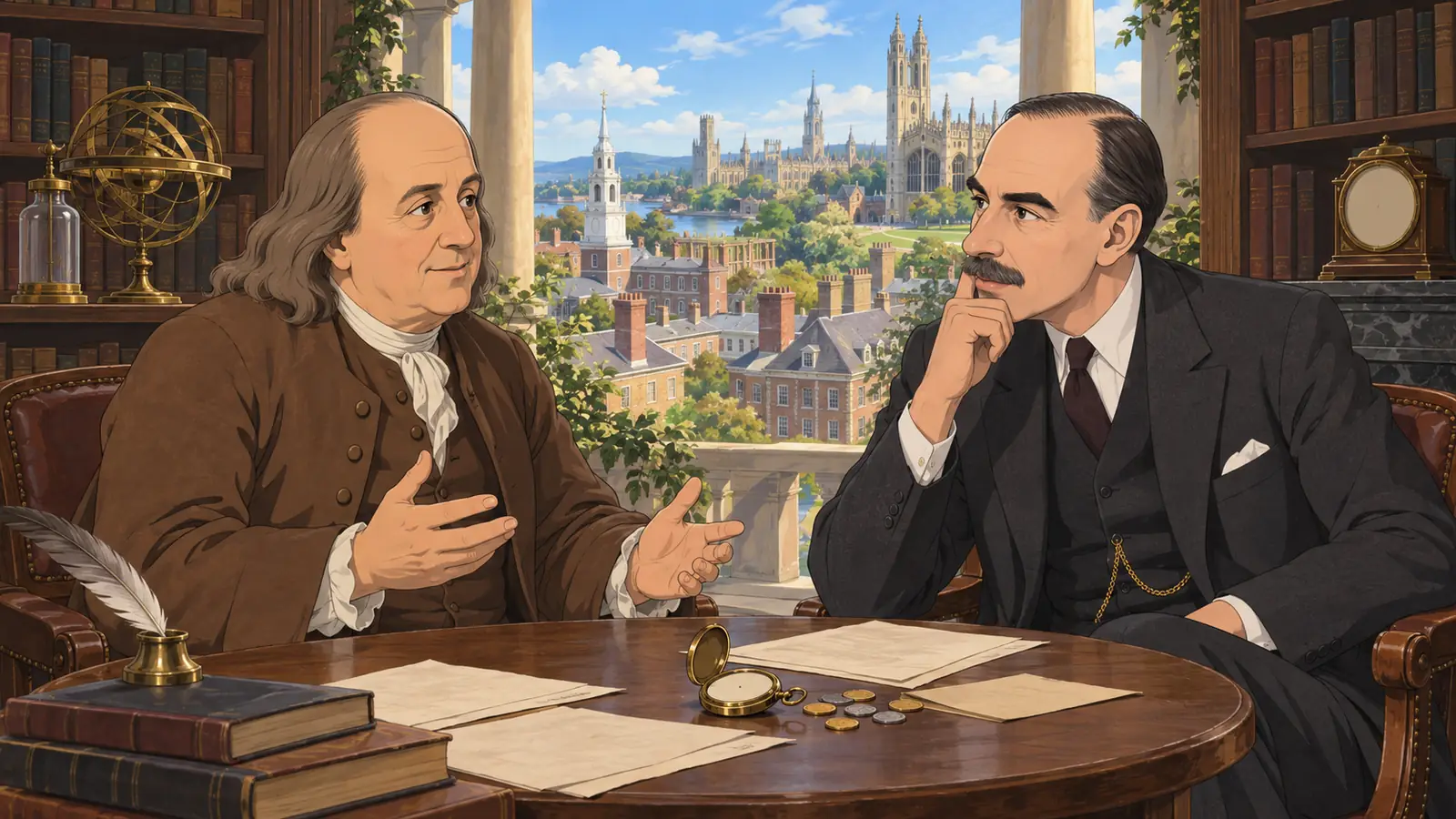
Watch on YouTube (13:20) · Audio in Korean · English subtitles
The Two
Franklin and Keynes
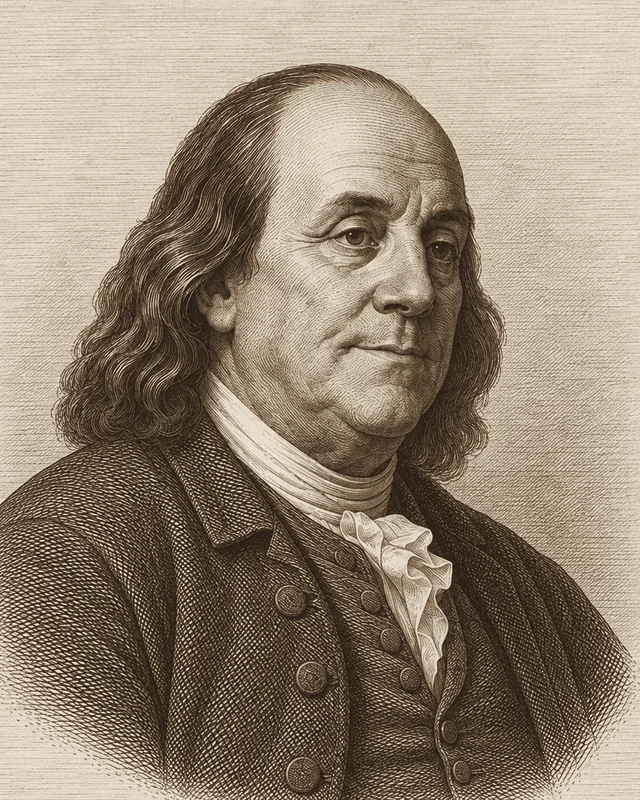 An imagined portrait
Benjamin Franklin, who spread "time is money,"
The way to wealth is simple. Time is money. Work diligently, young friend.Reconstruction; paraphrase; Advice to a Young Tradesman (1748)
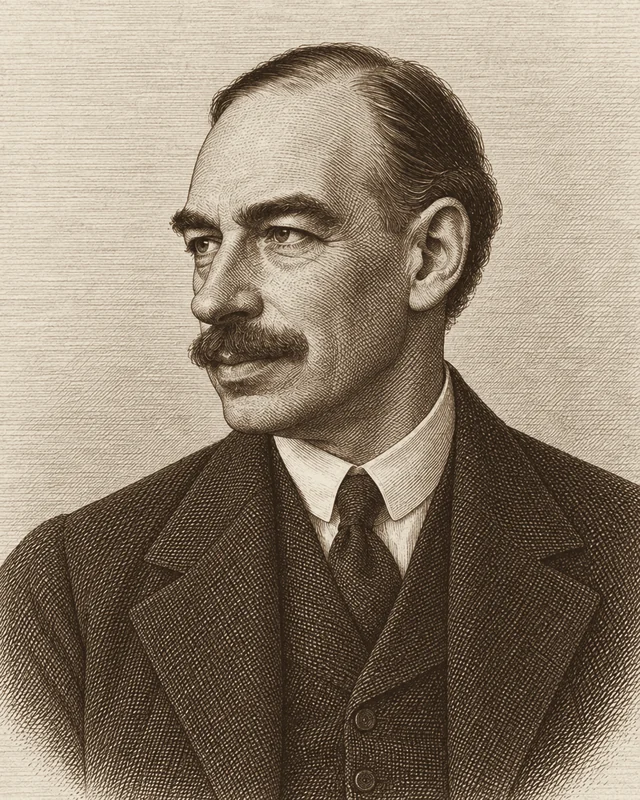 An imagined portrait
John Maynard Keynes, who said "in the long run we are all dead."
But those who own capital receive interest simply because capital is scarce.Reconstruction; paraphrase; The General Theory (1936), ch. 24
Twist → Essence
Keynes held that those who work sell their time, while those who own capital earn simply because capital is scarce.
Is there something in your storehouse that can meet other people's needs?
History · Philosophy · Science
Looking back
History
After the railways and fiber-optic cables were laid, scholars see those who rented them as the ones who opened the next era. So even if we borrow intelligence, we build up our regulars, recipes, and name as our own.
Philosophy
Keynes held that those who work sell their time, while those who own capital earn simply because capital is scarce.
Science
There is research suggesting that money worries take up room in our minds and can even reduce our capacity to think. Sugarcane farmers in India did better on the same test after the harvest than before it, when money was tight. Repeat experiments have had mixed results, so it's still debated.
Read
Script and sources
The video's English subtitles, line by line. The dialogue in this video is a dramatization reconstructed from historical sources.
Script
87 lines · 12 chapters
This is not investment advice. It does not recommend buying any asset or taking on debt. [Record] confirmed in documents · [Paraphrase] the original, shortened · [Scripture] a story told in scripture · [Tradition] a story handed down · [Reconstruction] scenes and lines written on the basis of the records (the content of the lines comes from the original texts) · [Interpretation] scholars' interpretation · [News reports] company announcements and press reports · [Debated] not yet settled · [Hypothetical example] an example made up for explanation (the side-dish shop owner) In the video, ① Fact · ② Interpretation · ③ My view are shown in Korean at the top left of the screen; the English subtitles mark only "My view". Stories handed down are marked [Tradition] only.
0:00
Watch to the end, and you will see why just turning time into money won't solve it, and what to hold on to in the age of AI.
0:30
Ancient Egypt, as the famine dragged on. People came to the granary with silver, to buy grain.
Scripture; Genesis 41 & 47
When the money ran out, they brought their cattle and sheep. The following year, they gave up their land.
Scripture; Genesis 41 & 47
All we have left is our bodies and our land. Just give us grain.
Reconstruction; scripture paraphrase; Genesis 47:18–19
The man who opened the granary was Joseph, who had stored up grain during seven years of plenty. That is the story told in the Book of Genesis.
Scripture; Genesis 41 & 47
When you're hungry, you can't eat silver. And yet we live chasing money. Our pay just brushes past our bank account on its way out.
Let's do one calculation. This year's minimum wage is 10,320 won an hour. Leave an AI subscription of about 30,000 won a month running all month, and it comes to a little over 40 won an hour. Not that they do the same work, though.
Note · Minimum wage 10,320 won an hour (2026) · An AI subscription of about 30,000 won a month, divided over a month (720 hours), comes to about 40 won (an analogy)
Record; 2026 minimum wage notice; Interpretation; illustrative calculation
Most of us have earned money by selling our time. If that time gets cheaper, what will money now be the price of?
Record; Statistics Korea (2025)
Today, let's ask two people who actually made a fortune. Stay to the end and you'll take away one thing each from history, philosophy, and science.
1:42
1706, Boston, back when it was an English colony. In a candlemaker's family of seventeen children, the fifteenth was born. That was Benjamin Franklin.
Record; The Autobiography of Benjamin Franklin
He left school at ten. At seventeen he left home and reached Philadelphia, with only a few coins in his pocket.
With that money he bought three big rolls, and he wrote himself that he walked the streets with two under his arms, eating the third. The young woman who would later become his wife saw him and thought he looked quite ridiculous. So his first impression was bread.
Record; The Autobiography of Benjamin Franklin
He learned the trade in other people's print shops, set up a print shop with money from his partner's family, then bought out the whole business with money borrowed from friends. He printed a newspaper and almanacs, and his almanac full of proverbs sold briskly year after year.
At forty-two, he stepped back from business and threw himself into science. It's said he flew a kite on a stormy day to show that lightning is electricity.
Record; details debated
And he left the world two words. One: he was the first to give the name 'battery' to a device that stores electricity.
Record; letter to Peter Collinson (1749)
The other is this saying, which he spread widely: Time is money.
Record; Advice to a Young Tradesman (1748)
2:57
1883, Cambridge, England. John Maynard Keynes studied mathematics, and mixing with philosophers, debated what a good life is.
When World War I ended, he went to the Paris Peace Conference with the British delegation. And when he saw defeated Germany being made to pay excessive reparations, he resigned.
If you deliberately make Central Europe poor, revenge will soon follow.
Reconstruction; The Economic Consequences of the Peace (1919), ch. 7
The book he wrote became a bestseller. When war broke out again twenty years later, his warning was brought up again. Opinions on that are still divided today.
Record; the causal link is debated
But he didn't get rich on a salary. He lost almost all his money investing, then got back on his feet, grew what he had, and became very rich.
3:40
Time. Most salaries are the price of the time we sell.
Note · Time = the hours I work; a salary is their price
Energy. The ability to move something or make it do work. There's energy in food, and in electricity too.
Note · Energy = the ability to do work
Record; textbook definition
And other people's needs. Something someone really needs. Money comes to whoever meets that need.
Note · Other people's needs = what someone really needs
4:04
But more than 2,000 years before these two, there was a philosopher who is said to have made money. Thales, who is called the first philosopher of the West.
Tradition; Aristotle, Politics I.11
It's said that while gazing up at the stars he fell into a well, and a servant girl teased him for looking at the sky without seeing what was at his feet.
Tradition; Plato, Theaetetus 174a
Aristotle passes on another story too: that this same Thales read the stars and knew ahead of time that next year's olive harvest would be a big one.
Tradition; Aristotle, Politics I.11
In winter, he rented all the olive presses in Miletus and on the island of Chios at a low price, and at harvest time he made a great deal of money, so it's said.
Tradition; Aristotle, Politics I.11
Not buying, just renting — the philosopher who fell into a well got hold of every press. Had the servant girl heard, she might have felt a little sheepish.
Tradition; Aristotle, Politics I.11
4:46
The two were born nearly 180 years apart and never once met. From here on, it's an imagined conversation, built from what the two of them wrote.
The way to wealth is simple. Time is money. Work diligently, young friend.
Reconstruction; paraphrase; Advice to a Young Tradesman (1748)
If time is money, sir — what if machines cut the need for labor faster than we can find new work?
Reconstruction; paraphrase; Economic Possibilities for our Grandchildren (1930)
Machines? I've used them myself. My printing press was a machine too.
Reconstruction; record; The Autobiography of Benjamin Franklin
I turned a wheel with electricity. Lightning, too, was the same electricity.
Reconstruction; paraphrase; Letter (1749); Opinions and Conjectures (1750)
I hoped that power would be of use to people. So I put up lightning rods.
Reconstruction; paraphrase; Letter (1749); Opinions and Conjectures (1750)
And now there's a new machine that runs on electricity and does work. AI. AI uses enormous amounts of electricity in data centers.
Record; IEA, Energy and AI (2025)
But AI is different from a printing press. Give it only a goal, and it can make decisions on its own. In 2016, AlphaGo's 37th move was one that professional players would rarely think of.
Record; AlphaGo, Game 2 (2016)
Still, money has a fine quality. Money begets money, and its offspring beget more.
Reconstruction; paraphrase; Advice to a Young Tradesman (1748)
Exactly, sir. Those who work are paid for the hours they work.
Reconstruction; paraphrase; The General Theory (1936), ch. 4
But those who own capital receive interest simply because capital is scarce.
Reconstruction; paraphrase; The General Theory (1936), ch. 24
Not as payment for any real sacrifice.
Reconstruction; paraphrase; The General Theory (1936), ch. 24
To the question in the title, let me answer with these words of Keynes. Time stops at 24 hours a day, but what you own can keep growing even while you rest. That's why just turning time into money won't solve it.
Note · Salary = the price of my time · Capital = the money and machines used to make money · Interest = money that money already owned produces
Interpretation; host
That's why, in my will, I left money to two cities. To be grown and spent over 200 years.
Reconstruction; record; Codicil to his will (1789)
Two hundred years? Sir, in the long run we are all dead.
Reconstruction · Record; quotation; A Tract on Monetary Reform (1923), ch. 3
That's something Keynes actually wrote in 1923. He meant that saying the sea will be calm once the storm has passed is no answer for people caught in the storm right now.
Record; A Tract on Monetary Reform (1923), ch. 3
When the day comes that the problem of making a living is solved, the real problem will be how to live well with the time left over.
Reconstruction; paraphrase; Economic Possibilities for our Grandchildren (1930)
Then leisure is time for doing something useful.
Reconstruction; paraphrase; The Way to Wealth (1758)
6:52
In 1790, Franklin left 1,000 pounds each to Boston and Philadelphia. The terms were to lend it to young tradesmen at 5 percent interest a year, growing and spending it over 200 years.
Record; codicil to his will (1789)
And sure enough, 200 years later, in 1990, Boston's fund had grown to about 4.5 million dollars.
Keynes wrote this in 1930: barring major wars and a surge in population, the problem of making a living might be solved within 100 years.
Record; paraphrase; Economic Possibilities for our Grandchildren (1930)
Then work could be shared out at around 15 hours a week, and the urge to clutch at money would come to be seen as a somewhat disgusting sickness.
Record; paraphrase; Economic Possibilities for our Grandchildren (1930)
Four years left until 2030. And yet we're still busy. Here's how I see it: as long as we live by selling our time, the time machines save is unlikely to become ours.
Interpretation; host
Britain's railways in the 1840s and fiber-optic cables around 2000 were both laid all at once, and many of the companies that laid them collapsed, but the lines they laid remained, and scholars see those who rented them cheaply as the ones who opened the next era.
Record; Interpretation; scholars' view
AI looks similar now. Big tech companies are building data centers all at once. On top of them, we can rent intelligence.
News reports
8:06
On the day machines do all the work, what would you hand over to AI, and what would you hold on to until the end? Just one of each, in the comments. Comments are free.
If everything so far has been facts and scholars' interpretations, from here on it's my own view.
8:31
Why can't we get rich, even working hard? Keynes knew. Those who work sell their time, while those who own earn simply because what they own is scarce.
My view · Record; paraphrase; The General Theory, ch. 24
Here's my answer. Just turning time into money won't solve it. Money comes to those who turn energy into other people's needs.
My view
So how do we earn in the AI age? I think it comes down to one line: what to hand over to AI, and what to keep in your own hands. Let's try it with the owner of a side-dish shop.
My view
First, you hand things over. Replying to order texts, describing the menu, keeping the books. Save just one hour a day, and in a year that's 365 hours. Two months' worth of working hours. There's even an experiment in which AI cut writing time by 40 percent.
Note · 1 hour a day × 365 days = 365 hours ≈ two months of work (8 hours a day, 22 days a month)
My view · Record; Noy & Zhang, Science (2023)
With that time, you make something to sell. Thirty years of cooking know-how, turned into recipe videos and meal kits. Borrowed intelligence helps with the scripts and the packaging copy too.
My view
And then you build up. A list of regulars, recipes, the shop's name. Things that sell even while you sleep. Because if you rely on a single delivery app, you get shaken along with it when its fees go up.
My view
In the past, you had to borrow money to buy assets like these. Now, just as Thales rented the presses, you can borrow intelligence and build first. Like Joseph's granary, which keeps working even in a famine.
Note · Old formula: borrow money → buy assets → money that comes in without working (passive income) · New formula: borrow intelligence → make something to sell → build it up as assets
My view
What you hold on to until the end is the goal. Tell AI only to raise sales, and the answer might be to switch to cheaper ingredients. Sales go up, and the regulars leave.
My view
In engineering terms, a machine given the wrong target value goes, precisely, to the wrong place. So: the seasoning stays the same, and 50 a day is enough. That line is drawn by the owner.
My view
Companies are the same. Rather than people who do the work directly, we'll need more people who manage and supervise what AI has done. People who check that contracts don't break the law and that the numbers are right, and then sign.
Note · Management & supervision = checking what AI has done against the rules, and taking responsibility
My view
Value attaches not to efficiency but to character. There may be many side-dish shops, but that shop's kimchi is one of a kind. Customers come once to a fast shop, but for a long time to a shop they trust.
Note · Brand = your own character. Like "that shop's kimchi," something people seek out just by hearing the name
My view
Today, try writing just two lines on paper. One job to hand over to AI. And how much is enough.
My view
Today's story isn't investment advice. It's not telling you to buy any asset, or to take on debt.
My view
11:08
Use AI — but how far must we not give way to it? The standard for drawing that line comes from history, philosophy, and science.
History. After the railways and fiber-optic cables were laid, scholars see those who rented them as the ones who opened the next era. So even if we borrow intelligence, we build up our regulars, recipes, and name as our own.
Interpretation; scholars' view
Philosophy. Keynes held that those who work sell their time, while those who own capital earn simply because capital is scarce.
Record; paraphrase; The General Theory, ch. 24
So just turning time into money won't solve it — that's my answer today. What we earn for, the goal, is ours to set.
My view
Science. There is research suggesting that money worries take up room in our minds and can even reduce our capacity to think. Sugarcane farmers in India did better on the same test after the harvest than before it, when money was tight.
Record; Mani et al., Science (2013)
Scholars see this as one of the reasons why having too little can easily lead to having even less. Repeat experiments have had mixed results, so it's still debated. Leave the repetition to AI, and spend your thinking power on your own work.
Debated; replication studies
12:13
Over the 200 years after his death, Franklin's money was at times lent to young tradesmen, and at times spent on technical education in the two cities.
Record; Franklin's bequest funds (1790–1990)
Just turning time into money won't solve it. Money comes to those who turn energy into other people's needs.
My view
Here's my last question. Is there something in your storehouse that can meet other people's needs?
Sources and research
Sources are listed in their original Korean.
- Scripture요셉의 흉년: 은(돈) → 가축 → 이듬해 몸과 땅(창세기 41:34~57, 47:13~20) · 7년 풍년 동안 수확의 5분의 1을 모음(창세기 41:34) · 창세기엔 금이 아니라 은 · Korean Bible Society
- Reconstruction백성의 대사 "이제 남은 건 우리 몸과 땅뿐입니다"(창세기 47:18~19) · Korean Bible Society
- Record『프랭클린 자서전』: 1706년 보스턴(영국령 매사추세츠만 식민지), 17남매 중 15째, 10살에 학교를 그만둠, 17살에 필라델피아, 빵 세 개 · 1728년 동업 인쇄소, 1730년 빌린 돈으로 단독 소유 · 『가난한 리처드의 달력』(1732~1758) · 1748년 은퇴 뒤 데이비드 홀과 18년간 이익 배분 · Project Gutenberg
- Record「젊은 상인에게 주는 충고」(1748): "Remember, that time is money." · 돈은 돈을 낳고, 그 새끼가 또 새끼를 낳는다(요지) — 같은 표현 "시간은 돈"은 1719년 『The Free-Thinker』에 이미 있음 · Founders Online
- Record콜린슨에게 보낸 편지(1749.4.29): 전기 장치에 'electrical battery'라는 이름을 붙임(말 자체는 원래 있던 군사 용어) · 전기 바퀴(1749) · 피뢰침(1750 제안, 1752 자기 집, 1753 달력): 『전기에 관한 실험과 관찰』 · Founders Online
- Record · Details debated연 실험(1752): 프랭클린 편지(1752.10.19) · 프리스틀리(1767) · Founders Online
- Record「부자가 되는 길」(1758): "Leisure is time for doing something useful" · Founders Online
- Record1789년 유언 추가서: 연 5%로 25세 미만 기혼 장인에게 대출, 100년 뒤 4분의 3 사용 · 1990년 보스턴 약 450만 달러, 필라델피아 약 200만 달러 · 대출, 보스턴의 기술학교(1908 프랭클린 유니언), 필라델피아의 프랭클린 연구소에 쓰임(HistoryNet · 보스턴시 기록보관소 「Franklin Fund records」) · historynet.com · cityofboston.gov
- RecordKeynes: resigned from the Paris Peace Conference in June 1919; The Economic Consequences of the Peace (December 1919, over 100,000 copies by summer 1920) · Chapter 7 (paraphrase: deliberately impoverishing Central Europe will bring vengeance) — whether the Treaty of Versailles caused the Second World War is [Debated] (Mantoux, The Carthaginian Peace, 1946) · marshall.econ.cam.ac.uk · Project Gutenberg
- Record케인스의 투자: 1920년 외환 투자로 파산 직전, 1929년 큰 손실 뒤 재기(케임브리지 저지 경영대학원 · 체임버스·딤슨 연구) · jbs.cam.ac.uk
- Record『화폐개혁론』(1923) 3장 "In the long run we are all dead."(원래 맥락은 경제학자들의 장기 균형론 비판) · Internet Archive
- Record · Paraphrase「손주 세대의 경제적 가능성」(1930): 큰 전쟁과 인구 급증이 없다면 100년 안에 경제 문제가 풀릴 수도, 주 15시간, 돈 집착은 "조금 역겨운 병", 남는 시간을 어떻게 잘 사느냐 · Internet Archive
- Reconstruction · Paraphrase『일반이론』(1936) 4장·24장: 자본 소유자는 자본이 희소해서 이자를 받는다, 이자는 진짜 희생의 대가가 아니다 · Project Gutenberg Australia
- Tradition탈레스가 우물에 빠졌다는 이야기(플라톤 『테아이테토스』 174a) · 올리브 압착기 이야기(아리스토텔레스 『정치학』 1권 11장 1259a, "전해지기로는") · Perseus
- Record에너지 = 일을 할 수 있는 능력(교과서 정의) · Standard Korean Dictionary
- Record알파고 제2국 37번째 수(2016), 사람이 둘 확률 1만 분의 1로 계산된 수(딥마인드 · Wired 2016.3.16) · Wired
- Record1840년대 영국 철도 광풍 · 2000년 무렵 광케이블 과잉 투자와 붕괴(오들리즈코 2010 · 리치먼드 연준 2003) · www-users.cse.umn.edu
- Interpretation깔린 기반 위에서 싸게 빌려 쓴 사람들이 다음 시대를 열었다: 카를로타 페레스 『기술 혁명과 금융 자본』(2002) · carlotaperez.org
- News reports2026년 빅테크의 데이터센터 투자(기업 발표·언론 보도) · 세계 데이터센터 투자는 2022년 이후 약 2배(IEA 「Energy and AI」 2025 요약) · IEA
- RecordIEA 「Energy and AI」(2025): 데이터센터 전체 2024년 약 415TWh(세계 전력의 약 1.5%), 그중 AI용 가속 서버 약 15% · IEA
- Record · Limited to a short writing task노이·장, Science 381(2023): AI 사용 시 글쓰기 시간 약 40% 감소 · DOI
- Record · Replication debated마니 외, Science 341(2013) 사탕수수 농부 연구 · 카르발류 외, AER(2016) · 오도널 외, PNAS(2021) · DOI
- Record2026 minimum wage of 10,320 won an hour (Ministry of Employment and Labor notice) · wage workers are the majority of the employed (Ministry of Data and Statistics (formerly Statistics Korea), supplementary survey on non-wage workers, August 2025: non-wage workers 22.6%) · mods.go.kr · Ministry of Employment and Labor
- Interpretation · Illustrative calculationLeave an AI subscription of about 30,000 won a month running all month, and it comes to about 40 won an hour (30,000 won ÷ 720 hours) — not that they do the same work.
- Hypothetical example반찬가게 사장님의 예 · 하루 1시간 × 365일 = 365시간 ≈ 두 달 치 근무(하루 8시간·한 달 22일 기준)
- Reconstruction프랭클린과 케인스의 대사는 위 기록을 바탕으로 지은 대사입니다
If you find a mistake, please tell us in the video's comments. We will check it and correct it. How We Check Facts
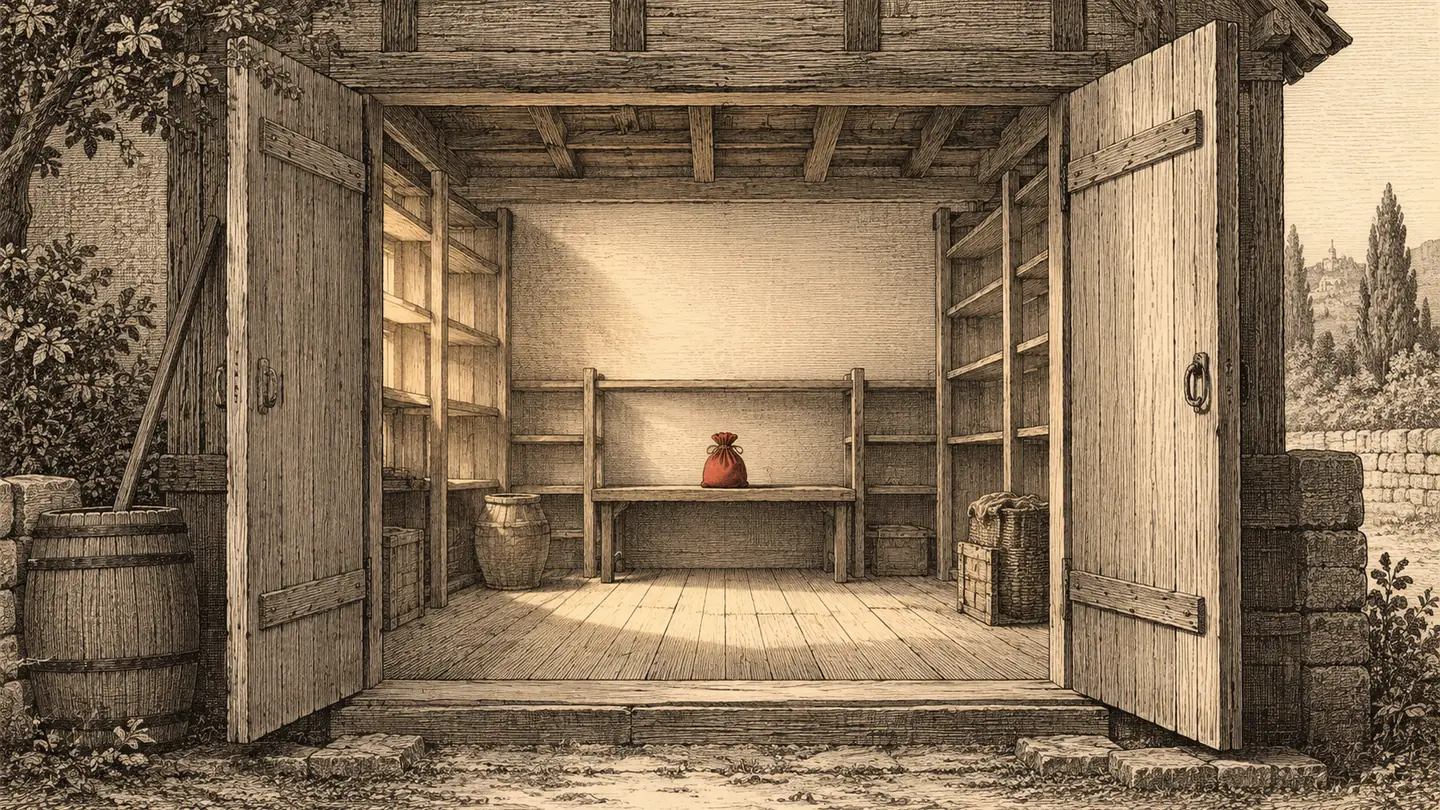
In the famine the silver ran out, but Joseph's granary fed Egypt.
Here's my last question. Is there something in your storehouse that can meet other people's needs?
Share your thoughts in the YouTube commentsKeep watching
Other games
 0112:22
Game 1·Schopenhauer×Hegel
Why You Crave Ramen at Midnight
 0213:44
Game 2·Zhuangzi×Turing
If AI Does All My Work, What Should I Do Next?
 0313:46
Game 3·Spinoza×Wonhyo
Why do we always regret it after we snap?
 0511:12
Game 5·Sejong the Great×Leibniz
Could Writing Speech As It Is Change the World?
 0710:18
Game 7·Eckhart×Naong
What Gets You Through a Hard Day?
 0910:51
Game 9·Van Gogh×Hokusai
Is It Really Too Late?
 1110:18
Game 11·Yi Sun-sin×Aurelius