Great Games of Thought · Game 2 · · 13 min 44 s
If AI Does All My Work, What Should I Do Next?
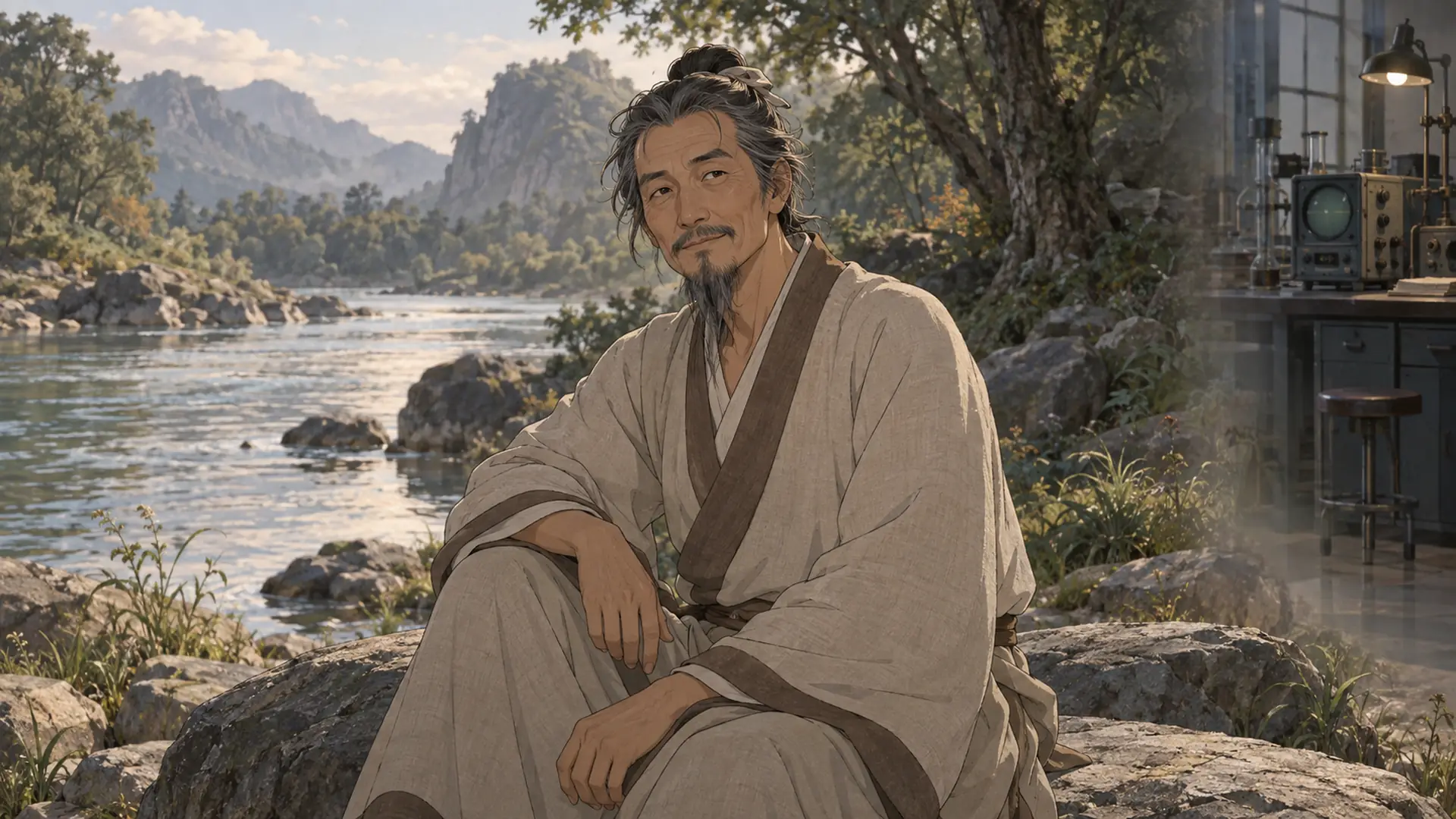
Zhuangzi×Turing
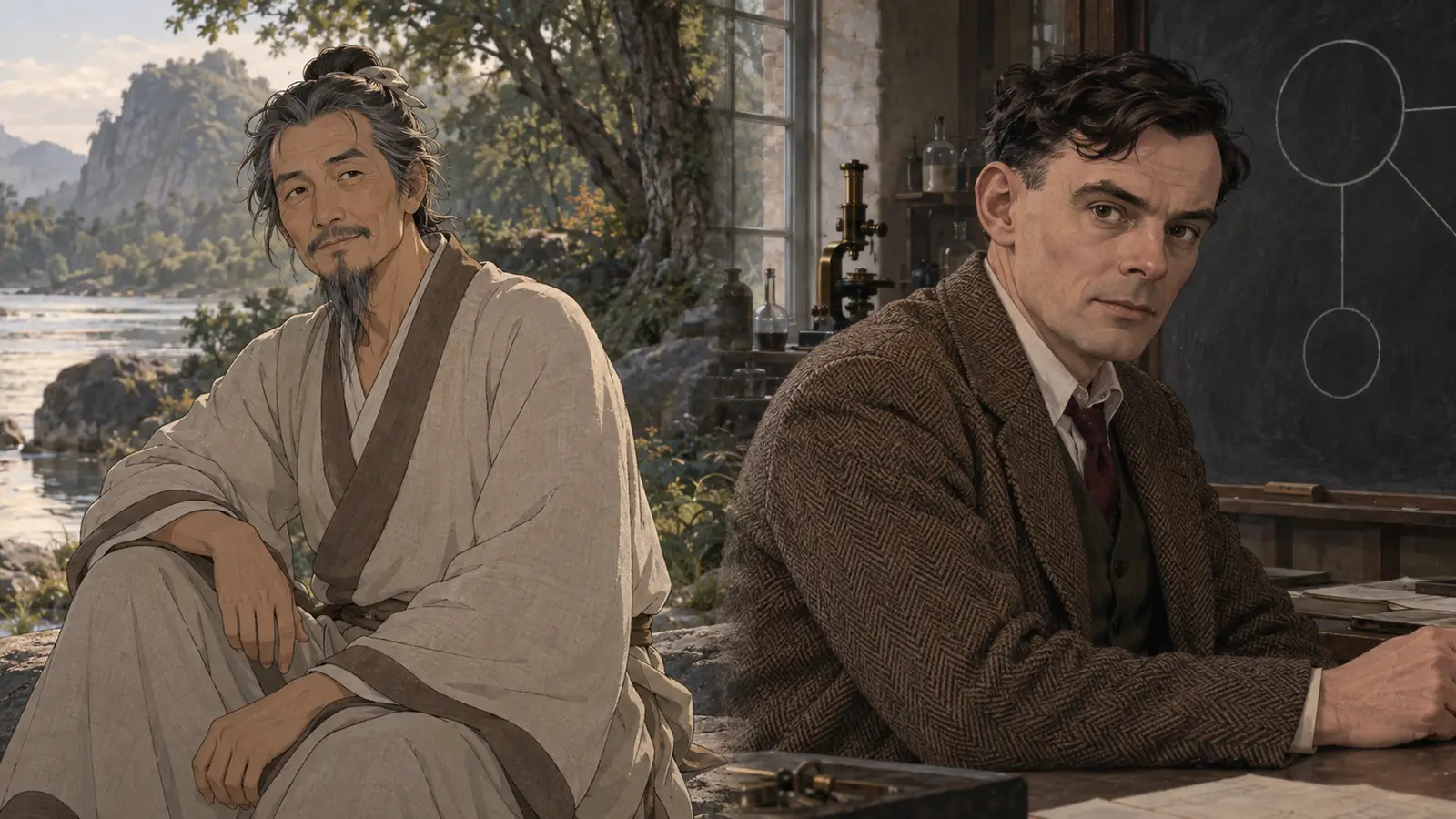
Watch on YouTube (13:44) · Audio in Korean · English subtitles
The Two
Zhuangzi and Turing
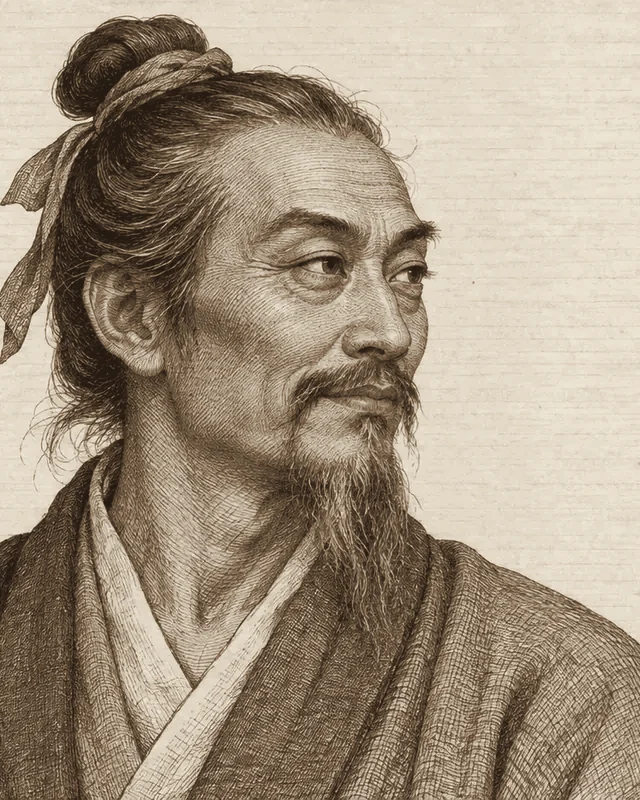 An imagined portrait
Zhuangzi
About 2,300 years agoOnce I dreamt I was a butterfly, fluttering happily, not knowing I was Zhuang Zhou.Reconstruction; Zhuangzi 'On Seeing Things as Equal' (Inner Chapters)
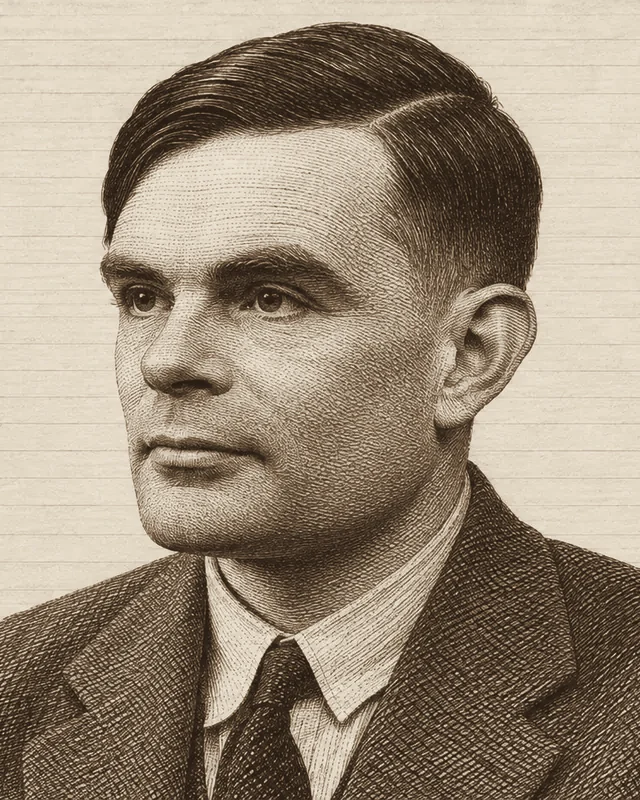 An imagined portrait
Can machines think? I propose to consider this question.Reconstruction · Record, Turing 1950 paper first sentence
History · Philosophy · Science
Looking back
History
Qin, bound tight by law, fell just 15 years after unifying China.
Philosophy
from the outside, we can't fully know what thinks or what's alive. So don't judge only by usefulness — learn to play freely.
Science
A healthy heart doesn't beat evenly, and evolution begins with small copying mistakes.
Read
Script and sources
The video's English subtitles, line by line. The dialogue in this video is a dramatization based on the writings the two men left.
Script
99 lines · 12 chapters
The codebreaker in the opening scene is a fictional character. [Record] confirmed in documents · [Tradition] a story handed down (whether it really happened has not been confirmed) · [Reconstruction] lines written on the basis of what the two left · [Interpretation] scholars' interpretation · [Debated] not yet settled
0:00
0:06
In the Atlantic, German submarines were sinking ships bound for Britain almost every day. They sent orders with a cipher machine called Enigma, and believed it was too complex for anyone to break.
Record
But German operators sent weather reports at the same time every day, in almost the same format. Captured codebooks plus this predictable habit, and the U-boat code began to be broken in earnest.
Record
Ever felt a little uneasy when YouTube knows exactly which video you'll watch next? It means you're predictable.
If AI does all my work, what should I do next? Today we look for the answer in Zhuangzi, 2,300 years ago.
Stay to the end and you'll take away three things. From history: why the state that first unified China collapsed in just 15 years. From philosophy: the question a butterfly dream asks of AI.
1:22
About 2,300 years ago, China's seven major states were at war with one another — the Warring States period.
Record
The western state of Qin would later unify China under the First Emperor. Led by a reformer named Shang Yang, it bound the whole country tightly with law.
Record
Households were grouped in fives to watch one another, and high rank went only to those who earned merit in war.
Record
In the same era, in the state of Song, there was a minor official who tended a lacquer-tree grove. His name was Zhuang Zhou — the man we call Zhuangzi.
Record, Shiji etc.
He was poor. The story goes that when he went to borrow grain, the lender said he'd lend him a fortune later, once his taxes came in. Zhuangzi shot back:
Tradition, Zhuangzi 'External Things' (Miscellaneous Chapters; by Zhuangzi's school)
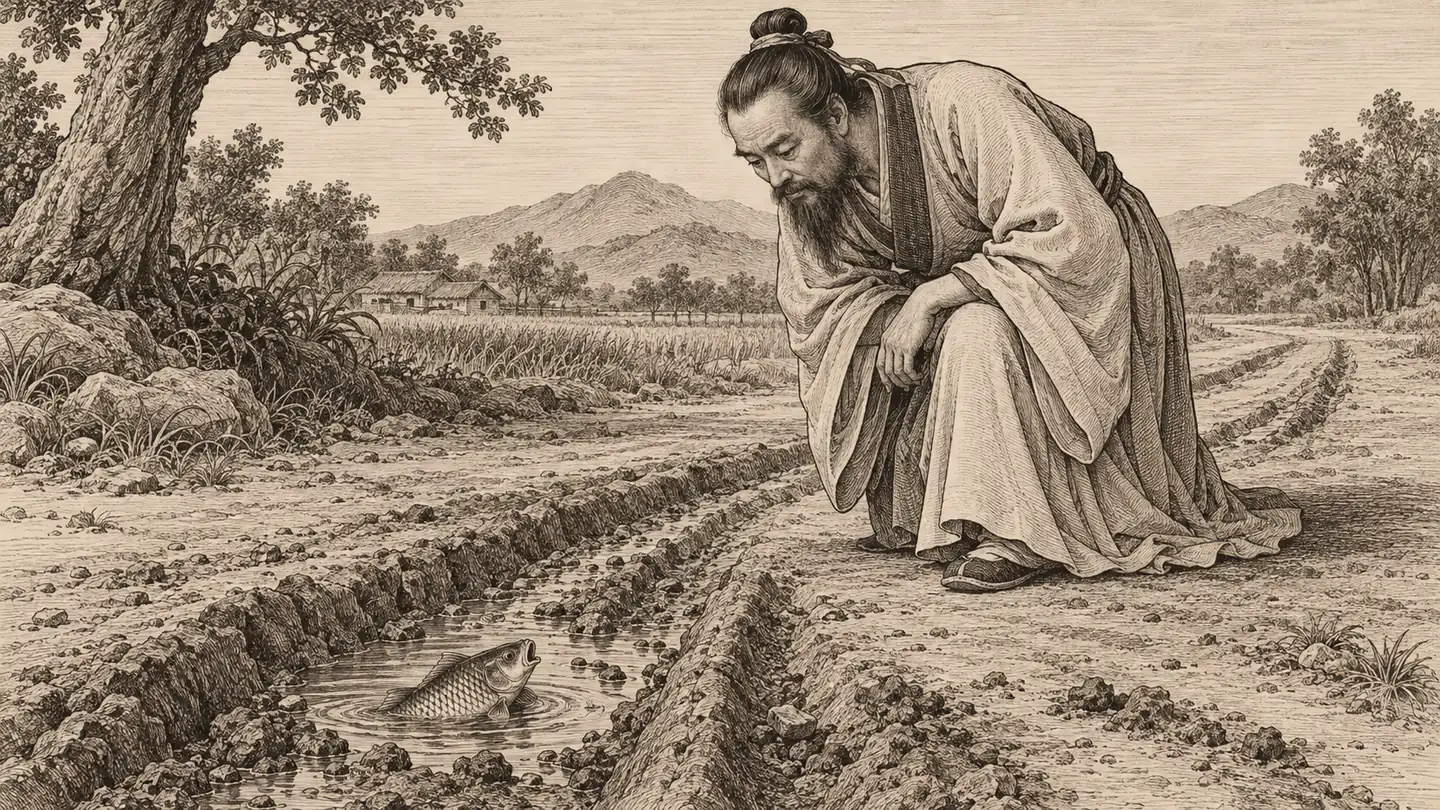
On my way here, a carp in a puddle in a wheel rut called out to me, asking for just a dipper of water.
Reconstruction · Tradition, Zhuangzi 'External Things' (Miscellaneous Chapters; by Zhuangzi's school)
So I said: soon I'll go to the southern kingdoms and bring you river water. The carp got angry.
Reconstruction · Tradition, Zhuangzi 'External Things' (Miscellaneous Chapters; by Zhuangzi's school)
'Then look for me at the dried-fish shop.'
Reconstruction · Tradition, Zhuangzi 'External Things' (Miscellaneous Chapters; by Zhuangzi's school)
Don't cover today's urgent need with a big promise for later. He lived 2,300 years ago, yet he talks just like someone today.
It is said that the king of Chu sent envoys offering him what today would be the prime minister's post. Zhuangzi, still holding his fishing rod, replied:
Tradition
Rather than a dead tortoise kept in the ancestral temple, I'd be a living one dragging its tail in the mud.
Reconstruction · Tradition, Zhuangzi 'Autumn Floods' (Outer Chapters; by Zhuangzi's school)
Scholars see Zhuangzi, with Laozi, as the thinker of living naturally without forcing things — what's called wu wei, 'effortless action.'
Interpretation
Zhuangzi's sparring partner in argument was his friend Huizi. After Huizi died, passing his grave, Zhuangzi is said to have remarked that he no longer had anyone to talk with.
Tradition, Zhuangzi 'Xu Wugui' (Miscellaneous Chapters; by Zhuangzi's school)
3:06
In 1936, at 24, Turing sketched an imaginary machine on paper — one that reads and writes symbols by following a few simple rules. The root of every computer today: the Turing machine.
Record
Note — Turing's paper was received by the London Mathematical Society on 28 May 1936, when he was 23, and read before it in November, when he was 24. "Root" is an interpretation: the foundation of the theory of computation.
When war broke out, at Bletchley Park he designed the Bombe, a huge machine for breaking Enigma.
Record
He was an eccentric. He reportedly cycled to work in a gas mask because of hay fever and chained his favorite mug to a radiator so no one would take it. He ran a marathon in 2 hours 46 minutes.
Tradition, Hodges biography (colleagues' recollections); Record (marathon, 1947)
Can machines think? I propose to consider this question.
Reconstruction · Record, Turing 1950 paper first sentence
His proposed test, the Turing test, is still used as a yardstick for how human-like AI is — though many still ask whether good imitation really means thinking.
Interpretation, debated
One, it is said, turned down high office and went fishing; the other tried to end a war with a machine run by rules.
4:17
To operate. Put a coin in a vending machine and the same can drops out every time. Moving by rules — that's operating.
Note · Operate = move by rules
To think: not following what's set, but weighing things for yourself.
Note · Think = weigh things for yourself
And to be alive. On which step of this staircase does AI stand today?
Note · Life = to be alive
4:41
See how freely the minnows swim. That is the joy of fish.
Reconstruction · Tradition, Zhuangzi 'Autumn Floods' (Outer Chapters; by Zhuangzi's school)
You're not a fish — how do you know fish are happy?
Reconstruction · Tradition, Zhuangzi 'Autumn Floods' (Outer Chapters; by Zhuangzi's school)
You're not me — how do you know I don't know the joy of fish?
Reconstruction · Tradition, Zhuangzi 'Autumn Floods' (Outer Chapters; by Zhuangzi's school)
5:11
Break down the process of human calculation into very small rules.
Reconstruction; Turing 1936 paper §9
Let me tell you about Ding, a man who butchered oxen. At first, all he could see was the ox.
Reconstruction; Zhuangzi 'Nourishing Life' (Inner Chapters)
After some years, he met the ox not with his eyes but with his mind.
Reconstruction; Zhuangzi 'Nourishing Life' (Inner Chapters)
His knife slid by itself through the gaps between bone and flesh, and after nineteen years its edge was still like new.
Reconstruction; Zhuangzi 'Nourishing Life' (Inner Chapters)
Can machines think? The question is too vague to argue about.
Reconstruction; Turing 1950 paper §1;§6
Talk only in writing with someone in another room, and guess whether it's a person or a machine.
Reconstruction; Turing 1950 paper §1;§2
My friend Huizi asked the same: 'You're not a fish — how do you know?'
Reconstruction; Zhuangzi 'Autumn Floods' (Outer Chapters; by Zhuangzi's school)
Push that view to its extreme, and the only way to know another person thinks is to be that person.
Reconstruction; Turing 1950 paper §6(4)
So we all live by the polite convention that everyone thinks.
Reconstruction; Turing 1950 paper §6(4)
One was written by a man 2,300 years ago; the other by AI for this video. Which one is human?
A is the human — Zhuangzi. B was written by AI. If you hesitated, Turing's question has already reached you.
Once I dreamt I was a butterfly, fluttering happily, not knowing I was Zhuang Zhou.
Reconstruction; Zhuangzi 'On Seeing Things as Equal' (Inner Chapters)
Suddenly I woke — and there I was, Zhuang Zhou.
Reconstruction; Zhuangzi 'On Seeing Things as Equal' (Inner Chapters)
Did Zhuang Zhou dream he was a butterfly, or is a butterfly dreaming it is Zhuang Zhou?
Reconstruction; Zhuangzi 'On Seeing Things as Equal' (Inner Chapters)
I do not wish to give the impression that there is no mystery about consciousness.
Reconstruction; Turing 1950 paper §6(4)
Hold on — today even scientists seriously ask whether our world might be a virtual one, like a game inside a computer. The butterfly's dream is back.
Lady Lovelace said a machine can only do what we tell it to do — it can't originate anything new.
Reconstruction; Turing 1950 paper §6(6)
Yet machines take me by surprise with great frequency.
Reconstruction; Turing 1950 paper §6(6)
If we build a learning machine, it's probably wise to include a little randomness.
Reconstruction; Turing 1950 paper §7
Huizi grumbled: he planted gourd seeds from the king, and the gourd grew so big —
Reconstruction; Zhuangzi 'Free and Easy Wandering' (Inner Chapters)
too heavy to hold water, too big to use as a ladle — that he just smashed it.
Reconstruction; Zhuangzi 'Free and Easy Wandering' (Inner Chapters)
Why didn't he think of making it into a big boat and floating on the river?
Reconstruction; Zhuangzi 'Free and Easy Wandering' (Inner Chapters)
8:00
Qin, the state of rules, unified China in 221 BC — and collapsed in just 15 years.
Record
Enigma had a strange weakness: no letter could ever be encrypted as itself. Turing and his colleagues exploited this gap — and the operators' predictable habits.
Record
All this stayed secret until the 1970s, so Turing could never tell the world what he had done. In 1952, under British law of the time that treated homosexuality as a crime, he was convicted.
Record
He died in June 1954, at 41. The official verdict was suicide, though some researchers point to the possibility of an accident.
Record; debated
Then, March 2016, Seoul: Google's Go AI, AlphaGo, versus Lee Sedol, 9-dan. In game two, AlphaGo's move 37 was one it estimated a human would play only once in ten thousand times.
Record
Game four: Lee Sedol's move 78. With this move AlphaGo failed to predict, a human won a single game.
Record
9:23
There's no right answer. So far, those were the facts and scholars' readings. From here on, it's my own view.
9:38
AI is imperfect too, so it keeps learning — and it's becoming perfect very fast. We race too, trying to work faster and more accurately than everyone else. But once it's all done, what comes next?
Life did exactly that. Genes copy themselves almost perfectly, but once in a while they make a mistake. Over long ages, nature sifts those small mistakes and they add up into new life. That's evolution.
Qin, on the other hand, bound tight by law, vanished just 15 years after unifying China. Living things are never finished. Within the time we're given, we keep searching for ourselves and learning.
The body is the same. A healthy heart doesn't beat evenly like a machine. The beats wobble slightly — and when that wobble disappears, doctors see it as a sign of illness.
Record (research)
An age when AI does more and more of the useful work. Rather than straining to be more useful, life is a play — so enjoy it, don't stress. Wu wei, naturally.
Note · Wu wei, naturally = without forcing things
Zhuangzi already knew, 2,300 years ago: to roam freely without measuring everything by its use. That's the story of the gourd too big to be useful — make it a boat and float down the river.
Note · 'Free and Easy Wandering', the first chapter of the Zhuangzi = roaming freely
Why didn't he think of making it into a big boat and floating on the river?
Reconstruction, Zhuangzi 'Free and Easy Wandering' (Inner Chapters)
But what about food on the table? We all have to do work we don't want, for money. Zhuangzi himself was a minor official guarding a lacquer grove, and is said to have been so poor he went to borrow grain.
Philosophy won't pay your salary. The work you must do is the stage. On it, once a day, you add a small wobble of your own choosing. Cook Ding, the butcher, roamed freely like that within his own work.
Note · 'Nourishing Life', the chapter with Cook Ding's story = how to nourish life
I think AI will take the predictable, repetitive work first. What's left, then, is probably helping people live like human beings. I dream of a world where that work pays.
So here's my suggestion: why not try studying history, philosophy, science — and literature too?
Make your own reason to live — your own will — with your own hands. Making new mistakes, and learning again. Searching for what AI can't give us.
Great Games of Thought will study it with you — easily, and with fun. Not staying asleep, but waking each other's minds.
And from today, look after your body, take a little less stress, and try walking a road you've never taken.
Rather than living only for tomorrow's big promises, live seeing that you are alive today. What the carp needed, too, was this one ladle of water — now.
12:44
Philosophy: from the outside, we can't fully know what thinks or what's alive. So don't judge only by usefulness — learn to play freely.
Science. A healthy heart doesn't beat evenly, and evolution begins with small copying mistakes.
13:12
Sources and research
Sources are listed in their original Korean.
- Record사마천, 『사기』 권63 — 장자(이름 장주), 몽 땅의 칠원리(옻나무 밭을 맡은 관리). 몽을 송나라 땅으로 보는 것은 유향 『별록』 등 · Wikisource
- Record『장자』 내편 — 소요유(너무 큰 박) · 양생주(포정) · 제물론(나비 꿈) · Wikisource
- Tradition『장자』 외편 — 추수(다리 위 물고기 문답 · 초나라의 재상 제안과 거북, 재상 제안은 『사기』 권63에도) / 잡편 — 외물(곡식을 꾸러 간 장자와 수레바퀴 자국 속 붕어) · 서무귀(혜시의 무덤) — 외편·잡편은 장자 학파의 글로 보는 견해가 많음 · Wikisource
- Record『사기』 권68 「상군열전」 — 상앙의 변법(다섯 집 연좌, 군공에 따른 작위) · 권6 「진시황본기」 — 진나라의 통일(기원전 221)과 멸망(기원전 206) · [해석] 멸망 원인을 가혹한 법에서 찾는 견해(가의 「과진론」 이래) · Wikisource
- Record앨런 튜링, 「계산 가능한 수에 관하여」(1936, 9절) · 「계산 기계와 지능」(Computing Machinery and Intelligence, Mind, 1950 — 1절 흉내 게임, 6절 (4) 예의 바른 약속·의식의 신비, 6절 (6) 러브레이스의 반론과 '기계는 나를 아주 자주 놀라게 한다', 7절 배우는 기계와 우연) · DOI
- Record에이다 러브레이스(1815~1852), 배비지의 해석 기관에 관한 주석(1843): '해석 기관은 무엇을 새로 만들어 낸다고 내세우지 않는다. 우리가 시킬 줄 아는 일은 무엇이든 할 수 있다.'(튜링 1950 인용) · Internet Archive
- Record에니그마를 처음 푼 것은 1932년 폴란드 암호국(마리안 레예프스키). 1941년 U보트 암호는 영국 해군이 붙잡은 암호표(기상선 뮌헨호·U-110·기상선 라우엔부르크호)에, 정해진 시각·형식으로 나가던 날씨 보고 같은 전문이 더해져 본격적으로 풀림. 봄브는 튜링이 설계(1939~1940)하고 웰치먼이 개량 · TNMOC · ethw.org · bletchleypark.org.uk
- Tradition방독면 쓰고 자전거 출근, 머그잔 쇠사슬 일화 — 동료 회고(앤드루 호지스, 『앨런 튜링의 이미테이션 게임』, 김희주·한지원 옮김, 동아시아, 2015) · [기록] 마라톤 2시간 46분(1947) · Aladin · turing.org.uk
- Record1946년 대영제국 훈장(OBE)을 받았으나 전시 공적의 내용은 1970년대까지 비밀 · 판결(1952)과 죽음(1954, 공식 판정 자살, 사고설은 [논쟁 중]) · 사후 사면(2013) · 50파운드 지폐(2021) · turing.org.uk · gov.uk · bankofengland.co.uk
- Record2016년 3월 서울, 알파고와 이세돌 9단의 다섯 경기(두 번째 경기 알파고의 37번째 수, 네 번째 경기 이세돌 9단의 78번째 수 — 딥마인드 발표) · Google DeepMind
- Record · Research돌연변이(유전자 복사 실수)는 진화의 원재료이고 자연선택 등이 함께 작용 · 심박 변이 감소와 건강(유럽심장학회·북미심박학회 태스크포스, 1996) · DOI · evolution.berkeley.edu
- Debated시뮬레이션 가설(닉 보스트롬, 2003) · DOI
- Note영상 속 'B' 문장은 이 영상을 위해 AI가 쓴 글입니다 · 'A' 문장은 『장자』 제물론(내편) 나비 꿈 구절(昔者莊周夢為胡蝶…不知周也)의 우리말 옮김입니다 · Wikisource
If you find a mistake, please tell us in the video's comments. We will check it and correct it. How We Check Facts
One last question. On the day AI does all your work, what will you be doing?
Share your thoughts in the YouTube commentsKeep watching
Other games
 0112:22
Game 1·Schopenhauer×Hegel
Why You Crave Ramen at Midnight
 0313:46
Game 3·Spinoza×Wonhyo
Why do we always regret it after we snap?
 0413:20
Game 4·Franklin×Keynes
Why Hard Work Alone Doesn't Make You Rich
 0511:12
Game 5·Sejong the Great×Leibniz
Could Writing Speech As It Is Change the World?
 0710:18
Game 7·Eckhart×Naong
What Gets You Through a Hard Day?
 0910:51
Game 9·Van Gogh×Hokusai
Is It Really Too Late?
 1110:18
Game 11·Yi Sun-sin×Aurelius