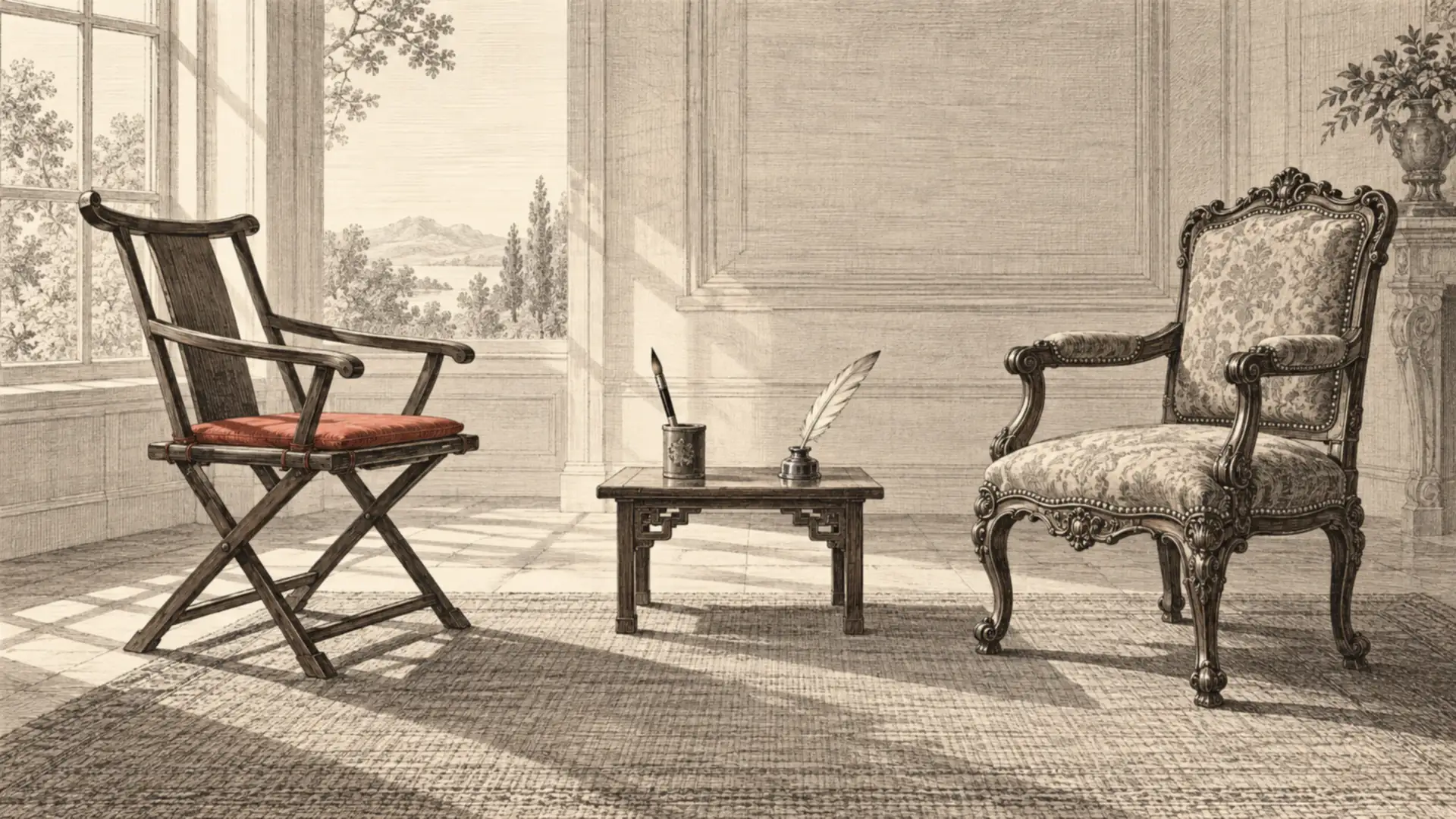
Great Games of Thought · Game 5 · · 11 min 12 s
Could Writing Speech As It Is Change the World?
Sejong the Great×Leibniz
If we could write down speech just as it is, would the world change? We look for the answer in Sejong the Great, who made 28 letters that write sounds, and Leibniz, who dreamed of symbols that would let us calculate thought. The two never met — this is an animated dramatization, and their lines come from what they wrote.
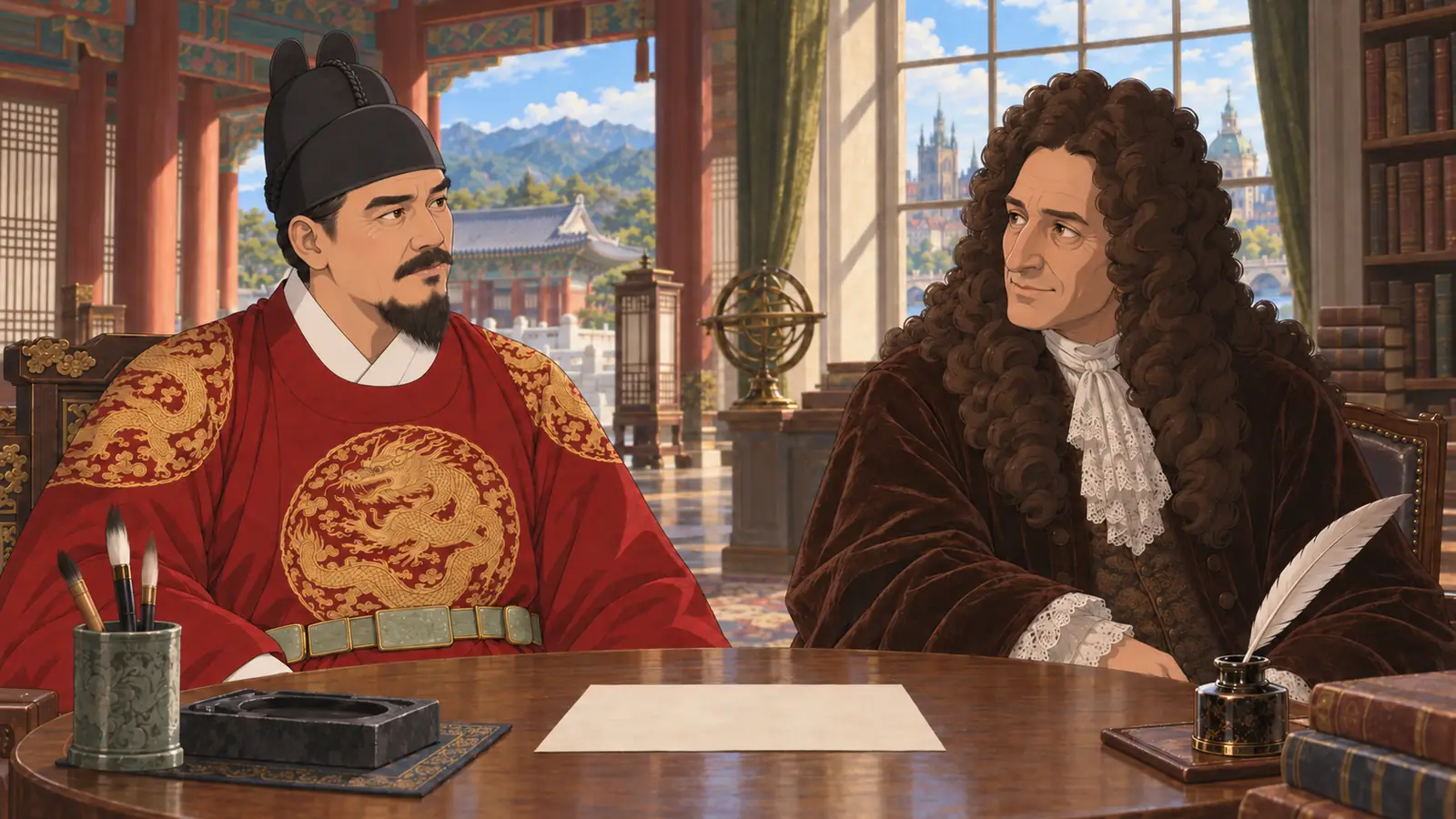
Watch on YouTube (11:12) · Audio in Korean · English subtitles
The Two
Sejong the Great and Leibniz
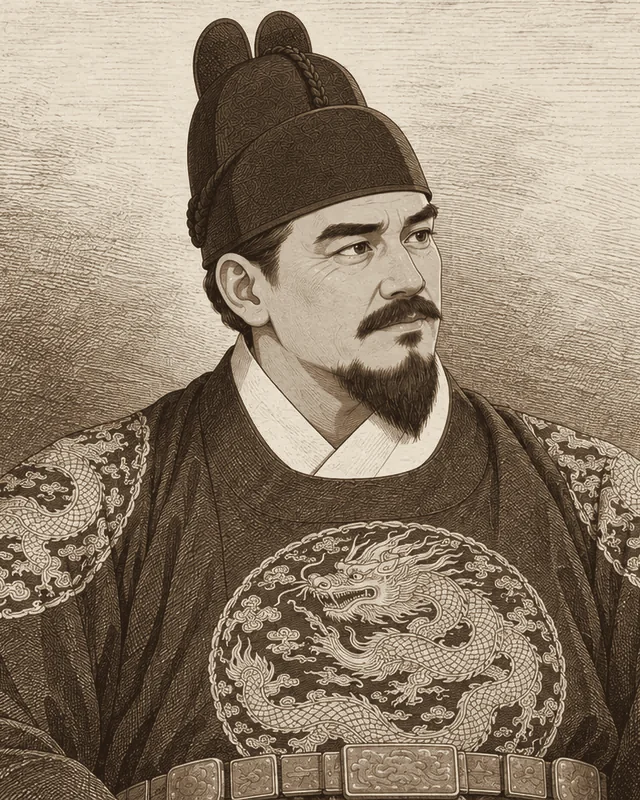 An imagined portrait
Sejong the Great, who made 28 letters that write sounds
I took pity on this, and newly made twenty-eight letters.Reconstruction; paraphrase; Hunminjeongeum, the king's preface (book of 1446)
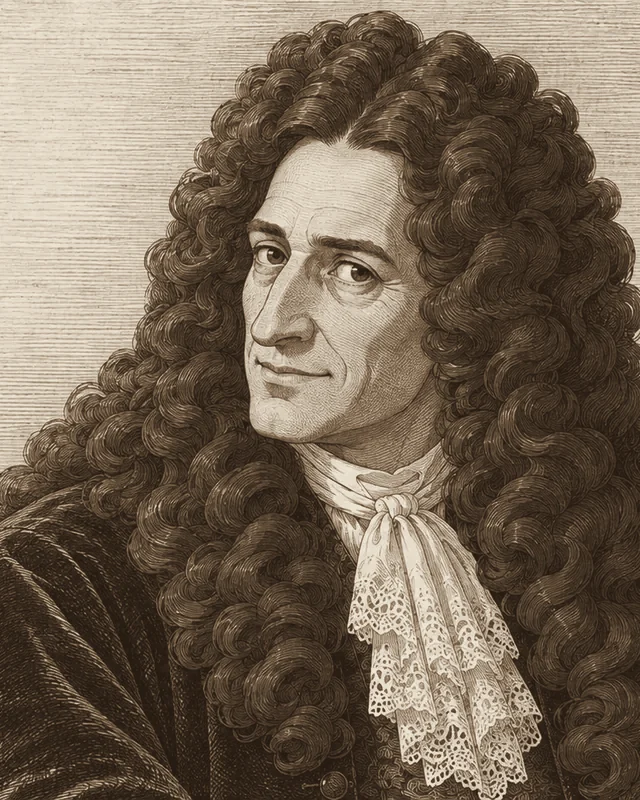 An imagined portrait
Leibniz, who dreamed of symbols that would let us calculate thought
If thoughts are written in signs, the mistakes would be visible at a glance.Reconstruction; paraphrase; The Art of Discovery (1685)
Twist → Essence
It is less a contest than a chance to look at each other's letters.
One dreamed of signs that write meaning and calculate; the other made letters for people that write sound. Both dreamed of a language to write down the world, but their paths were different.
History · Philosophy · Science
Looking back
History
Sejong took pity on people who could not express what they meant and made letters that write sound, and some years later, words rebuking a minister were written on a wall in those letters.
Philosophy
Leibniz dreamed of signs that calculate thought, and Sejong made letters that write human speech. Even if I leave calculation to machines, my own words I write myself.
Science
Learning to read changes the seeing brain, even in adulthood. That change took place in the brains of people who learned to read themselves.
Read
Script and sources
The video's English subtitles, line by line. The dialogue in this video is a dramatization reconstructed from what the two men wrote. The two never met.
Script
82 lines · 12 chapters
[Record] confirmed in documents · [Paraphrase] the original, shortened · [Tradition] a story handed down · [Reconstruction] scenes and lines written on the basis of the records (the content of the lines comes from the original texts) · [Interpretation] scholars' or the host's interpretation · [Calculation] a count of the years between dates In the video, ① Fact · ② Interpretation · ③ My view are shown in Korean at the top left of the screen; the English subtitles mark only "My view". Stories handed down are also marked [Tradition]. Dates from the Annals are in the lunar calendar.
0:00
Ever had something you really wanted to say — typed it, deleted it, typed it again, and never sent it? You have, right?
In a moment, I'll read you a line someone wrote on a wall, just a few years after the new letters appeared — a line scolding a high minister.
0:25
The second lunar month of 1444, in the royal palace of Joseon. Choe Manri, a deputy director of the Hall of Worthies, and others submit a petition opposing Eonmun, the new letters the king has made.
Note · Sangso = a written petition an official submits to the king · Eonmun = a common name for Hangul at the time
Record; Sejong Sillok vol. 103, Sejong 26.2.20 (lunar)
Sejong summoned them and questioned them, had seven of them held in the Uigeumbu, and the next day ordered them released. Jeong Changson, however, was removed from office, and Kim Mun was charged separately.
Note · Uigeumbu = the office that tried offenses on the king's orders
Record; Sejong Sillok vol. 103, Sejong 26.2.20 (lunar)
The petition said that writing down sounds and combining letters went entirely against the old ways. That is how new these letters were.
Record; the petition, article 1; Interpretation; host
About 200 years later, a genius born in Europe would also dream of signs that could write down human thought so that it could be calculated.
1:05
In 1432, he proposed that at least the articles of law dealing with serious crimes be put into Idu and made known to the people. To the objection that wicked people would play tricks with the law if they knew it, he answered like this.
Note · Idu = a way of writing Korean by borrowing Chinese characters
Record; paraphrase; Sejong Sillok vol. 58, Sejong 14.11.7 (lunar)
If we keep the people from knowing the law and then punish them, is that not close to trickery?
Note · The original says 'the trick of four in the morning, three in the evening' = a proverbial sleight of hand
Reconstruction; paraphrase; Sejong Sillok (1432)
1:30
In a book he published in 1666, he tried to work out complex ideas as combinations of simple ideas.
Record; De Arte Combinatoria (1666)
In 1673 he took a model of a calculating machine to the Royal Society in London, and he developed calculus independently of Newton.
Record
There was a dream he held on to for a long time. Signs that write down human thought so that it can be calculated. The universal characteristic.
Note · Universal characteristic = signs meant to write thought so that it could be calculated (Latin: characteristica universalis)
1:57
Meaning-writing. Like Chinese characters, letters that write meaning instead of sound.
Note · Meaning-writing = letters that write meaning (Chinese characters)
Sound-writing. Like Hangul, letters that write the sounds of speech.
Note · Sound-writing = letters that write sound (Hangul, the alphabet)
And binary. A way of writing every number with just two characters, 0 and 1.
Note · Binary = writing numbers with 0 and 1
2:16
The two never met. Leibniz was born 196 years after Sejong died. What follows is an imagined meeting, woven from what the two men wrote. It is less a contest than a chance to look at each other's letters.
Language is the best mirror of the human mind.
Reconstruction; quotation; New Essays on Human Understanding (written c. 1704)
The speech of our country differs from that of China, and does not fit with Chinese characters.
Reconstruction; paraphrase; Hunminjeongeum, the king's preface (book of 1446)
So even when they have something they want to say, many in the end cannot express what they mean.
Reconstruction; paraphrase; Hunminjeongeum, the king's preface (book of 1446)
Chinese characters do the same work as our alphabet, yet they are infinitely different.
Reconstruction; paraphrase; New Essays on Human Understanding (written c. 1704)
They might look like writing made by someone who cannot hear.
Reconstruction; paraphrase; New Essays on Human Understanding (written c. 1704)
I took pity on this, and newly made twenty-eight letters.
Reconstruction; paraphrase; Hunminjeongeum, the king's preface (book of 1446)
It is only so that people may learn them easily and use them every day.
Reconstruction; paraphrase; Hunminjeongeum, the king's preface (book of 1446)
This letter is a molar sound, like the first sound of the character 'gun'.
Reconstruction; quotation; Hunminjeongeum, Yeui (book of 1446)
The Hunminjeongeum Haerye explained it like this. The letter giyeok (g) is the shape of the root of the tongue blocking the throat. The basic consonants, it says, were modeled on the tongue, mouth, teeth and throat that make the sounds, and the three basic vowels on heaven, earth and humankind.
Record; Hunminjeongeum Haerye, Jejahae (1446)
Letters must always be combined to form a sound.
Reconstruction; quotation; Hunminjeongeum, Yeui (book of 1446)
Jeong Inji wrote in his preface that the twenty-eight letters can be varied and used without end, and that even the sound of the wind, the cry of a crane, the crow of a rooster and the bark of a dog can be written down.
Record; Jeong Inji's claim; Sejong Sillok vol. 113, Sejong 28.9.29 (lunar)
If small pictures were used in place of words, one might introduce a script better than Chinese characters.
Reconstruction; paraphrase; New Essays on Human Understanding IV.6 (written c. 1704)
If thoughts are written in signs, the mistakes would be visible at a glance.
Reconstruction; paraphrase; The Art of Discovery (1685)
When a dispute arises, we need only take up our pens and say to each other: Let us calculate!
Reconstruction; quotation; Fragment on the universal characteristic (1680s)
He means settling arguments by calculation. Whether that would work in a family quarrel, I'm not so sure.
I write every number with just two characters, 0 and 1.
Reconstruction; paraphrase; Explication de l'Arithmétique Binaire (1703)
In 1701, Bouvet, a missionary in Beijing, sent him a diagram of hexagrams. It is a diagram said to have been drawn by the legendary ruler Fuxi. Read the unbroken lines as 1 and the broken lines as 0, and it matched binary.
Record; Bouvet's letter (1701); Leibniz's paper (1703); Tradition; Fuxi
0 and 1 give the meaning of Fuxi's ancient figures.
Reconstruction; quotation; Explication de l'Arithmétique Binaire (1703); Fuxi is tradition
One man read 0 and 1 in the figures of yin and yang, and the Haerye explained the letters through the same yin and yang and through heaven, earth and humankind. You could say that from the same Eastern ideas, one saw calculation and the other saw human speech.
Record; Jejahae; Interpretation; host
The Eonmun of today, too, is meant to make things easier for the people.
Reconstruction; paraphrase; Sejong Sillok (1444)
Examine the meaning of words exactly, and you can know the workings of human thought better than by anything else.
Reconstruction; paraphrase; New Essays on Human Understanding (written c. 1704)
One dreamed of signs that write meaning and calculate; the other made letters for people that write sound. Both dreamed of a language to write down the world, but their paths were different.
Interpretation; host
5:04
In the ninth lunar month of 1446, the book Hunminjeongeum is completed. Hangul Day, October 9, is a date set by converting the 'first ten days of the ninth month' written at the end of this book into the solar calendar.
Record; Sejong Sillok vol. 113; National Hangeul Museum
The Annals for 1449 contain this record. Someone, it says, wrote on a wall in Eonmun: Minister Ha, do not handle public affairs recklessly again.
Note · Jeongseung = a post at about today's prime-minister level · Gongsa = affairs of state
Record; Sejong Sillok vol. 126, Sejong 31.10.5 (lunar), historian's comment; when it was written is not recorded
In 1504, when an anonymous letter in Eonmun slandering him appeared, Yeonsangun ordered that Eonmun be neither taught nor learned.
Record; Yeonsangun Ilgi vol. 54, Yeonsangun 10.7.19–20 (lunar)
In easy letters that write the sounds of speech, words rebuking a minister and a king alike had been written. The world was changing, little by little.
Interpretation; host
The letters have changed too. Four of the original twenty-eight are no longer used, and the 1933 Unified Spelling System dropped the arae-a, whose sound had disappeared.
Record; Korean Language Society, Unified Spelling System (1933)
Still, scholars see his calculating signs and his 0 and 1 as one of the distant roots leading to today's computers.
Interpretation; scholars
6:07
In 2010, a team led by the French neuroscientist Stanislas Dehaene scanned the brains of 63 Portuguese and Brazilian adults, from people who could not read to people who had learned as children.
Record; Dehaene et al., Science 330 (2010)
In people who could read, one spot toward the back of the left brain responded more strongly when they looked at letters. In turn, the response to faces at that same spot was slightly reduced.
The visual cortex, which first receives what the eyes see, also responded more strongly. And most of these changes also appeared in people who learned to read as adults.
Note · Visual cortex = the part of the brain that processes what the eyes see
Dehaene's team sees this as writing, an invention only a few thousand years old, borrowing a part of the brain that originally recognized objects.
Interpretation; Dehaene & Cohen's 'neuronal recycling' hypothesis (Neuron, 2007)
You could say letters are not only on paper; they also take up a place in the brain of the person who has learned them.
Interpretation; host
There is also something a physicist wrote. Niels Bohr, one of the founders of quantum mechanics, wrote in 1949 that an experiment is a situation where we can tell others what we have done and what we have learned.
Record; paraphrase; Bohr, Discussion with Einstein (1949), p. 209
And that it must therefore be written in unambiguous language, using the terms of classical physics.
Record; paraphrase; Bohr, Discussion with Einstein (1949), p. 209
What can be written down can be handed to others, and what can be handed over can be looked at together. Sejong and Leibniz both, as I see it, believed in that power of writing things down.
Interpretation; host
7:19
Before I give my own view, let me ask you. Leibniz's signs that calculate thought, or Sejong's letters that write the sounds of speech. Which are you more drawn to? Leave it in the comments, with one line on why.
7:41
If we could write down speech just as it is, would the world change? Sejong knew. That without writing that fits one's own speech, even with something to say, one cannot in the end express what one means.
My view
If even the tiniest subtlety can be put into words, it can be recorded. That is the language of the universe.
My view
In engineering terms, it is resolution. Only a ruler with fine gradations can measure small differences, and only what can be measured can be fixed.
Note · Resolution = how small a difference can be told apart
My view
If letters and expression can express the universe, just as it is spoken, then we see the universe more clearly.
My view
We express our will in words, leave it as a record, and so make the world evolve.
Note · Will = what one means to do
My view
The genes of living things also copy themselves almost perfectly, but very occasionally get it wrong. Those small mistakes, filtered by nature and accumulated, become evolution.
Record; biology
Being passed from generation to generation. Mistakes arising along the way, and learning and growing from those mistakes. It is how we forgive the past and move forward.
My view
In engineering terms, a record is a log. Only when a log remains can we find mistakes and fix them. Because Sejong's preface and Leibniz's writings both remain, we can seat the two of them face to face today.
Note · Log = a record of what a machine did, written down in order
My view
Try just one thing today. Instead of the summarize button, leave one handwritten line, for your child or for yourself.
My view
9:32
Use AI, but how far must we not hand things over? The standard for drawing that line comes from history, philosophy and science.
My view
History. Sejong took pity on people who could not express what they meant and made letters that write sound, and some years later, words rebuking a minister were written on a wall in those letters.
Philosophy. Leibniz dreamed of signs that calculate thought, and Sejong made letters that write human speech. Even if I leave calculation to machines, my own words I write myself.
Interpretation
Science. Learning to read changes the seeing brain, even in adulthood. That change took place in the brains of people who learned to read themselves.
So if speech can be written down just as it is, the world changes. That is my answer today.
My view
10:24
A preface from about 580 years ago and writings from some 300 years ago: because they remain, we read them again today.
If letters and expression can express the universe, just as it is spoken, then we see the universe more clearly.
My view
One last question. What is the one sentence you would want to write down and leave today, just as you would say it?
Sources and research
Sources are listed in their original Korean.
- Record1444년 음력 2월 20일, 집현전 부제학 최만리 등의 언문 반대 상소 · 세종의 문답 · 일곱 명을 의금부에 가뒀다가 이튿날 석방, 정창손 파직, 김문 국문: 『세종실록』 103권 세종 26년 2월 20일·21일 · Annals of the Joseon Dynasty
- Record · Paraphrase / Reconstruction1432년 법 조항을 이두로 옮겨 알리자는 제안과 반대, 세종의 반문: 『세종실록』 58권 세종 14년 11월 7일 · Annals of the Joseon Dynasty
- Record세종: 1397년 출생, 1418년 즉위, 조선 4대 임금 · 1450년 음력 2월 17일 사망(『세종실록』 127권) · Annals of the Joseon Dynasty
- Reconstruction · Paraphrase세종의 대사: 『훈민정음』 어제 서문과 예의(『세종실록』 113권 세종 28년 9월 29일) · 1444년 2월 20일 문답 · Annals of the Joseon Dynasty
- Record『훈민정음』 해례 제자해: ㄱ은 혀뿌리가 목구멍을 막는 모양, 기본 자음은 발음 기관, 기본 모음 ㆍㅡㅣ는 하늘·땅·사람을 본뜸 · "天地之道, 一陰陽五行而已" · Wikisource
- Record (Jeong Inji's claim)스물여덟 자를 바꿔 가며 끝없이 쓸 수 있고 바람 소리·학 울음·닭 울음·개 짖는 소리까지 적을 수 있다: 정인지 서문(『세종실록』 113권) · Annals of the Joseon Dynasty
- Record1446년 음력 9월 『훈민정음』 완성 · 한글날 10월 9일은 책 끝 '9월 상순'을 양력으로 바꿔 정한 날(국립한글박물관) · National Hangeul Museum
- Record1449년 실록의 언문 벽서 "하 정승아, 또 공사를 망령되게 하지 말라": 『세종실록』 126권 세종 31년 10월 5일 — 쓴 때는 기록에 없음 · Annals of the Joseon Dynasty
- Record1504년 연산군의 언문 교습·학습 금지: 『연산군일기』 54권 연산 10년 7월 19일·20일 · Annals of the Joseon Dynasty
- Record처음 스물여덟 자 가운데 넷(ㆍ ㅿ ㆁ ㆆ)은 지금 쓰지 않음 · 1933년 한글 맞춤법 통일안은 아래아를 뺌(조선어학회 「한글 맞춤법 통일안」 1933 · 현행 「한글 맞춤법」 제4항) · National Institute of Korean Language
- Record라이프니츠: 1646년 라이프치히 출생 · 1666년 『조합술에 관하여』 · 1673년 런던 왕립학회에 계산기 모형 · 뉴턴과 따로 미적분 · 보편 기호(characteristica universalis)의 꿈 · 1716년 사망까지 완성하지 못함(브리태니커 · 스탠퍼드 철학 백과 · 쿠튀라 『라이프니츠의 논리학』 1901) · SEP
- Reconstruction · Paraphrase라이프니츠의 대사: 『신인간지성론』(1704년 무렵 씀) 2권 9장·3권 7장·4권 6장 · 「발견의 기술」 등 단편 · 1703년 논문 · Internet Archive
- Record + Tradition1701년 베이징의 선교사 부베가 괘 배열도를 보냄, 이어진 선을 1·끊긴 선을 0으로 읽으면 이진법과 맞음(라이프니츠 1703년 논문 「이진 산술의 설명」) · 복희가 그렸다는 것은 [전승] · hal.science
- Interpretation라이프니츠의 계산하는 기호와 0·1을 컴퓨터로 이어지는 먼 뿌리 가운데 하나로 봄: 노버트 위너 『사이버네틱스』(1948) · 마틴 데이비스 『The Universal Computer』(2000) · Internet Archive
- Record드앤 외, Science 330권(2010) 1359~1364쪽: 포르투갈과 브라질 어른 63명, 글을 아는 사람은 왼쪽 뇌 뒤쪽 한 자리의 글자 반응이 더 큼, 같은 자리의 얼굴 반응은 조금 줄어듦, 시각 피질 반응도 커짐, 변화의 대부분은 어른이 되어 글을 배운 사람에게도 나타남 · DOI
- Interpretation (hypothesis)글이 원래 사물을 알아보던 뇌 자리를 빌려 쓴다: 드앤·코엔, Neuron 56권(2007) · DOI
- Record · Paraphrase닐스 보어(1949): 실험이란 우리가 한 일과 알게 된 것을 남에게 말할 수 있는 상황이며, 그래서 고전 물리학의 용어로 모호하지 않게 적어야 한다(Schilpp 편 『Albert Einstein: Philosopher-Scientist』) · Marxists Internet Archive
- Record유전자 복사의 드문 오류가 자연선택에 걸러지며 쌓여 진화가 됨(UC Berkeley 'Understanding Evolution' · NHGRI) · evolution.berkeley.edu
- Calculation세종 사망(1450)과 라이프니츠 출생(1646) 사이 196년 · 서문(1446)은 약 580년 전, 라이프니츠의 글(1703~1704년 무렵)은 300여 년 전
If you find a mistake, please tell us in the video's comments. We will check it and correct it. How We Check Facts
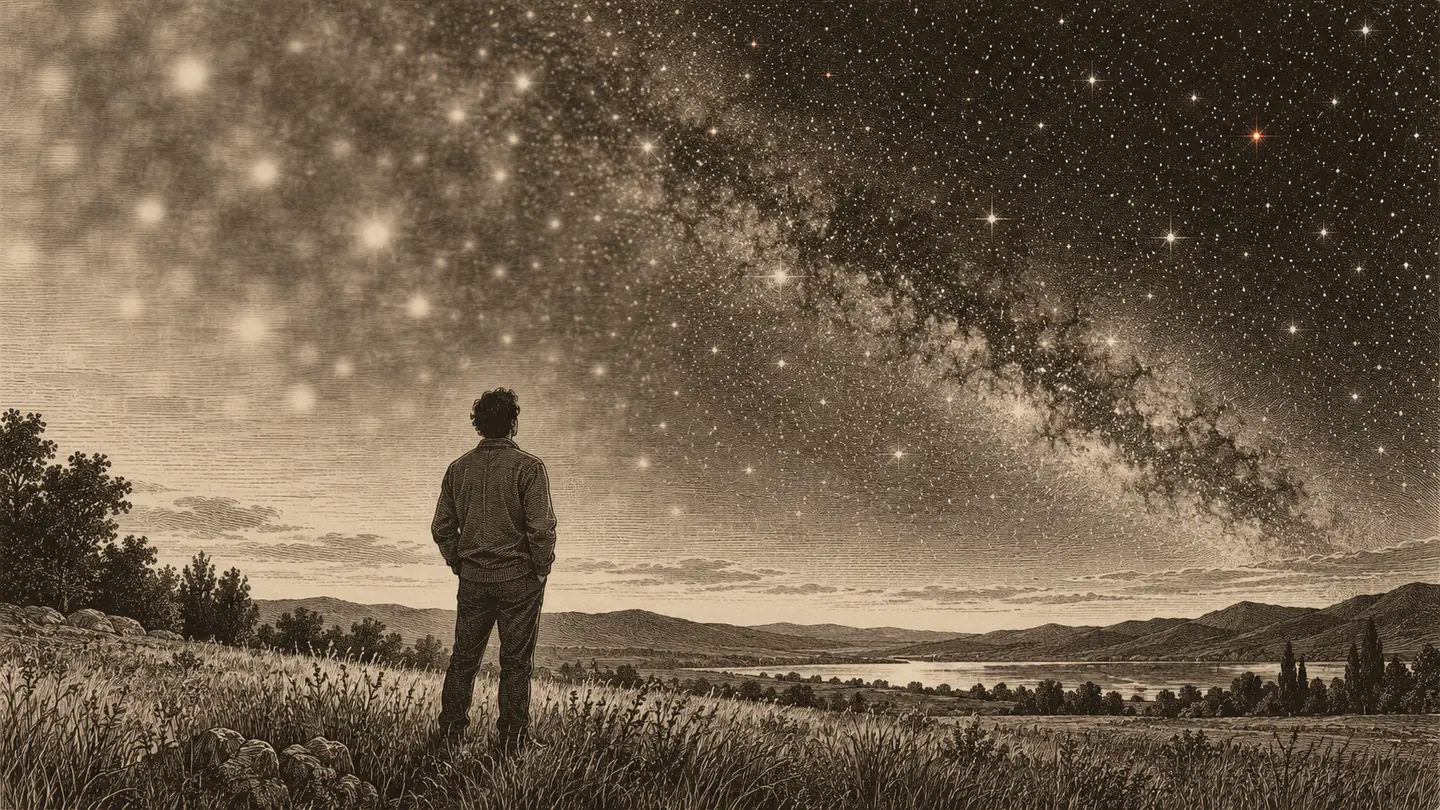
If letters and expression can express the universe, just as it is spoken, then we see the universe more clearly.
One last question. What is the one sentence you would want to write down and leave today, just as you would say it?
Which are you more drawn to? ① Leibniz's signs that calculate thought ② Sejong's letters that write the sounds of speech — leave it in the comments, with one line on why
Keep watching
Other games
 0112:22
Game 1·Schopenhauer×Hegel
Why You Crave Ramen at Midnight
 0213:44
Game 2·Zhuangzi×Turing
If AI Does All My Work, What Should I Do Next?
 0313:46
Game 3·Spinoza×Wonhyo
Why do we always regret it after we snap?
 0413:20
Game 4·Franklin×Keynes
Why Hard Work Alone Doesn't Make You Rich
 0710:18
Game 7·Eckhart×Naong
What Gets You Through a Hard Day?
 0910:51
Game 9·Van Gogh×Hokusai
Is It Really Too Late?
 1110:18
Game 11·Yi Sun-sin×Aurelius