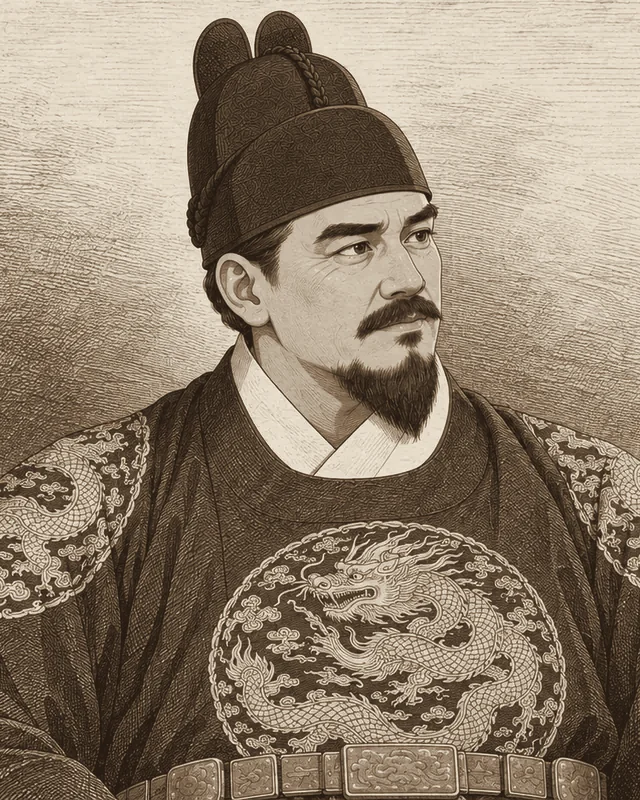
- 1397
He was born on the 10th day of the fourth lunar month (the Annals: the imjin day of the fourth month), the third son of King Taejong, at Junsubang in Hanyang. Record
Sejong sillok (Annals of King Sejong), vol. 1, general preface (sillok.history.go.kr/id/kda_000) · Uri Yeoksanet, 'Sejong 1397–1450' (contents.history.go.kr, levelId=kc_n305800) · Encyclopedia of Korean Culture, 'Sejong' (by Choe Seung-hui, encykorea.aks.ac.kr/Article/E0029857)
- 1418
In the eighth lunar month he received the throne from his father, King Taejong, and was enthroned in Geunjeongjeon Hall of Gyeongbokgung Palace. Record
Sejong sillok, vol. 1, accession year, 8th month, 11th day (musa), entry 1 (accession proclamation, kda_10008011_001) · Uri Yeoksanet, 'Sejong 1397–1450' (contents.history.go.kr, levelId=kc_n305800) · Encyclopedia of Korean Culture, 'Sejong' (by Choe Seung-hui, encykorea.aks.ac.kr/Article/E0029857)
- 1420
In the third lunar month he set up the Hall of Worthies (Jiphyeonjeon) inside the palace, where young scholars lectured on the classics and history and prepared answers to the king's questions. Record
Sejong sillok, vol. 7, year 2, 3rd month, 16th day (gapsin), entry 1 (kda_10203016_001) · Encyclopedia of Korean Culture, 'Jiphyeonjeon' (E0055081)
- 1429
By royal order, Jeong Cho and others gathered the experience of farmers in each province and published the farming manual Nongsa jikseol, suited to Joseon's own climate and soil; the following year it was distributed to local officials. Record
Encyclopedia of Korean Culture, 'Nongsa jikseol' (E0013114) · Uri Yeoksanet, Korean History through Sources, 'Publication of farming manuals' (hm_082_0020)
- 1432
In the eleventh lunar month he proposed that at least the articles of law dealing with serious crimes be rendered in Idu and made known to the people. When the Minister of Personnel, Heo Jo, objected, he asked in return whether punishing people who do not know the law is not close to trickery. Record · Paraphrase
Sejong sillok, vol. 58, year 14, 11th month, 7th day (imsul), entry 1 (kda_11411007_001) · Kim Seul-ong, 'Why did Sejong create Hunminjeongeum?' (Chungcheong Review, idxno=316852, in Korean)
- 1430s–1440s
On the upper Yalu River he newly set up the counties of Jaseong, Muchang and Uye, which with Yeoyeon county (set up under Taejong in 1416) made the Four Commanderies, and on the Tumen River side he set up the Six Garrisons (1434–1449), extending the northern frontier to the two river basins. Record
Encyclopedia of Korean Culture, 'Sejong' (by Choe Seung-hui, encykorea.aks.ac.kr/Article/E0029857) · Encyclopedia of Korean Culture, 'Yukjin' (E0042168) · 'Sagun' (E0025393)
- 1434
From the 1st day of the seventh lunar month, the automatic water clock Jagyeongnu, made by Jang Yeong-sil and others, came into use. Record
Encyclopedia of Korean Culture, 'Jagyeongnu' (E0047854) · Uri Yeoksanet, 'Changgyeonggung Jagyeongnu' (kc_r300785)
- 1441–1442
An entry in the Annals for the fourth lunar month of 1441 records the king saying that in recent years the Crown Prince (later King Munjong) had made a bronze vessel and measured rainfall in the palace. In the eighth lunar month of the same year, on the proposal of the Ministry of Taxation (Hojo), a system was set up of placing rain-measuring vessels at the Office of Astronomy (Seoungwan) and at local government offices; in the fifth lunar month of 1442 this was revised, and the name 'cheugugi' (rain gauge) and its specifications were fixed. Record
Sejong sillok, vol. 92, year 23, 4th month, 29th day (kda_12304029_001) · vol. 93, year 23, 8th month, 18th day (kda_12308018_004) · vol. 96, year 24, 5th month, 8th day (jeongmyo) (kda_12405008_001) · Encyclopedia of Korean Culture, 'Sejong' (by Choe Seung-hui, encykorea.aks.ac.kr/Article/E0029857) · Kyunghyang Shinmun, Lee Ki-hwan, 6 March 2023 (in Korean)
- 1443
The Annals record that in the twelfth lunar month the king himself created 28 letters of eonmun (the vernacular script) and called them 'Hunminjeongeum'. Record
Sejong sillok, vol. 102, year 25, 12th month, 30th day (gyeongsul), entry 2 (kda_12512030_002) · Encyclopedia of Korean Culture, 'Hangeul' (by Kang Sin-hang, E0061508)
- 1444
On the 20th day of the second lunar month, when Choe Manri, a deputy director of the Hall of Worthies, and others submitted a petition opposing the eonmun, he summoned them and questioned them, had seven of them held in the Uigeumbu (State Tribunal), and the next day ordered them released. Record
Sejong sillok, vol. 103, year 26, 2nd month, 20th day (gyeongja), entry 1 (kda_12602020_001) · Encyclopedia of Korean Culture, 'Choe Manri' (E0057279) · Pressian, Choi Tae-ho, 5 May 2023 (in Korean)
- 1446
In the ninth lunar month the book Hunminjeongeum was completed. Today's Hangeul Day (9 October) was set by converting to the solar calendar the 10th day of the ninth lunar month, the last day of the 'first ten days of the ninth month' (上澣) given at the end of the book. Record
Sejong sillok, vol. 113, year 28, 9th month, 29th day (gabo), entry 4 (kda_12809029_004) · National Hangeul Museum webzine, October 2018, 'Why is Hangeul Day 9 October?' (in Korean) · Encyclopedia of Korean Culture, 'Hangeul' (E0061508)
- 1450
He died on the 17th day of the second lunar month in the East Detached Palace at the residence of Grand Prince Yeongeung. Record
Sejong sillok, vol. 127, year 32, 2nd month, 17th day (imjin), entry 1 (kda_13202017_001) · Uri Yeoksanet, 'Sejong 1397–1450' (contents.history.go.kr, levelId=kc_n305800)