Great Games of Thought · Game 9 · · 10 min 51 s
Is It Really Too Late?
Van Gogh×Hokusai
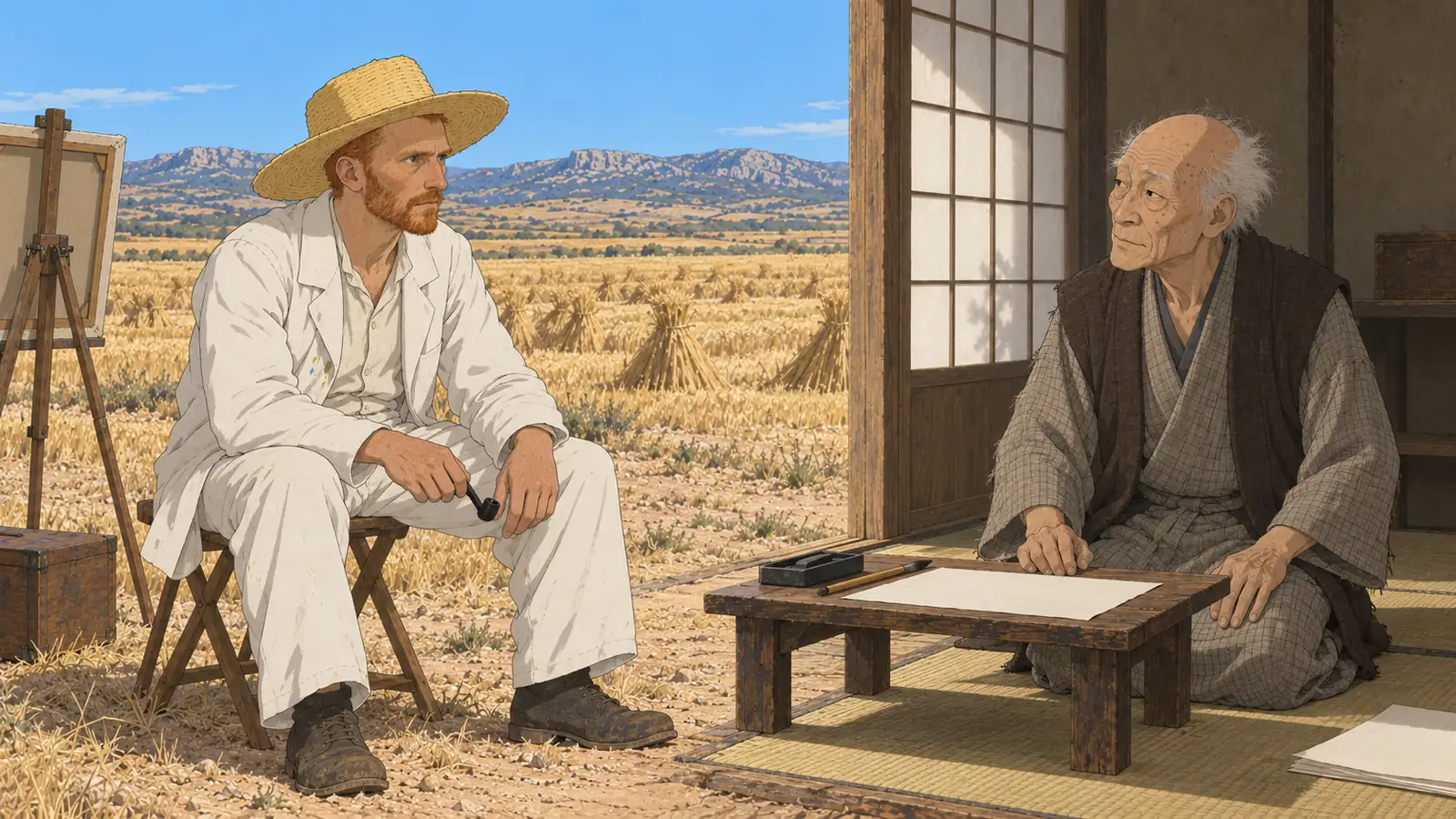
When you think it's too late, is it really too late? We look for the answer in Vincent van Gogh, who decided at 27 to become a painter and wrote to his brother that, having started late, he had to work twice as hard, and Katsushika Hokusai, who gave his own age as 75 and wrote that nothing he drew before 70 was worth noticing. A painter who burned hot for about ten years, and a painter who kept going doggedly for 70 years. Yet two people who never once met wrote similar lists, from grasses and trees to beasts. Short and long, fiery and cold: that was only the outward appearance. Neither of them stopped because it was late. Hokusai said his pictures before 70 were not worth noticing, and Van Gogh did not stay with what he knew how to do. The two never met; the dialogue is a dramatization reconstructed from what they wrote.
Watch on YouTube (10:51) · English version
The Two
Van Gogh and Hokusai
 An imagined portrait
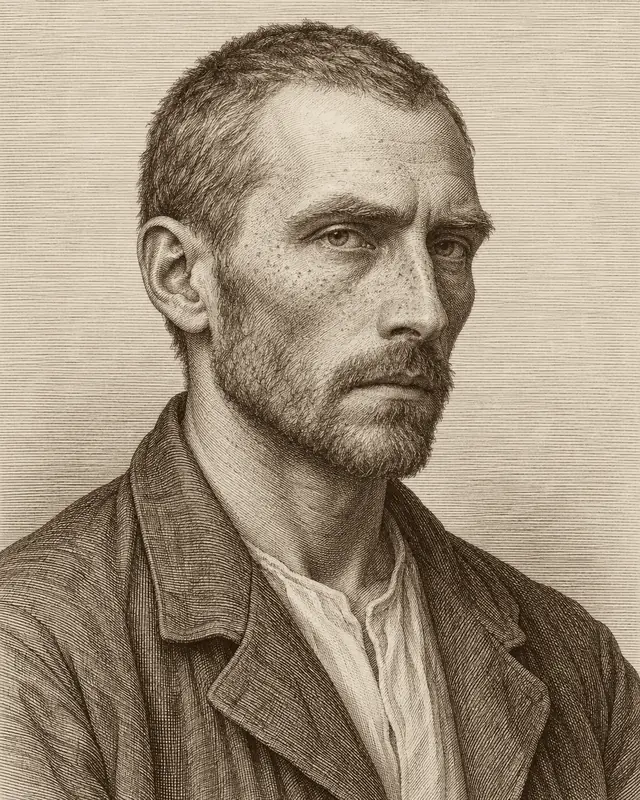
Vincent van Gogh
Born in 1853Vincent van Gogh, who decided at 27 to become a painter and wrote to his brother that, having started late, he had to work twice as hard
I always draw what I can't do yet.Reconstruction; paraphrase; Letter 528 (1885); the idea of working twice as hard after starting late is from letter 312 (February 1883)
 An imagined portrait
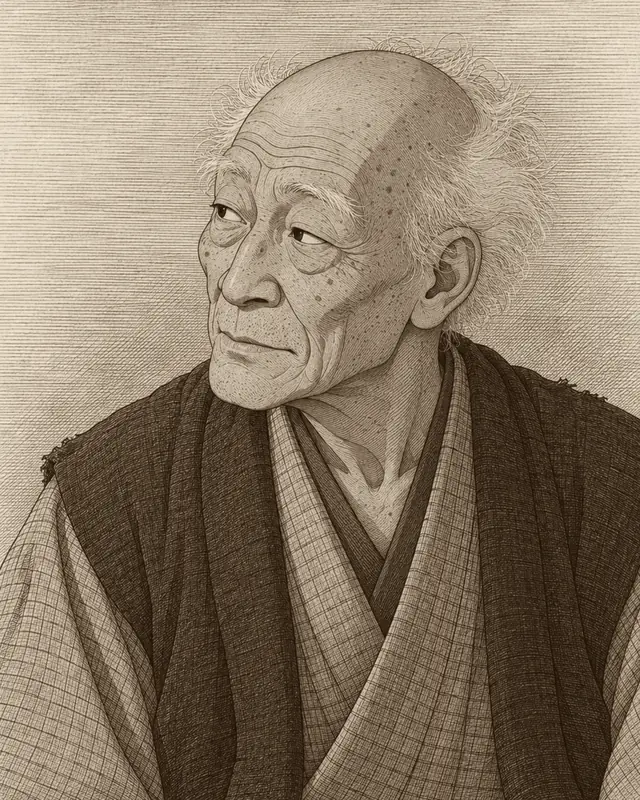
Katsushika Hokusai, who gave his own age as 75 and wrote that nothing he drew before 70 was worth noticing
Nothing I drew before 70 is worth noticing.Reconstruction · Record; paraphrase; One Hundred Views of Mount Fuji, first volume, postscript (1834)
Twist → Essence
Yet two people who never once met wrote similar lists, from grasses and trees to beasts.
Short and long, fiery and cold: that was only the outward appearance. Neither of them stopped because it was late.
Read
Script and sources
The video's English subtitles, line by line. The dialogue in this video is an imagined conversation built from the writings the two men left. The two never met.
Script
79 lines · 8 chapters
[Record] confirmed in documents · [Paraphrase] the original, shortened · [Reconstruction] scenes and lines written on the basis of the records (the content of the lines comes from the original texts) · [Observation] pointed out by looking at the picture itself · [Interpretation] scholars' or the host's interpretation In the video, ① Fact · ③ My view are shown in Korean at the top left of the screen; the English subtitles mark only "My view". The small text at the bottom right gives the kind of image; the English subtitles show it in brackets. The age bar at the top right shows Van Gogh's age in full years and Hokusai's age as he wrote it himself, by the traditional count. The bars in the learning-study picture have no figures on their heights.
0:00 · When you think it's too late — is it really too late?
Painting, or a musical instrument. A time you stopped in front of the sign-up button, thinking 'At my age, why bother?', and set it aside. You've had one, haven't you?
In a little while, I will show you a short piece of writing by an old man of 75, and the time a 30-year-old Van Gogh reckoned he had left.
I started late, so I have to work twice as hard.
Reconstruction · Record; paraphrase; Letter 312 (February 1883, to Theo)
Nothing I drew before 70 is worth noticing.
Reconstruction · Record; paraphrase; One Hundred Views of Mount Fuji, first volume, postscript (1834)
A painter who burned hot for about ten years, and a painter who kept going doggedly for 70 years. Which of them was late?
0:45 · A Letter and the Great Wave
September 1888, Arles. Van Gogh reads a letter from his brother Theo. Looking at Hokusai's waves, Theo had written this:
Record; letter 676 (8 September 1888) — that it refers to the Great Wave is an inference by the scholars of the letters edition
'These waves are claws. The ship is caught in them.'
Record; paraphrase; letter 676 — Theo's words, copied out by Van Gogh
Look here. The tips of the wave split like fingers, and those tips split again, like hooks. Inside a small wave, another small wave.
Observation; interpretation — Cartwright & Nakamura 2009
That small peak far in the distance is Mount Fuji. It is the main subject of this series, but here it is hiding under the wave. There are three boats.
Record; the picture; Art Institute of Chicago; Korenberg 2020
The man who drew this picture is today's second main figure.
Record; the woodblocks were cut by a block carver
1:26 · Katsushika Hokusai
Katsushika Hokusai. Born in 1760 in Edo, today's Tokyo, he lived as a painter for 70 years.
Record; Sumida Hokusai Museum — 1779–1849
The Hokusai Manga he published is not manga in today's sense, but a drawing textbook that gathers people, animals and waves, drawn as the fancy took him.
Record; the Met, JIB82; Sumida City — first volume 1814
In 1834, he placed a short piece of writing at the end of a picture book. This is the piece I promised.
Record; One Hundred Views of Mount Fuji, first volume, postscript — printed with the book
Look here. 'Nothing I drew before 70 is worth noticing. At 73 I came at last to grasp a little of the bones of birds and beasts, insects and fish, and of how grasses and trees grow.'
Record; One Hundred Views of Mount Fuji, first volume, postscript, '七十年前…' '七十三才…'
'So at 80 I shall advance still further, at 90 I shall fully grasp their deep meaning, and at 100 shall I reach the marvellous? At 110, a single dot, a single stroke, will seem to live.'
Note · Marvellous = so excellent it is hard to believe it is human skill
Record; postscript, '八十才'; '一百歳にして正に神妙ならん歟'; '生るがごとく'
A man who, at 75, wrote that from now on he would go further. For him, it seems, there was no such word as 'late'.
Interpretation
In his prints from around 70, Prussian blue, a blue pigment made in Europe that had just become cheap and widespread, was used mixed with indigo. In a Japanese print, a European blue.
Note · Prussian blue = a blue pigment made in Berlin around 1706 (in Japan, 'bero-ai')
Record; Berlin 1706; imported to Japan 1747; cheaper and widespread from c. 1829; Heritage Science 2020
Quiz two. It is the same Great Wave, so why is the sky a different color in these two prints?
Prints are made one sheet at a time, so their colors differ with when they were printed and how much they have faded.
Record; 111 impressions examined; Korenberg 2020
3:06 · Vincent van Gogh
Vincent van Gogh. Born in 1853 in the Netherlands, he decided at 27 to become a painter.
Record; Van Gogh Museum
At 30, he wrote to his brother that he estimated the time his body would hold out at, say, six to ten years. He painted for nearly seven years after that, and then he died.
Record; paraphrase; letter 371 (August 1883), 'zonder voorbarigheid … bijvoorbeeld'
In Paris he collected Japanese prints, and copied pictures by Hiroshige, a print artist of Edo, keeping their composition just as it was.
Record; Van Gogh Museum; Hiroshige born 1797
Quiz three. On the left is Hiroshige's print; on the right, the painting Van Gogh copied from it. What changed?
Look here. The tree trunks, which were black and gray, have turned red and blue. And on both sides, orange bands and Japanese characters.
Record; Van Gogh Museum s0115V1962
These characters were taken from other prints. They are words like the names of a shop and a person, and have nothing to do with the plum-blossom picture.
Record; Van Gogh Museum (added as decoration); The Art Newspaper 2025
In my view, nothing is mine from the start. It is from the moment I choose what to learn and what to mix that something of my own comes into being.
My view
How he described himself to his younger sister after moving down to Arles: in white clothes and a yellow straw hat, loaded down with gear like a prickly porcupine, always covered in dust.
Note · Porcupine = an animal covered in long quills (bigger than a hedgehog)
Record; paraphrase; letter 626 (June 1888, to Willemien)
From that winter on, he was shaken again and again, and the next spring he entered a sanatorium of his own accord.
Note · Sanatorium = a place to stay while a sick body and mind are cared for
Record; Van Gogh Museum; letter 760 (21 April 1889), note 4 — admitted 8 May 1889; no diagnosis is asserted
Based on the dawn view he saw from that room's window, this painting was made in the daytime, in the studio: The Starry Night.
Record; MoMA 472.1941; letters 776 and 777
But the village below could not be seen from the window. He mixed what he saw with what he imagined.
Record; MoMA
It is often said just one, but the Van Gogh Museum holds that it was more than one or two. In his last year, a long critical article on him alone also appeared. That summer, he died.
Record; Van Gogh Museum FAQ; Aurier, January 1890
5:04 · Great Games of Thought · Van Gogh and Hokusai
Two people who never met. Nearly four years after Hokusai died, Van Gogh was born. This is an imagined conversation, built from the writings they left.
Record; dates of birth and death
I started drawing relatively late.
Reconstruction; paraphrase; Letter 371 (August 1883), 'Niet alleen ben ik laat begonnen betrekkelijk met teekenen'; letter 158 (September 1880) — 27
From the age of six, I copied the shapes of things.
Reconstruction; paraphrase; One Hundred Views of Mount Fuji, first volume, postscript
I always draw what I can't do yet.
Reconstruction; paraphrase; Letter 528 (1885); the idea of working twice as hard after starting late is from letter 312 (February 1883)
If we study Japanese art, we see a man who studies a single blade of grass.
Reconstruction; paraphrase; Letter 686 (September 1888), 'on voit un homme … il etudie un seul brin d'herbe' — not a specific person
Then he goes on to all the plants, to landscapes, to animals, to people.
Reconstruction; paraphrase; Letter 686
At 73 I came at last to grasp a little of the bones of birds and insects, and of how grasses grow.
Reconstruction; paraphrase; Postscript
At 110, a single dot, a single stroke, will seem to live.
Reconstruction; paraphrase; Postscript, '生るがごとく'
Which of them was late? If I add one thought of my own here: I believe there is lateness in goals meant to be shown to others, but on the path of looking into myself, there is no lateness.
My view
This text of Hokusai's was translated and printed in a French book in 1883, and the scholars of the letters edition think Van Gogh may have seen that book.
Note · Scholars of the letters edition = the scholars who compiled and annotated the complete letters of Van Gogh (the Van Gogh Museum edition)
Record; Gonse, L'Art japonais (1883); interpretation; letter 620, notes
I think both of them held on to the self here and now, and let go of what was past of their own free will. Hokusai said his pictures before 70 were not worth noticing, and Van Gogh did not stay with what he knew how to do.
My view · Interpretation; record: postscript; letter 528
7:06 · Learning Late — Science
And science? A 2014 study had adults aged 60 to 90 learn digital photography, something new to them, for three months. That group's memory improved, while the group that spent the same time just socializing showed no difference.
Record; Park et al. 2014, Psychological Science; over 200 people, 15+ hours a week
It was not the time but the hard learning of something new that made the difference.
Interpretation
Hokusai said that only at 73 did he come to understand a little. By that reckoning, about how old are you now? What have you set aside? Tell us in the comments.
7:35 · My View
From here on, this is my own view. Not a right answer, but a thought I want to share.
My view
I look at this text again. A man who, at 75, wrote that from now on he would go further. Since there is no end, there is neither late nor early. That 'from now on', too, is in the end a now that we meet anew every day.
My view
Around the time one period of his work gave way to the next, he often let go of his old name and started anew. To polish without end, and when the time comes, to let go without attachment.
My view
Deciding when that time comes is free will, and life goes all the way to taking responsibility for it.
Note · Free will = the power to decide for myself, not others deciding for me
My view
Letting go, too, need not be called failure. If I decide by my own free will, take responsibility, and walk a path that is my own rather than others' judgment, only I know what it is worth.
My view
I look at these two pictures again. The world grows wider when different pieces meet and mix. Art is one universe meeting another universe and exploding. And making a new universe.
My view
Within those combinations, coming to know my meaning little by little, building my will little by little, and making my own universe richer. I think that is how to love myself.
My view
Van Gogh died at 37, but he left more than 800 letters and his paintings, and more than 130 years later they have reached us now. Not the DNA of the body, but the DNA of the mind. Just as King Sejong the Great left his in written characters.
Note · DNA = the blueprint that passes the body's makeup on to the next generation · DNA of the mind = thoughts that remain and are passed on through writing, pictures and voice
My view · Record; 820 letters written by Van Gogh
Reaching is up to time. My part is to write one reflection on life. Not something stored up, but one written in this very moment.
My view
9:19 · My Answer · One Last Question
When you think it's too late, is it really too late? My answer is this. On the path of looking into myself, no one is late. All there is, is the now we write again today.
My view
Hokusai at 75, and Van Gogh after starting late, did not stop. One study in science, too, judged that even late in life, learning something hard and new, like digital photography, can improve memory.
Earning a living still has to be done. But there is no need to live your whole life only for earning a living. As far as you can, the effort to find that proportion is itself the meaning. That effort is the beating of wings.
My view
This is how I see it. The road has no end, and the walker's time is finite. So there is no lateness, but the beating of wings is now.
My view
Try just one thing today. The thing you set aside: start it with just one line, one stroke.
My view
The words 'too late', too, are in the end measured by someone else's clock. So let me ask one last question. Do we live only if we are recognized, or is it because we go on living that both recognition and a record can remain?
Sources and research
Sources are listed in their original Korean.
- Record · Paraphrase / Reconstruction · Paraphrase늦게 시작했으니 두 배로 일해야: 고흐 편지 312(1883.2.11, 테오에게) · 비교적 늦게 시작, 몸이 버틸 시간을 이를테면 여섯 해에서 열 해쯤으로 어림: 371(1883.8.7 무렵, 테오에게) · 스물일곱에 다시 연필을 듦: 158(1880.9.24) · 고흐가 쓴 편지 820통(남은 903통 가운데) — vangoghletters.org(반 고흐 미술관·Huygens ING)
- Reconstruction · Paraphrase늘 아직 못 하는 것을 한다(할 수 있게 배우려고): 편지 528(1885.8.18 무렵, 친구 화가 안톤 판 라파르트에게)
- Record · Paraphrase「이 파도는 발톱이다. 배가 그 속에 붙잡혀 있다」 — 테오의 말을 고흐가 옮김: 편지 676(1888.9.8, 아를) · 「큰 파도」를 두고 한 말로 보는 것은 편지 전집 주석 16의 추정
- Reconstruction · Paraphrase풀 한 포기를 공부하는 사람(특정 인물 아님) → 모든 식물·풍경·동물·사람, 그 전부를 하기엔 삶이 너무 짧음: 편지 686(1888.9.23~24 무렵, 테오에게)
- Record · Paraphrase흰 옷, 노란 밀짚모자, 가시 돋친 호저처럼 짐을 잔뜩, 늘 먼지투성이: 편지 626(1888.6, 아를, 여동생 빌레민에게)
- Record그해 겨울부터 거듭 흔들림, 1889.5.8 스스로 생레미 요양원에(병명은 단정하지 않음): 편지 760(1889.4.21) 주석 4 · 반 고흐 미술관
- Record「별이 빛나는 밤」(1889.6): 창으로 본 새벽 풍경을 바탕으로 낮에 작업실에서, 아래 마을은 창에서 안 보임: MoMA 472.1941 · 편지 776·777
- Record1853년 네덜란드 출생, 스물일곱에 화가가 되기로 함 · 생전 판매는 정확한 수는 몰라도 두어 점보다 많음: 반 고흐 미술관 FAQ · 1890년 1월 그만을 다룬 긴 평론: 알베르 오리에, 『메르퀴르 드 프랑스』 — 편지 845 주석 2
- Record파리에서 일본 판화를 모으고 히로시게(1797년생)의 그림을 구도 그대로 따라 그림 · 줄기 색, 주황 띠와 일본 글자: 반 고흐 미술관 s0115V1962 설명
- Record테두리 글자는 다른 판화에서 옮겨 온 실제 일본 글귀로, 매화 그림과는 상관없음: 반 고흐 미술관 s0115V1962 · The Art Newspaper (2025.8.1)
- Record / Interpretation발문은 1883년 루이 공스 『L'Art japonais』 1권에 프랑스어로 실림 · 고흐가 그 책을 보았을 수 있다는 견해: 편지 620 주석 6
- Record1760년 에도(지금의 도쿄) 출생, 칠십 년 동안 화가(1779~1849): 스미다 호쿠사이 미술관 · 1849년에 떠나고 네 해 가까이 지나 1853년 고흐 출생
- Record『호쿠사이 만화』 — 1814년 첫 편, 그림 교과서(絵手本), 화면은 5편(1816): 메트로폴리탄 미술관 JIB82 · 스미다구
- Record · Paraphrase여섯 살부터 베껴 그림 · 「七十年前画く所は実に取に足ものなし」 · 「七十三才にして稍禽獣虫魚の骨格草木の出生を悟し得たり」 · 「一百歳にして正に神妙ならん歟」 · 「生るがごとく」 · 서명 「画狂老人卍」 「七十五齢」(옛 셈법): 『부악백경』 초편 발문(1834) — 스미소니언 도서관 소장본 실물 판독(시마네 현립미술관 판독과 대조)
- Observation · Interpretation작은 파도 안에 또 작은 파도: Cartwright & Nakamura, Notes Rec. R. Soc. 63:119–135 (2009)
- Record「큰 파도」(1830~32년 무렵 — 메트로폴리탄 미술관 JP1847 표기): 후지산이 연작의 주인공, 배 세 척, 판목은 각수가 새김: 시카고 미술관 1952.343 · Korenberg, 「The making and evolution of Hokusai's Great Wave」(대영박물관, 2020)
- Record프러시안 블루(일본 이름 베로아이): 1706년 무렵 베를린, 1747년 일본에 들어옴, 1829년 무렵 값싸져 퍼짐, 그의 판화에서 쪽빛과 섞여 쓰임: Heritage Science 8:62 (2020) · H. Smith (2005) · 동양문고 「Prussian Blue in East Asian Paintings」
- Record · Interpretation찍은 때와 바랜 정도에 따라 색이 다름 · 시카고 1952.343은 늦게 찍은 인쇄본, 구름은 복원 때 덧칠됐을 수 있음: Korenberg (2020)
- Record시기가 바뀔 무렵이면 흔히 이름을 바꿈(春朗·宗理·北斎·戴斗·為一·画狂老人卍 등): 시마네 현립미술관 · 스미다 호쿠사이 미술관
- Record예순에서 아흔 살 어른 200여 명, 석 달, 주 15시간 넘게: Park 외, Psychological Science 25(1):103–112 (2014)
Photo credits
CC0: 「큰 파도」(늦게 찍은 인쇄본) The Art Institute of Chicago · 「개풍쾌청」·히로시게 「오하시 아타케의 소나기」 The Cleveland Museum of Art · 히로시게 「가메이도 매화 정원」(같은 판화의 다른 인쇄본) Rijksmuseum, Amsterdam · 『호쿠사이 만화』 5편 The Metropolitan Museum of Art · 『부악백경』 초편 발문 Smithsonian Libraries
Public Domain: 「큰 파도」 Minneapolis Institute of Art, Bequest of Richard P. Gale · 「北斎仮宅之図」 国立国会図書館デジタルコレクション · 「별이 빛나는 밤」 The Museum of Modern Art, New York · 「꽃 피는 매화나무」·「빗속의 다리」(히로시게 모사)·「아몬드 꽃」·편지 속 「아를의 침실」 스케치·고흐 사진(1873) Van Gogh Museum, Amsterdam (Vincent van Gogh Foundation) · 「해바라기」 The National Gallery, London · 「고갱에게 바친 자화상」 Harvard Art Museums/Fogg Museum · 「자화상」(1889년 1월) The Courtauld, London · 「자화상」(1889년 9월) Musée d'Orsay, Paris
If you find a mistake, please tell us in the video's comments. We will check it and correct it. How We Check Facts
In short
Shorts from this game


The words 'too late', too, are in the end measured by someone else's clock. So let me ask one last question. Do we live only if we are recognized, or is it because we go on living that both recognition and a record can remain?
Which side are you on? ① Short and fiery — Van Gogh ② Long and dogged — Hokusai · Leave your answer in the comments
Keep watching
Other games
 0112:22
Game 1·Schopenhauer×Hegel
Why You Crave Ramen at Midnight
 0213:44
Game 2·Zhuangzi×Turing
If AI Does All My Work, What Should I Do Next?
 0313:46
Game 3·Spinoza×Wonhyo
Why do we always regret it after we snap?
 0413:20
Game 4·Franklin×Keynes
Why Hard Work Alone Doesn't Make You Rich
 0511:12
Game 5·Sejong the Great×Leibniz
Could Writing Speech As It Is Change the World?
 0710:18
Game 7·Eckhart×Naong
What Gets You Through a Hard Day?
 1110:18
Game 11·Yi Sun-sin×Aurelius