- 1760
He was born in Edo in the ninth lunar month of Hōreki 10. His birthday (the 23rd day of the ninth month) is worked out from the cyclical date of his birth that he wrote in the signature of Daikokuten, a painting he made at 85; the painting's whereabouts are now unknown, and it survives only in a photograph in an old book. His birthplace (Honjo Warigesui) and childhood names (Tokitarō, later Tetsuzō) come from an 1893 biography. Record (year) · Tradition (birthplace and names)
Shimane Art Museum, 'Hokusai chronology' (北斎年譜) (based on Katsushika Hokusai den, '出生したという', 'is said to have been born') · Sumida Hokusai Museum, 'Hokusai's life' (北斎の生涯) ('といわれています', 'it is said') · Ota Memorial Museum of Art, note article '葛飾北斎の誕生日はどうやって判明したのか' (How was Hokusai's birthday worked out?, Hinohara Kenji 日野原健司)
- c. 1765
He wrote of himself that from about the age of six he had a habit of copying the shapes of things. Record · his own recollection
Postscript to One Hundred Views of Mount Fuji, first volume (1834), "己六才より物の形状を写の癖ありて" — transcription by the Shimane Art Museum · Shimane Art Museum, 'Hokusai chronology' (北斎年譜) (based on Fugaku hyakkei 富嶽百景 and Ehon saishikitsū 画本彩色通)
- c. 1773
He is said to have learned to carve woodblocks at about fourteen. Tradition
Shimane Art Museum, 'Hokusai chronology' (北斎年譜) (based on Katsushika Hokusai den) · Sumida Hokusai Museum, 'Hokusai's life' (北斎の生涯) ('とされ', 'it is held')
- 1778–79
At nineteen (by the traditional count) he joined the studio of the ukiyo-e artist Katsukawa Shunshō, and from the next year he issued pictures of kabuki actors and other works under the name 'Shunrō (春朗)'. Record
Sumida Hokusai Museum, 'Hokusai's life' (北斎の生涯) (entered the studio in 1778) · Shimane Art Museum, 'Hokusai chronology' (北斎年譜) (1778, '入門するか', 'probably entered the studio'; works signed 春朗 in 1779)
- 1794
He left the Katsukawa school and took the name 'Sōri (宗理)', a name from the Rinpa line, a school of decorative painting. Record
Sumida Hokusai Museum, 'Hokusai's life' (北斎の生涯) · Shimane Art Museum, 'Hokusai chronology' (北斎年譜) ('襲名するか', 'probably took the name')
- 1798
He passed the name 'Sōri' to a pupil and changed his name to 'Hokusai Tokimasa (北斎辰政)'. The Sumida Hokusai Museum explains that he then declared he would belong to no school. Record · independence from any school is interpretation
Shimane Art Museum, 'Hokusai chronology' (北斎年譜) (「宗理」号を門人の宗二に譲り, 'passed the name Sōri to his pupil Sōji') · Sumida Hokusai Museum, 'Hokusai's life' (北斎の生涯)
- 1814
The Nagoya publisher Eirakuya Tōshirō issued the first volume of the Hokusai Manga (formal title 伝神開手北斎漫画). It is not manga in today's sense but a drawing manual (絵手本) collecting pictures drawn as the fancy took him; it continued into the Meiji era and ran to 15 volumes. Record
Sumida City, 'Hokusai Manga' (北斎漫画) · Shimane Art Museum, 'Hokusai chronology' (北斎年譜) · Sumida Hokusai Museum, 'Hokusai's life' (北斎の生涯) · Metropolitan Museum of Art JIB82 (vol. 5, 1816)
- 1820
He began to use the name 'Iitsu (為一)'. Record
Shimane Art Museum, 'Hokusai chronology' (北斎年譜) (the signature 「為一」 on New Year surimono, 摺物) · Sumida Hokusai Museum, 'Hokusai's life' (北斎の生涯)
- 1827–28
He is said to have collapsed with a stroke and then recovered after taking a yuzu remedy he made himself. Tradition
Iijima Kyoshin, Katsushika Hokusai den (飯島虚心『葛飾北斎伝』, 1893), vol. 1 — National Diet Library digital copy (dl.ndl.go.jp/pid/992198), 'Mr Tsuyuki's account' (露木氏の話) · Shimane Art Museum, 'Hokusai chronology' (北斎年譜) ('回復するという', 'is said to have recovered')
- 1828
On the 5th day of the sixth lunar month his wife died. Record
Shimane Art Museum, 'Hokusai chronology' (北斎年譜) (based on the death register of Seikyō-ji, 誓教寺, and other records) · Cartwright & Nakamura 2009 (a series of family troubles in the 1820s)
- c. 1830
Researchers cite a letter he wrote to a publisher saying, in effect, 'this spring I have neither money nor clothes, and can barely keep myself fed'. Studies that date the letter to the first month of 1830 differ from sources that place it early in the Tenpō era. Record · Paraphrase (original letter not checked)
British Museum Late Hokusai research, 'Dating Hokusai's prints of the 1830s' (Roger Keyes, archived copy) · Art Institute of Chicago, '10+ Things to Know about The Great Wave', item 7
- c. 1831
Thirty-six Views of Mount Fuji appears in an 1831 advertisement by the publisher Nishimuraya Yohachi. One print of the series, Under the Wave off Kanagawa (the Great Wave), was printed with Prussian blue, a synthetic pigment first made in Europe, mixed with indigo. It is thought that up to about 8,000 impressions were printed; a hundred or so are known today. Record · the number printed is an estimate
Shimane Art Museum, 'Hokusai chronology' (北斎年譜) (advertisement in Ryūtei Tanehiko's Shōhon-jitate, 柳亭種彦『正本製』) · Sumida Hokusai Museum, 'Hokusai's life' (北斎の生涯) (around Tenpō 2, 天保2年頃) · Vermeulen et al. 2020, Heritage Science 8:62 · Korenberg 2020 (British Museum, 'up to 8,000 impressions'; 111 impressions examined)
- 1834
At 75 (by the traditional count) he published the first volume of his picture book One Hundred Views of Mount Fuji. At the end he placed a postscript, signed 'Gakyō Rōjin Manji (画狂老人卍, the old man mad about painting)', in which he looked back on his life in painting and vowed to go further. He named the master carver Egawa Tomekichi to cut the blocks. Record
Shimane Art Museum, commentary on 'One Hundred Views of Mount Fuji' (富嶽百景) and transcription of the postscript · Sumida Hokusai Museum, 'About Hokusai' (北斎について) · Ota Memorial Museum of Art, note article '90歳の北斎が、死の間際に望んだこと' (17 April 2021)
- c. 1839
It is said that when his house caught fire he ran out holding only his brush, and lost the pile of reduced copies of other artists' pictures (Western ones included) that he had gathered since his youth. Tradition
Iijima Kyoshin, Katsushika Hokusai den (飯島虚心『葛飾北斎伝』, 1893), vol. 1 (National Diet Library digital copy) · Shimane Art Museum, 'Hokusai chronology' (北斎年譜) ('消失するといわれる', 'is said to have lost') · Matthi Forrer 2021
- 1842
At the end of a letter to a publisher he drew himself as an old man, signed it '八右衛門' (Hachiemon) and wrote '八十三歳' (aged 83). In the letter he asked that the drawings for this book, made when he was about forty-one or forty-two, be seen as immature old work. Record
Wereldmuseum Leiden (formerly the National Museum of Ethnology), collection record RV-3513-1496 (including a transcription of the letter) hdl.handle.net · Matthi Forrer, 'Hokusai's Self-portrait and his Sōhitsu Gafu' (2021)
- c. 1847–48
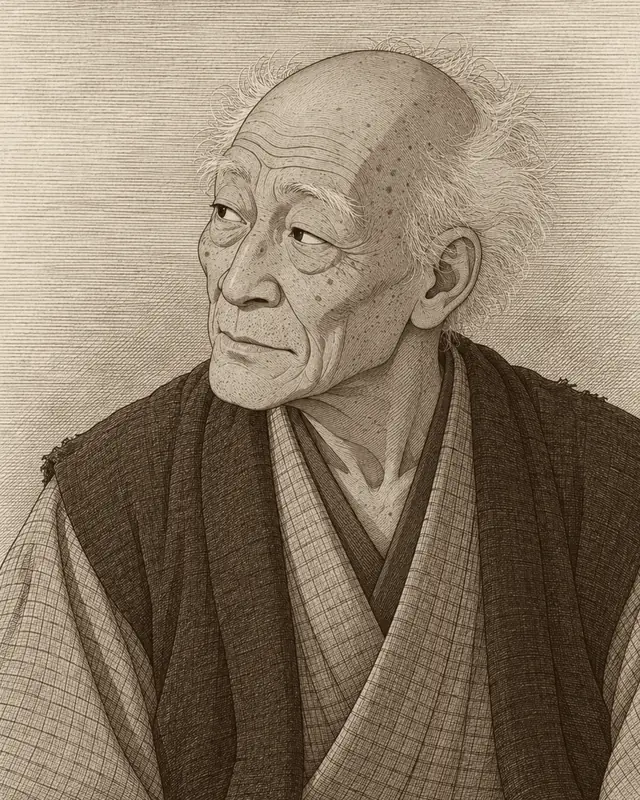
In a letter in which he called himself 'Miuraya Hachiemon', he described himself as having 'small eyes, a big nose and shaggy white hair', and drew his own profile. Beside it he drew the face of his daughter Ei (Katsushika Ōi), whom he described as 'a woman with a square jaw'. Record
Shimane Art Museum, 'Letter of Hokusai, with portraits of Hokusai and Oei' (北斎書簡(北斎・お栄似顔絵付)), Nagata Collection · quoted in a book edited by Kubota (久保田) (checked at the first stage of planning)
- 1848
In the postscript to Ehon saishikitsū (画本彩色通), published at 89 (by the traditional count), he wrote that from ninety he would change his style of painting, and that after a hundred his only wish was to renew this way of art. Record · Paraphrase (not checked against a scan of the original)
Ota Memorial Museum of Art, note article (17 April 2021) (transcription of the postscript) · Shimane Art Museum, 'Hokusai chronology' (北斎年譜) (1848, Ehon saishikitsū 画本彩色通, parts 1 and 2)
- 1848
His temporary lodging in Asakusa at this time is said to have been the ninety-third house he had moved to. The Sumida Hokusai Museum notes that he moved house more than ninety times in his life. Tradition
Shimane Art Museum, 'Hokusai chronology' (北斎年譜) (based on Katsushika Hokusai den) · Sumida Hokusai Museum, 'About Hokusai' (北斎について) ('といわれます', 'it is said')
- 1849
He died at about four in the morning (七ツ時) on the 18th day of the fourth lunar month, at his temporary lodging in the grounds of Henjō-in (遍照院) in Shōden-chō, Asakusa. That day his daughter Ei sent notice of his death to his pupil Hokushin (北岑), and the next day the funeral was held at Seikyō-ji (誓教寺) in Asakusa. His grave is also at this temple. Record
Shimane Art Museum, 'Hokusai chronology' (北斎年譜) (notice of Hokusai's death addressed to Hokushin, 北岑宛北斎死亡通知, Nagata Collection) · Ota Memorial Museum of Art, note article (17 April 2021) ('今暁七ツ時', 'at the seventh hour this morning'; grave at 誓教寺)