- 1853
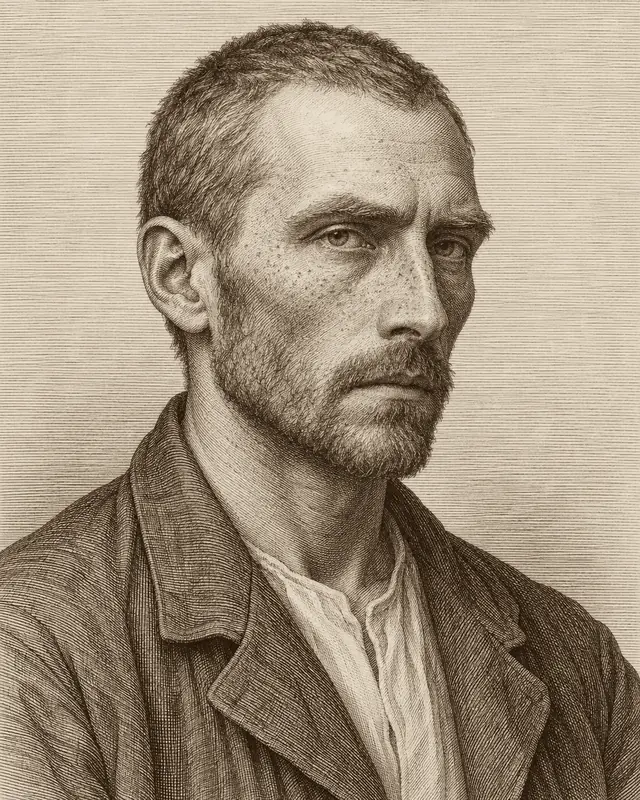
On 30 March he was born in Zundert, a village in Dutch Brabant, the son of the minister Theodorus van Gogh and Anna Carbentus. Exactly one year earlier, on the same day, a brother with the same name had been stillborn. Record
Van Gogh Museum, 'Vincent van Gogh's Early Years' · birth registration, West Brabant Archives (Open Archieven, 'Vincent Willem van Gogh, 30 maart 1853, Zundert')
- 1869
At sixteen he joined the Hague branch of the international art dealers Goupil & Cie as an apprentice clerk. His uncle had arranged the post. Record
Van Gogh Museum, 'Vincent van Gogh's Early Years' · vangoghletters.org chronology (30 July 1869, apprentice at the Hague branch)
- 1873–76
He moved to work at Goupil's London branch (1873) and then its Paris branch (1875), and was dismissed with effect from 1 April 1876. Record
Van Gogh Museum, 'Vincent van Gogh's Search for His Purpose in Life' · vangoghletters.org chronology (London, May 1873; notice of dismissal on 4 January 1876 — letter 65)
- 1876–80
He worked as an assistant teacher at a boarding school in England and as a bookshop assistant in Dordrecht, and in Amsterdam he studied for the entrance examination in theology but gave it up. He then worked as a lay preacher in the Borinage, a coal-mining region of Belgium, but his contract was not renewed. Record · Paraphrase
Van Gogh Museum, 'Vincent van Gogh's Search for His Purpose in Life' · Van Gogh Museum FAQ, 'Why Did Van Gogh Become an Artist?' · vangoghletters.org chronology (Ramsgate 1876; Dordrecht and Amsterdam 1877; Borinage, December 1878)
- 1880
In a letter to Theo of 24 September he wrote that he would take up again the pencil he had put down in his deep discouragement, and go back to drawing. In October he moved to Brussels and began to study art. The Van Gogh Museum explains that he decided at twenty-seven to become an artist. Record · Paraphrase
Letter 158 (Cuesmes, 24 September 1880, to Theo) · Van Gogh Museum, 'Vincent van Gogh's Search for His Purpose in Life' · vangoghletters.org chronology (in August 1880 he decided to become an artist, 'probably at Theo's urging'; Brussels in October — letters 156 and 159)
- 1881–83
He learned to draw and paint at his parents' home in Etten and in The Hague. In The Hague the painter Anton Mauve, the husband of his cousin, taught him the basics of watercolour and oil painting. Record
Van Gogh Museum, 'Vincent van Gogh's First Steps as an Artist' · vangoghletters.org chronology
- 1883
In February he wrote to Theo that he felt he had to work twice as hard to make up for starting late. In August he wrote that he had started drawing relatively late, and estimated the time his body would hold out at, say, six to ten years. Record · Paraphrase
Letter 312 (The Hague, 11 February 1883, to Theo) · letter 371 (The Hague, on or about 7 August 1883, to Theo) — original text at vangoghletters.org
- 1883–85
In December he moved to his parents' home in Nuenen and painted peasants and weavers. After his father died at the end of March 1885, he painted The Potato Eaters. Record
Van Gogh Museum, 'Vincent van Gogh as a Peasant Painter' · vangoghletters.org chronology (Nuenen, December 1883; lithograph of The Potato Eaters sent in May–June 1885)
- 1885
In August he wrote to his friend, the painter Anthon van Rappard, that he always does what he cannot do yet, in order to learn to do it. Record · Paraphrase
Letter 528 (Nuenen, on or about 18 August 1885, to Van Rappard) — original text at vangoghletters.org
- 1885–86
In November he went to Antwerp and attended the art academy, then at the end of February 1886 he came without warning to Theo's home in Paris. He never went back to the Netherlands. Record
Van Gogh Museum, 'Vincent van Gogh as a Peasant Painter' (quoting the letter of 28 February 1886) · vangoghletters.org chronology (Antwerp, 24 November 1885; Paris, on or about 28 February 1886)
- 1886–87
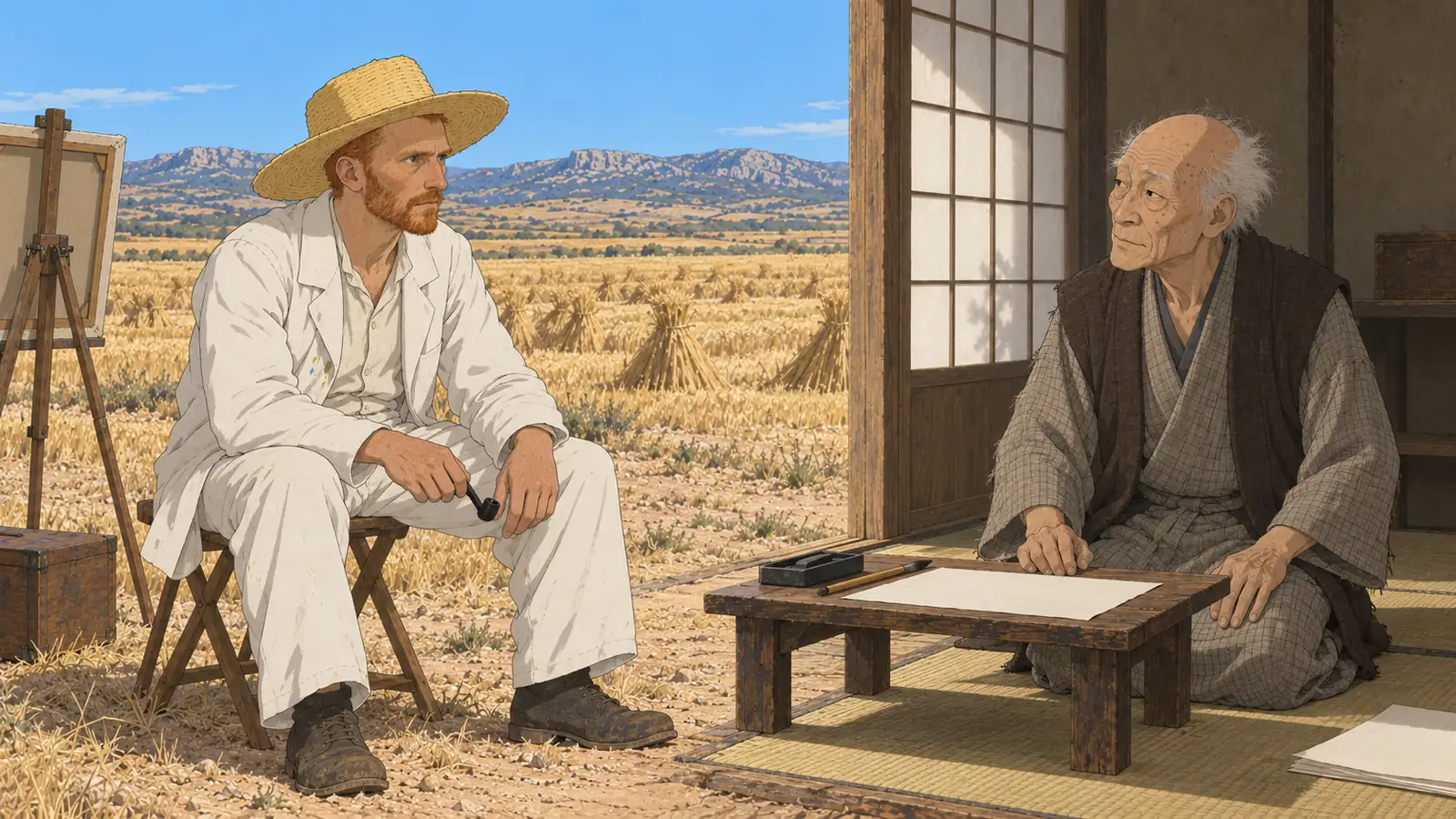
In Paris he attended Fernand Cormon's studio and befriended Toulouse-Lautrec, Émile Bernard and others, and his painting changed from dark colours to light ones. He collected Japanese prints with Theo, and in 1887 painted Flowering Plum Orchard and Bridge in the Rain after prints by Hiroshige. Record
Van Gogh Museum, 'Vincent van Gogh's Style: From Dark to Light' · Van Gogh Museum, 'Inspiration from Japan' · Van Gogh Museum collection s0115V1962 and s0114V1962 · vangoghletters.org chronology (Cormon's studio, March–June 1886)
- 1888
On 20 February he arrived in Arles in the south of France. Dreaming of a 'studio of the South' where painters would work together, on 1 May he rented four rooms in the Yellow House on Place Lamartine. Record
Van Gogh Museum, 'From Dark to Light' and 'Vincent van Gogh in the South of France' · vangoghletters.org chronology (Arles, 20 February 1888) · letter 602 (1 May 1888)
- 1888
In August he painted the Sunflowers series to decorate the studio he would share with Gauguin. The Sunflowers in the National Gallery, London, is the work he called in his letters the 'fourth picture': fourteen flowers on a yellow background. Record
Letters 666 (21–22 August 1888) and 668 (23–24 August 1888, note 2) · National Gallery, London, NG3863 commentary
- 1888
In September, after Theo wrote of Hokusai's waves in a letter, 'these waves are claws, the ship is caught in them', Van Gogh copied the words into his reply. The scholars of the letters edition take Theo to have meant Under the Wave off Kanagawa. Record · identifying the print is interpretation
Letter 676 (Arles, 8 September 1888), original "ces vagues sont des griffes, le vaisseau est pris là-dedans" · note 16 to the same letter ("Theo must have written about … The great wave")
- 1888
On 23 October Gauguin came to the Yellow House. On 23 December, during an attack, Van Gogh cut off his own left ear, and the next day he was taken to hospital. Later he could remember almost nothing of it. Record
Van Gogh Museum FAQ, 'Why Did Vincent van Gogh Cut off His Ear?' · Van Gogh Museum, 'Vincent van Gogh in the South of France' · vangoghletters.org chronology (Gauguin's arrival, 23 October 1888; first attack, 23 December — letter 728)
- 1889
On 8 May, at his own wish, he entered the asylum of Saint-Paul-de-Mausole in Saint-Rémy. Despite repeated attacks he painted about 150 works in a year, and in June he painted The Starry Night. Record
Van Gogh Museum, 'Vincent van Gogh's Hospitalization' · vangoghletters.org chronology (8 May 1889, letter 769) · letter 760 (21 April 1889), note 4 · MoMA 472.1941 (June 1889)
- 1890
In January the critic Albert Aurier published an article on him alone in the Mercure de France. Around the same time six of his paintings were shown at the exhibition of Les XX in Brussels, and the painter Anna Boch bought one of them, The Red Vineyard. In March ten of his works were shown at the Salon des Indépendants in Paris. Record
Van Gogh Museum, 'Vincent van Gogh's Hospitalization' · vangoghletters.org chronology (Les XX, 28 January–23 February 1890, six works; bought by Anna Boch — letter 855) · letter 845, note 2 (Aurier, January 1890)
- 1890
On 20 May he moved to Auvers-sur-Oise near Paris and painted almost one work a day. On 27 July he shot himself in the chest in a field, and on 29 July he died with Theo at his side. On 30 July he was buried at Auvers. Record
Van Gogh Museum, 'Vincent van Gogh's Final Months' and 'Van Gogh's Death' · vangoghletters.org chronology (20 May, 27 July, 29 July and 30 July 1890)
- 1891–1914
Theo died in Utrecht on 25 January 1891. Theo's wife, Jo van Gogh-Bonger, took charge of the paintings and lent them to exhibitions, and in 1914 she first published Vincent's letters to Theo as a book. Record
Van Gogh Museum, 'What Happened After Vincent Van Gogh's Death?' · vangoghletters.org chronology (25 January 1891)
- 1973
On 2 June the Van Gogh Museum opened in Amsterdam, built on the collection that his nephew Vincent Willem van Gogh had handed over to a foundation. Record
Van Gogh Museum, 'What Happened After Vincent Van Gogh's Death?' · Van Gogh Museum, 'Without Family, No Museum'