Great Games of Thought · Game 11 · · 10 min 18 s · 7 primary sources · 5 studies
Why Write the Same Day Twice?
Yi Sun-sin×Aurelius
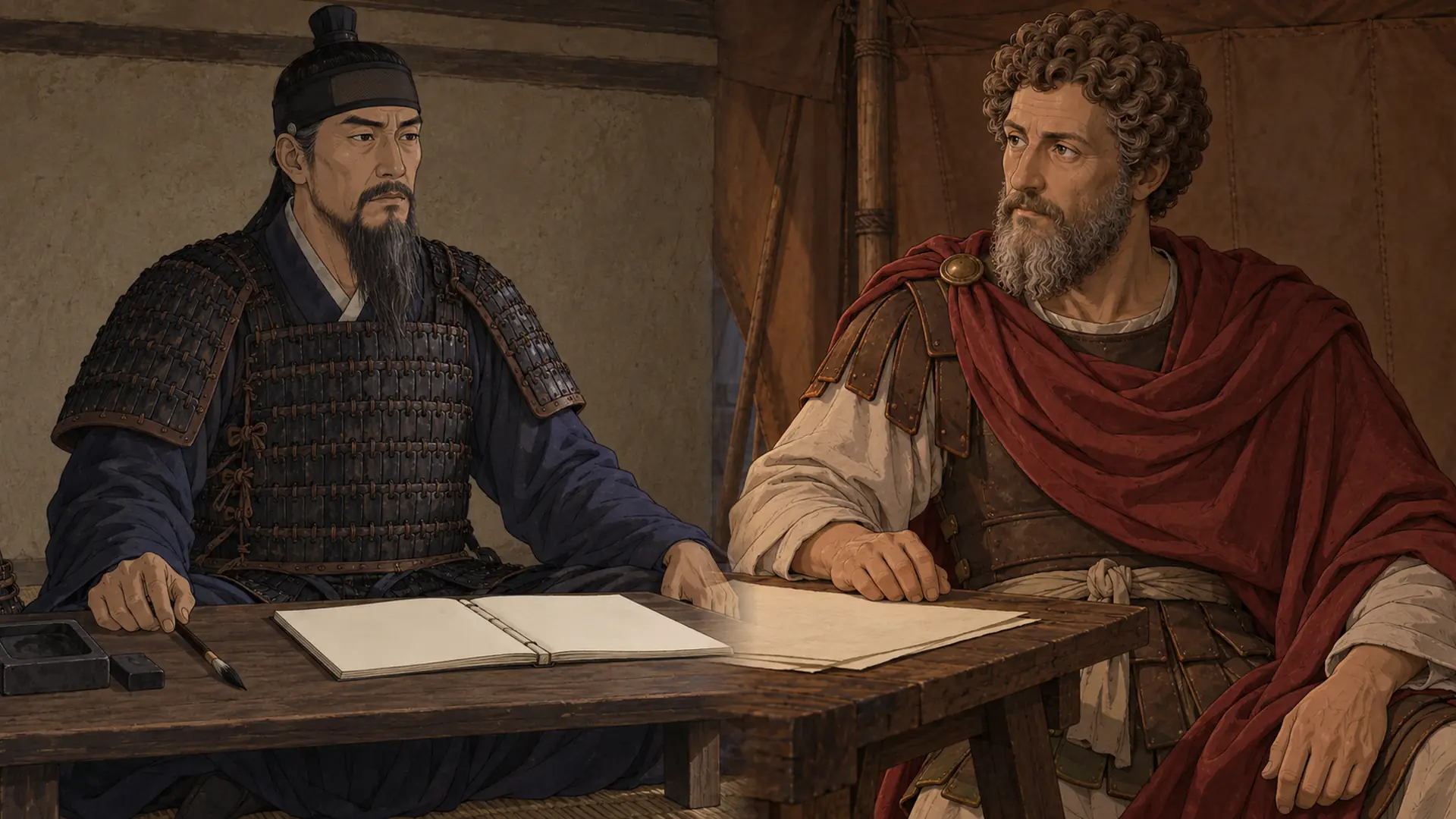
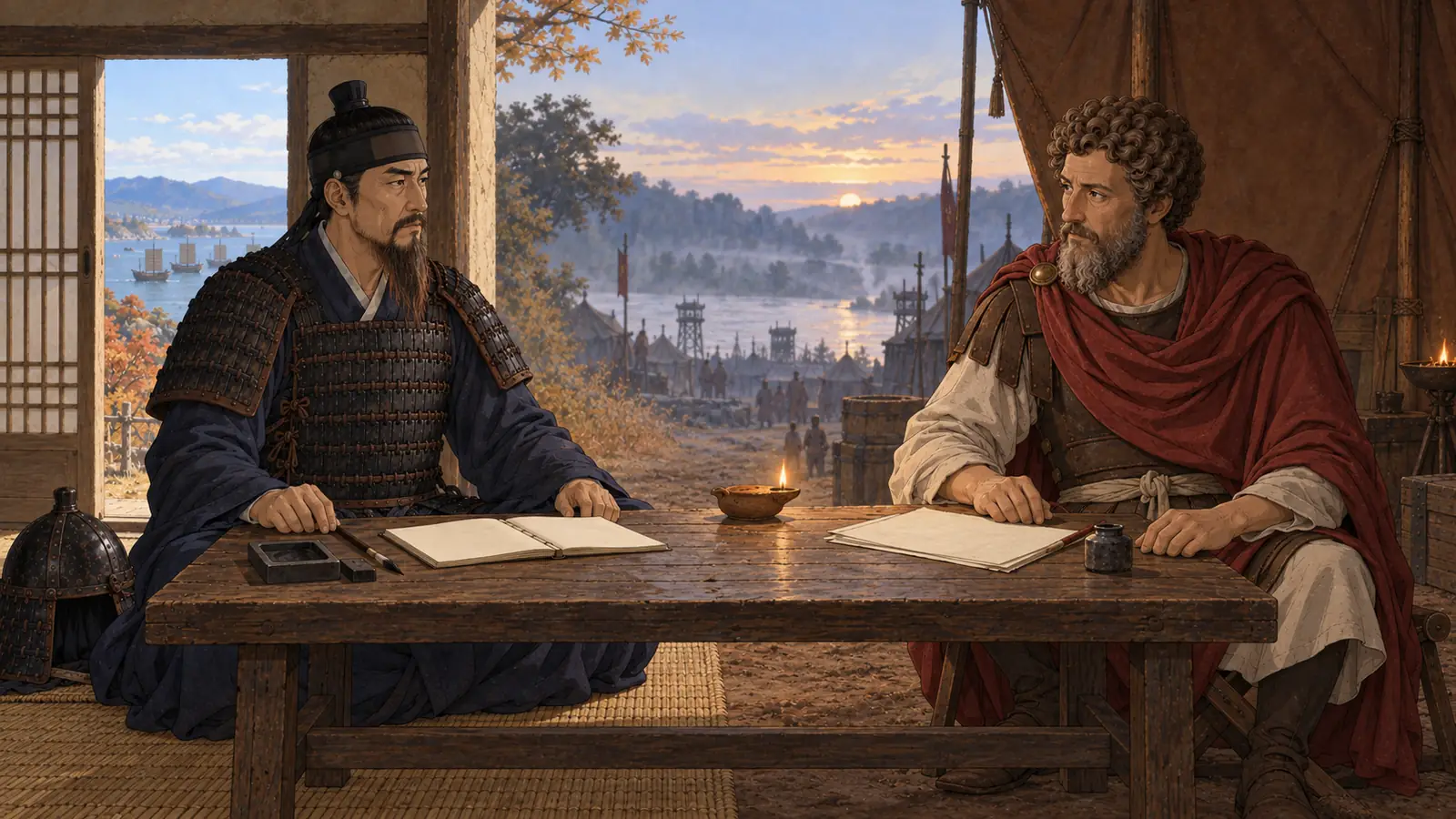
Why did Yi Sun-sin write the same day in his diary twice? We look for an answer to what to write on a hard day in Yi Sun-sin, the Joseon commander who wrote down even his weeping, saying "I cannot write it all," and Marcus Aurelius, the Roman emperor who wrote to himself to add nothing more to what happened.
Watch on YouTube (10:18) · English version
Chapters · tap to jump
- Why did Yi Sun-sin write the same day in his diary twice?
- The Day He Wrote Down His Weeping
- Yi Sun-sin and Aurelius
- Great Games of Thought — On the Day You Fall Apart, What Should You Write?
- Why Write the Same Day Twice?
- Famous Words Not in Their Writings
- One Thing in Common
- Seeing Yourself from the Outside
- My View
- My Answer · One Line Tonight · The Last Question
The Two
Yi Sun-sin and Aurelius
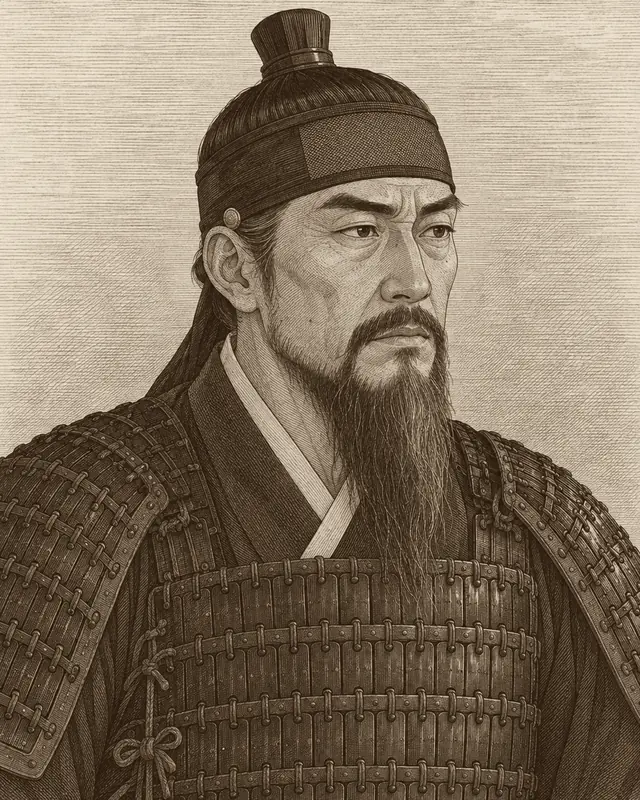 An imagined portrait
Yi Sun-sin, the Joseon commander who wrote down even his weeping
My heart is torn apart; I cannot write it all. I set it down afterward, roughly.Reconstruction
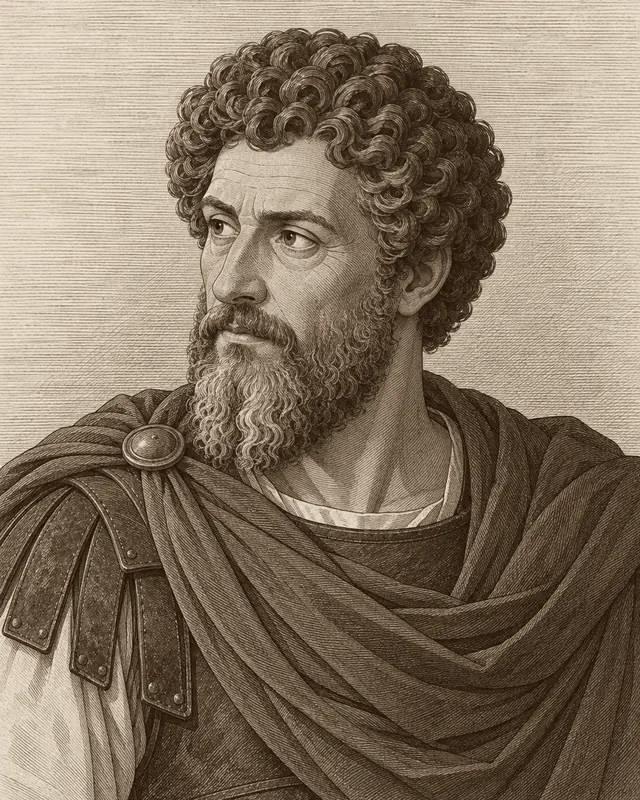 An imagined portrait
Marcus Aurelius, the Roman emperor who wrote to himself to add nothing more to what happened
Add nothing to what has happened. Do not tell yourself more than what you first saw.Reconstruction
Twist → Essence
And yet the two of them had one thing in common
once the writing was done, each had a battlefield he had to go back to.
Read
Script and sources
The video's English subtitles, line by line. [Record] confirmed in documents · [Paraphrase] the original, shortened · [Later record] a record left later by someone other than the person · [No record] words not found in the person's own writings or records · [Interpretation] scholars' or the host's interpretation
Script
66 lines · 10 chapters
The small words at the bottom right tell you, whenever the picture changes, what kind of image it is (actual bust, actual coin, original text newly typeset, drawn from a bust, drawn from a reconstruction, imagined scene, and so on). The diary screens are the transcription of the handwritten diary (Korea's National Heritage Portal), newly typeset over old paper; the experiment scenes are redrawn as illustrations. All diary dates are in the lunar calendar.
0:00 · Why did Yi Sun-sin write the same day in his diary twice?
Those who are ready to die will live. These words of Yi Sun-sin, from the eve of the Battle of Myeongnyang, are not in the first diary entry for that day.
0:39 · The Day He Wrote Down His Weeping
Released from prison, he was heading south, stripped of any rank. His mother was on her way to him by boat.
My heart is torn apart; I cannot write it all. I set it down afterward, roughly.
Reconstruction
At dawn, tell yourself in advance: today I will meet the ungrateful and the deceitful.
Reconstruction
1:27 · Yi Sun-sin and Aurelius
Yi Sun-sin. The commander who led Joseon's navy during the Imjin War, when Japan invaded Korea. This diary, which he wrote on the battlefield, would later be inscribed on UNESCO's Memory of the World Register.
Aurelius left behind the Meditations. Scholars generally take the view that it was not written for others to see.
1:49 · Great Games of Thought — On the Day You Fall Apart, What Should You Write?
This is an imagined meeting, woven from the writings of two men who never met. First question. On the day you fall apart, what should you write?
Between heaven and earth, where else could there be anything like what has befallen me?
Reconstruction
Add nothing to what has happened. Do not tell yourself more than what you first saw.
Reconstruction
The emperor's way of steadying himself was not pressing everything down. Even when what happens is out of my hands, the judgment I attach to it is in my hands.
Pour it out, or steady yourself? In the autumn of that year, Yi Sun-sin's diary falls apart even further.
On the envelope, two characters: "Bitter weeping." His youngest son, Myeon, had been killed in battle.
That I should die and you should live is the order of things. Yet you are dead, and I am alive. Each night passes like a year.
Reconstruction
His diary, two days later: unable even to weep aloud as he wished, he went to the house of a salt-maker.
People seek out the seashore and the mountains. But you can withdraw into yourself, whenever you wish.
Reconstruction
One man had nowhere he could even weep freely. The other wrote that the place to withdraw to was within himself.
In Yi Sun-sin's weeping there was a question: how could the order of things be so broken? The emperor repeatedly wrote that everything happens according to the nature of the whole.
3:40 · Why Write the Same Day Twice?
From August to October 1597. A little over two months of the diary overlap across two volumes. Why he wrote it again is not recorded anywhere.
The first version of the eve of Myeongnyang is short. "Went to the waters off Usuyeong and stayed the night. Many strange omens in my dreams."
The art of war says: those who are ready to die will live, and those who are bent on living will die. Those words are about us, now.
Reconstruction
These were not words Yi Sun-sin made up. They are a passage from an old book on the art of war. In the rewritten diary, he set that passage down as the pledge he made to his captains that day.
This is as far as the record takes us. The fact that he wrote it twice, we'll keep as the last key of this game.
What you think about often becomes the very shape of your mind. For the soul is dyed by its thoughts.
Reconstruction
Take care that you are not dyed in the emperor's color. For it does happen.
Reconstruction
This is how the emperor wrote himself little scoldings. So that the throne would not dye him.
5:05 · Famous Words Not in Their Writings
Those who are ready to die will live. These words, at least, are in Yi Sun-sin's writing. But among the sayings known as theirs, there are also words that are not in their writings.
There is a saying attributed to Japan's Admiral Tōgō Heihachirō: "You may compare me to Britain's Nelson, but not to Yi Sun-sin." No record of Tōgō actually saying this has been found so far.
"I, your servant, still have twelve ships." These words are not in the diary either. They come down to us, undated, in an account of Yi Sun-sin's life written later by his nephew.
"Live a good life. If there are gods and they are just, they will not care how devout you have been, but how you have lived." These lines, passed around as a quote from Marcus Aurelius, are nowhere in the Meditations.
That is why what a person left behind in their own writing is precious. It is there that what they really thought stays closest to us.
6:04 · One Thing in Common
The general who poured it out, and the emperor who steadied himself. And yet the two of them had one thing in common.
The night he heard of his son's death. Even that day's entry ends with the words that rain began late at night. From the next day on, beside the weeping, he writes again of wind and rain, of ships, of his captains' affairs.
The emperor wrote this, too: a few short, fundamental principles are enough. Enough to send himself back, without resentment, to the work he returns to.
6:45 · Seeing Yourself from the Outside
The ability to step back and watch yourself thinking. Psychology calls this metacognition.
A study from 2014. Picturing the same kind of quarrel, people reasoned more wisely when it was a friend's. When it was their own, less so. But when they were asked to look at their own as if from a distance, like someone else's, the gap disappeared.
Another experiment the same year. People about to give a nerve-racking speech. They were asked to reflect on themselves using their own name or "you" instead of "I." Those who did got higher scores from the evaluators. And after the speech, they felt less shame.
It is like the emperor, who called himself "you" as he wrote himself scoldings. But these studies were short experiments lasting a few minutes. It does not mean that a diary is a cure.
7:50 · My View
The two are not different at all. For some people, every single day is one battlefield after another; so all that differs is how hard, and how often, they must steady themselves.
Why are they one? In engineering terms, it's because a diary is the work of looking at yourself objectively, and so raising your metacognition.
When I pour my weeping out onto the page, the weeping inside me becomes letters on paper. In that moment, for the first time, I see myself from the outside. Writing that steadies is speaking to myself from that outside. Yi Sun-sin, who wrote the same day twice. In him, as I see it, both of these happened together.
And we must write on the brief days of peace, too. That is how the blade keeps from going dull.
The emperor wrote something similar: to keep giving himself this retreat inward, constantly, and to renew himself.
The emperor's retreat resembles the strength to embrace the swaying and come back. I'd like to call this strength virtue.
But trying to look, as deeply as I can, into how I myself think and feel, even into the self beyond my unconscious. That is my part, and it must not be handed over.
9:22 · My Answer · One Line Tonight · The Last Question
So this is my answer. Whether you pour it out or steady yourself, writing is one thing: seeing yourself again from the outside, and setting yourself upright again.
Tonight, try writing just one line. One thing that happened today. And then one line: what you would have told a friend, if it had happened to them.
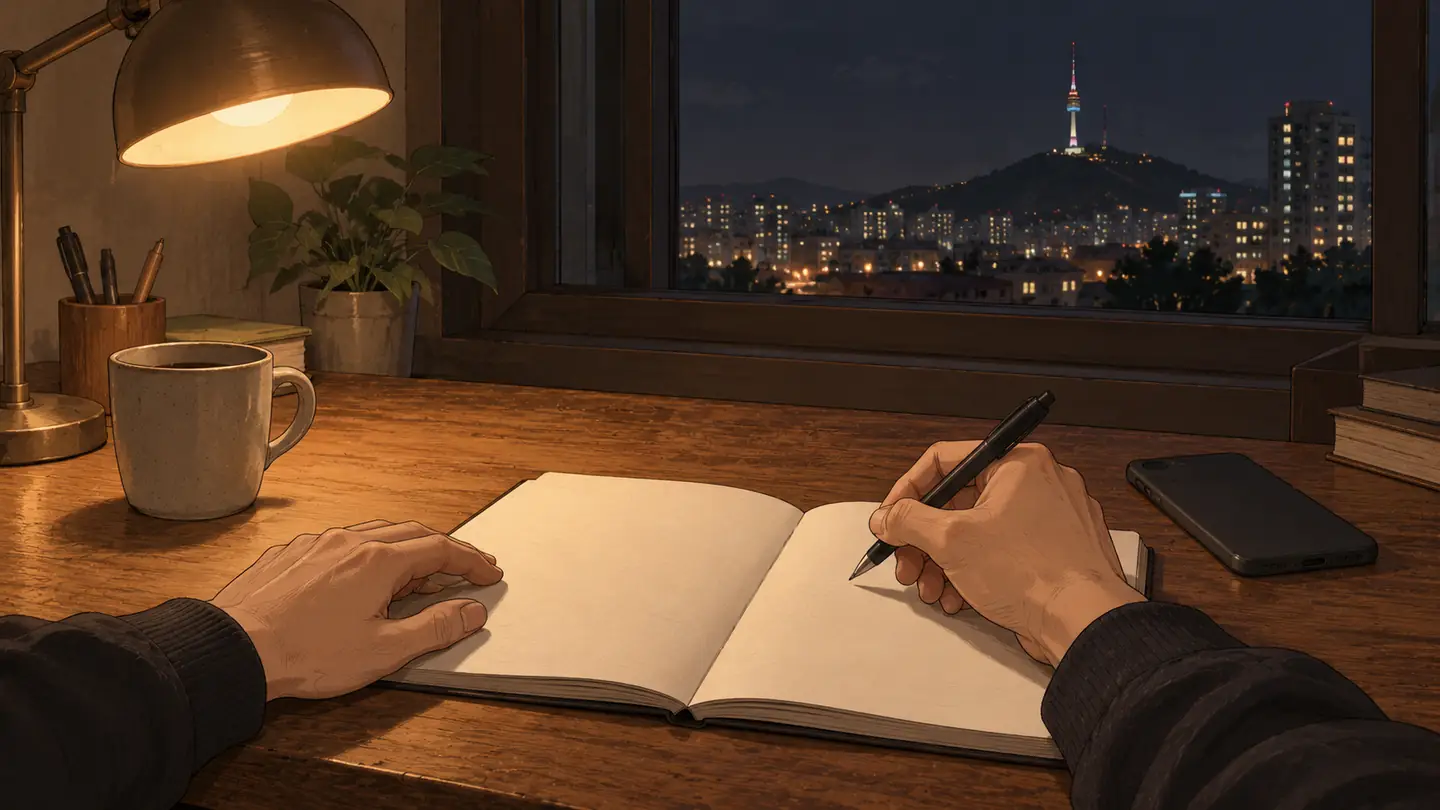
One last question. Today, what did you steady yourself against? Or what did you need to pour out?
Sources and research
7 primary sources · 5 studies
Sources are listed in their original Korean.
- Record「반드시 죽고자 하면 살고, 반드시 살고자 하면 죽는다」는 다시 쓴 일기(제6책 속정유일기) 1597년 9월 15일(일기 날짜는 모두 음력) 「招集諸將約束曰 兵法云 必死則生 必生則死 … 今我之謂矣」에만 있고, 처음 적은 일기(제5책 정유일기) 같은 날은 「潮水率諸船入于右水營前洋 因留宿 夜夢多異祥」 · 이 구절은 병법서 『오자』 「치병」 「必死則生,幸生則死」에서 온 말
- Record두 책은 1597년 8월 4일~10월 8일이 겹침 · 다시 쓴 까닭은 기록에 없음(한국민족문화대백과 「무슨 이유로 다시 썼는지 알 수 없다」)
- Record · Paraphrase1597년 4월 1일 옥에서 풀려나 벼슬 없이 종군 · 4월 12일 어머니가 배로 올라오는 중 · 4월 13일 부고가 배 안에서 오고 해암에 가니 배가 이미 와 있었음 「至自船中 告天只訃 … 船已至矣」(디지털아산문화대전 「선상에서」) · 「路望慟裂 不可盡記 追錄草草」 — 이 며칠 치는 뒤에 몰아 적은 것으로 읽힘(「草草」는 친필에만)
- Record4월 19일 「天地安有如吾之事乎」
- Record · Paraphrase10월 14일 집에서 온 편지 「未開封 骨肉先動」 「外面書慟哭二字 心知葂戰死」 「我死汝生 理之常也 汝死我生 何理之乖也」 「度夜如年」, 같은 날 끝 「是二更雨作」 · 10월 15일 「風雨終日 … 乘小船」 · 10월 16일 「不能任情痛哭 到于鹽干姜莫只家」(그 집으로 「갔다」까지) · 10월 17일 「大風終日」 — 친필 속정유일기, 『이충무공전서』(1795) 권8과 대조
- Later record「신에게는 아직 열두 척의 배가 있습니다」(今臣戰船尙有十二): 일기에는 없고, 조카 이분의 「행록」(『이충무공전서』 권9)이 9월 7일 기사 뒤·명량 앞에 날짜 없이 전함
- No record도고 제독의 「넬슨에는 비할 수 있어도 이순신에는 비할 수 없다」: 도고가 그렇게 말한 기록은 지금까지 확인된 것이 없음 — 석영달·김준배, 『역사문화연구』 92 (2024)의 기원 추적 · 조선일보 2025.4.12(완성된 꼴은 1955년 신문 칼럼에서 처음)
- No record「좋은 삶을 살라. 신들이 정의롭다면 …」: 『명상록』에 없음(영역 두 판본 전문 대조, 가장 가까운 2.11은 결이 다름)
- Record이순신 1545~1598 · 친필 일기는 국보(1962 지정, 옛 제76호), 유네스코 세계기록유산(2013) · 「난중일기」라는 이름은 1795년 『이충무공전서』를 엮을 때 붙음
- Record · Paraphrase『명상록』(그리스어 Farquharson 1944·Leopold 1908 두 판본, Long 영역 대조): 2.1 새벽에 스스로에게 미리 말해 두라(여섯 부류 중 둘만) · 8.49 처음 인상이 전하는 것보다 더 스스로에게 말하지 말라 · 8.47 괴로움은 일이 아니라 그 일에 대한 네 판단에서 오고, 판단은 네게 달렸다 · 누가 네가 판단을 바로잡는 것을 막는가 · 4.3 사람들은 시골·바닷가·산을 찾지만 언제든 자기 안으로 물러날 수 있다 · 짧고 근본적인 원칙이면 돌아갈 일로 언짢음 없이 돌려보내기에 넉넉하다 · 이 물러남을 끊임없이 스스로에게 주고 자신을 새롭게 하라 · 5.16 영혼은 생각에 물든다 · 6.30 황제 물이 들지 않도록 조심하라 · 12.26 모든 일은 온 자연의 이치를 따른다
- Record · Interpretation아우렐리우스 121~180, 161년부터 황제 · 재위 후반 다뉴브 북쪽 부족과 전쟁(카시우스 디오 『로마사』 72권) · 『명상록』의 적어도 일부는 원정 중에 썼고, 남에게 보이려 쓴 글이 아니라는 것이 학계의 대체적 견해(SEP·IEP) · 날짜 없는 노트이고, 자필 원본 없이 사본으로 전함 · 「천팔백오십 년쯤 전」은 170년대를 2026년에서 셈
- Record메타인지의 정의 「knowledge and cognition about cognitive phenomena」: Flavell, American Psychologist 34(10):906–911 (1979)
- Record같은 다툼을 상상해도 친구의 일일 때 더 지혜롭게 따졌고, 자기 일을 떨어져서 생각하게 하자 차이가 사라짐: Grossmann & Kross, Psychological Science 25(8):1571–1580 (2014) · 그 차이의 크기는 작음~중간(d≈0.32): Lin, Zheng & Wang, Frontiers in Psychology (2023) 메타분석
- Record발표 앞에서 「나는」 대신 자기 이름·「너」로 돌아본 무리가 평가자 점수가 높고 발표 뒤 부끄러움이 덜함: Kross 외, J. Pers. Soc. Psychol. 106(2):304–324 (2014) 실험 3
- Interpretation두 연구 모두 몇 분짜리 짧은 실험이고 같은 연구자가 함께해 독립된 재현은 제한적 · 「같은 날을 두 번 쓴 이순신 안에서 두 일이 함께 일어났다」는 진행자의 생각(이순신이 그런 뜻으로 다시 썼다는 기록은 없음)
Photo credits
Public Domain: Bust of Marcus Aurelius, Glyptothek, Munich · photo Bibi Saint-Pol — Wikimedia Commons
CC BY 2.0: Silver denarius of Marcus Aurelius (c. AD 174–175), The British Museum · Andrew Brown / Portable Antiquities Scheme (FindID 973094) — Wikimedia Commons · Changes: obverse only, cropped and placed on a paper-coloured background
All other figures and scenes are imagined depictions based on the records, the bust and reconstructions.
If you find a mistake, please tell us in the video's comments. We will check it and correct it. How We Check Facts
One last question. Today, what did you steady yourself against? Or what did you need to pour out?
Share your thoughts in the YouTube commentsKeep watching
Other games
 0112:22
Game 1·Schopenhauer×Hegel
Why You Crave Ramen at Midnight
 0213:44
Game 2·Zhuangzi×Turing
If AI Does All My Work, What Should I Do Next?
 0313:46
Game 3·Spinoza×Wonhyo
Why do we always regret it after we snap?
 0413:20
Game 4·Franklin×Keynes
Why Hard Work Alone Doesn't Make You Rich
 0511:12
Game 5·Sejong the Great×Leibniz
Could Writing Speech As It Is Change the World?
 0710:18
Game 7·Eckhart×Naong
What Gets You Through a Hard Day?
 0910:51
Game 9·Van Gogh×Hokusai