Great Games of Thought
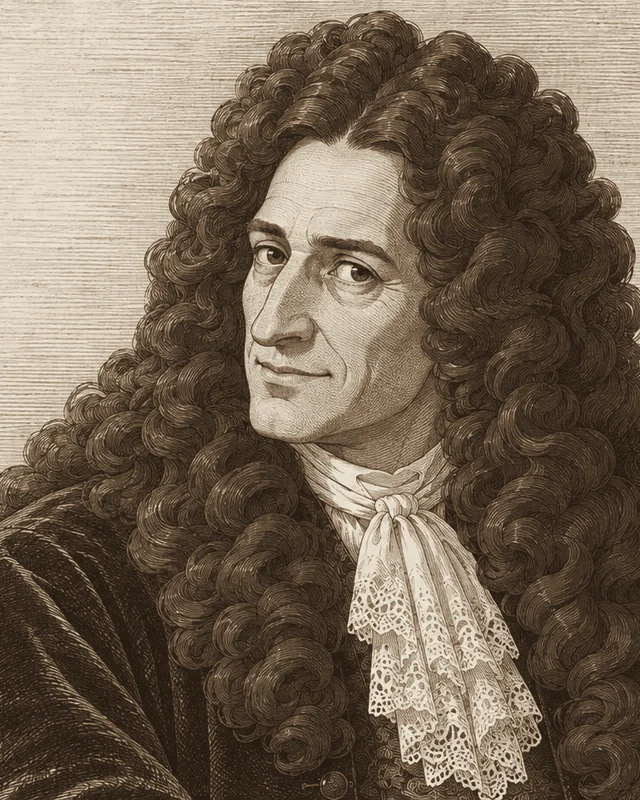
Leibniz — an imagined portraitAn imagined portrait

Gottfried Wilhelm Leibniz

1646–1716

Leibniz, who dreamed of calculating thought

If thoughts are written in signs, the mistakes would be visible at a glance.
Game 5 · Reconstruction; paraphrase; The Art of Discovery (1685)

Overview

Leibniz was a German philosopher and mathematician born in Leipzig in 1646. Record

From 1676 until his death in 1716 he worked at the court of Hanover, in charge of the library and as a counsellor. Record

He created the calculus independently of Newton, and the integral sign ∫ that he used is still in use today. Record

He developed binary notation, which writes every number with only 0 and 1, and he dreamed of a 'universal characteristic' that would write down human thought so that it could be calculated. Record

Scholars see his binary notation, his calculating machine and his plans for a logical calculus as part of the foundations of today's computer technology. Interpretation · NDB (Schepers) · Leibniz Association

Timeline

  1. 1646

    He was born in Leipzig on 1 July (21 June in the Old Style calendar then in use). Record

    NDB vol. 14 (1985), pp. 121–131, 'Leibniz' (Heinrich Schepers, deutsche-biographie.de/sfz49946.html) · MacTutor 'Gottfried Wilhelm von Leibniz' (mathshistory.st-andrews.ac.uk/Biographies/Leibniz/) · SEP 'Gottfried Wilhelm Leibniz' (plato.stanford.edu/entries/leibniz/)

  2. 1666

    He published On the Art of Combinations, attempting to explain thought and discovery as combinations of basic elements. Record

    MacTutor 'Gottfried Wilhelm von Leibniz' (mathshistory.st-andrews.ac.uk/Biographies/Leibniz/) · SEP 'Gottfried Wilhelm Leibniz' (plato.stanford.edu/entries/leibniz/)

  3. 1672

    On a diplomatic mission for the Elector of Mainz he went to Paris, where he stayed until 1676. Record

    SEP 'Gottfried Wilhelm Leibniz' (plato.stanford.edu/entries/leibniz/) · MacTutor 'Gottfried Wilhelm von Leibniz' (mathshistory.st-andrews.ac.uk/Biographies/Leibniz/)

  4. 1673

    He went to London and showed a model of his calculating machine to the Royal Society, becoming a Fellow of the Royal Society in April that year. Record

    MacTutor 'Gottfried Wilhelm von Leibniz' (mathshistory.st-andrews.ac.uk/Biographies/Leibniz/) · NDB vol. 14 (1985), pp. 121–131, 'Leibniz' (Heinrich Schepers, deutsche-biographie.de/sfz49946.html) · SEP 'Gottfried Wilhelm Leibniz' (plato.stanford.edu/entries/leibniz/)

  5. 1675

    He first used the integral sign ∫ in a manuscript dated 29 October 1675, and in November wrote it in the form ∫ f(x)dx. Around this time he laid down the framework of the calculus. Record

    Cajori, A History of Mathematical Notations, vol. 2, §570 (manuscript of 29 October 1675, Analyseos tetragonisticae pars secunda, quoted at jeff560.tripod.com) · MacTutor 'Gottfried Wilhelm von Leibniz' (the form ∫ f(x)dx, 21 November 1675, mathshistory.st-andrews.ac.uk/Biographies/Leibniz/) · IEP 'Leibniz, Gottfried Wilhelm' (Glowienka, iep.utm.edu/leib-ove/) · Leibniz-Gemeinschaft 'Gottfried Wilhelm Leibniz' (leibniz-gemeinschaft.de)

  6. 1676

    He took charge of the court library of Duke Johann Friedrich of Hanover, and in November, on his way to Hanover, he met Spinoza in The Hague. Record

    SEP 'Gottfried Wilhelm Leibniz' (plato.stanford.edu/entries/leibniz/) (used only for the date of the meeting — the SEP wrongly gives the place as Amsterdam, so it is not used for the place) · IEP 'Leibniz, Gottfried Wilhelm' (Glowienka, iep.utm.edu/leib-ove/) · NDB vol. 14 (1985), pp. 121–131, 'Leibniz' (Heinrich Schepers, deutsche-biographie.de/sfz49946.html)

  7. 1679

    He worked out binary notation, which writes numbers with 0 and 1, and also left a design for a calculating machine that worked in binary. Record

    NDB vol. 14 (1985), pp. 121–131, 'Leibniz' (Heinrich Schepers, deutsche-biographie.de/sfz49946.html) · MacTutor 'Gottfried Wilhelm von Leibniz' (mathshistory.st-andrews.ac.uk/Biographies/Leibniz/)

  8. 1684

    He published his paper on differential calculus, 'Nova Methodus pro Maximis et Minimis', in the October issue of the journal Acta Eruditorum. Record

    MacTutor 'Gottfried Wilhelm von Leibniz' (mathshistory.st-andrews.ac.uk/Biographies/Leibniz/) · Samuel V. Lemley, The Library 22(2) (2021)

  9. 1700

    In July he became the first president of the Brandenburg Society of Sciences, founded in Berlin. Record

    MacTutor 'Gottfried Wilhelm von Leibniz' (mathshistory.st-andrews.ac.uk/Biographies/Leibniz/) · Leibniz-Gemeinschaft 'Gottfried Wilhelm Leibniz' (leibniz-gemeinschaft.de) · NDB vol. 14 (1985), pp. 121–131, 'Leibniz' (Heinrich Schepers, deutsche-biographie.de/sfz49946.html)

  10. 1703

    After receiving a diagram of the arrangement of the hexagrams that the missionary Bouvet had sent from Beijing in November 1701, he published his 'Explanation of Binary Arithmetic' in the 1703 memoirs of the Royal Academy of Sciences in Paris. Record

    Swiderski, Eighteenth-Century Studies (1980), 'Bouvet and Leibniz' · Ehrke, 'Binary Arithmetic: From Leibniz to von Neumann' · title of the original paper (HAL copy, 'Académie royale des sciences - Année 1703')

  11. 1704

    He finished the New Essays on Human Understanding, his reply to Locke's book. It was first published in 1765, after his death. Record

    SEP 'Gottfried Wilhelm Leibniz' (plato.stanford.edu/entries/leibniz/) · Oeuvres philosophiques, ed. Raspe (Amsterdam and Leipzig, 1765, archive.org/details/oeuvresphilosoph00leibuoft)

  12. 1710

    He published the Theodicy, on the goodness of God and the evil in the world. Record

    MacTutor 'Gottfried Wilhelm von Leibniz' (mathshistory.st-andrews.ac.uk/Biographies/Leibniz/) · IEP 'Leibniz, Gottfried Wilhelm' (Glowienka, iep.utm.edu/leib-ove/)

  13. 1712–1713

    A report by a committee of the Royal Society, siding with Newton on who had created the calculus first, came out as the Commercium epistolicum. Its title page is dated 1712, and the book circulated at the beginning of 1713. Record

    MacTutor 'Gottfried Wilhelm von Leibniz' (near the beginning of 1713, mathshistory.st-andrews.ac.uk/Biographies/Leibniz/) · MAA Convergence, 'Mathematical Treasure: John Collins's Commercium Epistolicum' (title page 1712) old.maa.org · NDB vol. 14 (1985), pp. 121–131, 'Leibniz' (Heinrich Schepers, deutsche-biographie.de/sfz49946.html)

  14. 1714

    He wrote the Monadology, a short summary of his philosophy. Record

    MacTutor 'Gottfried Wilhelm von Leibniz' (mathshistory.st-andrews.ac.uk/Biographies/Leibniz/) · IEP 'Leibniz, Gottfried Wilhelm' (Glowienka, iep.utm.edu/leib-ove/) · SEP 'Gottfried Wilhelm Leibniz' (plato.stanford.edu/entries/leibniz/)

  15. 1716

    He died in Hanover on 14 November. Record

    NDB vol. 14 (1985), pp. 121–131, 'Leibniz' (Heinrich Schepers, deutsche-biographie.de/sfz49946.html) · MacTutor 'Gottfried Wilhelm von Leibniz' (mathshistory.st-andrews.ac.uk/Biographies/Leibniz/) · Leibniz-Gemeinschaft 'Gottfried Wilhelm Leibniz' (leibniz-gemeinschaft.de)

Key ideas

Signs that write down thought so that it can be calculated

From On the Art of Combinations (1666) onward, Leibniz sketched plans for a 'universal characteristic' and a logical calculus. The idea is that if concepts are broken down into basic elements and written in signs, reasoning can be done like calculation. He left many drafts of a logical calculus but did not publish them in his lifetime; pieces such as the 1686 'General Inquiries on the Analysis of Concepts and Truths', which scholars count among his mature logical writings, were first printed in Couturat's 1903 collection. Record · Paraphrase

SEP 'Leibniz' · SEP 'Leibniz's Influence on 19th Century Logic' (Peckhaus) · IEP 'Leibniz: Logic' (Lenzen) · Gerhardt edition, Philosophische Schriften, vol. 7, p. 200

With 0 and 1, every number can be written

Binary notation carries to the next place at every 2 rather than every 10, writing every number with only two characters, 0 and 1. He worked it out around 1679, and in the title of his 1703 paper he described it as 'binary arithmetic, which uses only the characters 0 and 1'. Record · Paraphrase

'Explication de l'arithmétique binaire, qui se sert des seuls caractères 0 & 1 …' (1703) · NDB vol. 14 (1985), pp. 121–131, 'Leibniz' (Heinrich Schepers, deutsche-biographie.de/sfz49946.html) · Leibniz-Gemeinschaft 'Gottfried Wilhelm Leibniz' (leibniz-gemeinschaft.de)

The world is made of simple substances, 'monads'

The Monadology defines the monad as a simple substance without parts and says that monads come together to form composites. The book, from 1714, is a short summary of his philosophy. Record · Paraphrase

Monadology, §1 (Gerhardt edition on Wikisource · checked against IntraText) · IEP 'Leibniz, Gottfried Wilhelm' (Glowienka, iep.utm.edu/leib-ove/) · MacTutor 'Gottfried Wilhelm von Leibniz' (mathshistory.st-andrews.ac.uk/Biographies/Leibniz/)

The best of all possible worlds

Sections 53–55 of the Monadology explain that there are infinitely many possible universes but only one can exist, so God chose the best of them. In the Theodicy of 1710 he used this idea to address the problem of evil in the world. He did not say that the world is perfect. Record · Paraphrase

Monadology, §§53–55 · MacTutor 'Gottfried Wilhelm von Leibniz' (mathshistory.st-andrews.ac.uk/Biographies/Leibniz/) ("the universe is the best possible without being perfect") · IEP 'Leibniz, Gottfried Wilhelm' (Glowienka, iep.utm.edu/leib-ove/)

Language is the mirror of the human mind

At the end of Book 3, Chapter 7 of the New Essays on Human Understanding, he wrote that languages are the best mirror of the human mind. He added that an exact examination of what words mean would reveal the workings of thought better than anything else. Record · Paraphrase

New Essays on Human Understanding, end of Book 3, Ch. 7 (Raspe edition 1765 · Flammarion 1921, checked against the original text on archive.org)

In their words

languages are the best mirror of the human mind, and an exact analysis of what words signify would, more than anything else, make known the workings of the understanding

les langues sont le meilleur miroir de l'esprit humain, et qu'une analyse exacte de la signification des mots ferait mieux connaître que toute autre chose les opérations de l'entendement

New Essays on Human Understanding, end of Book 3, Ch. 7, spoken by Theophilus (written around 1704, first published 1765) · translated from the French by Great Games of Thought Record · Quotation
Once this is done, when disputes arise there will be no more need for argument between two philosophers than between two accountants. It will be enough to take pens in hand, sit down at the reckoning boards and say to one another (calling in a friend, if they like): Let us calculate.

Quo facto, quando orientur controversiae, non magis disputatione opus erit inter duos philosophos, quam inter duos Computistas. Sufficiet enim calamos in manus sumere sedereque ad abacos, et sibi mutuo (accito si placet amico) dicere: calculemus.

Latin fragment on the universal characteristic (1680s), Gerhardt edition, Philosophische Schriften, vol. 7, p. 200 · translated from the Latin by Great Games of Thought Record · Quotation
And this is why the best exists: wisdom makes it known to God, goodness makes him choose it, and power makes him produce it.

Et c'est ce qui est la cause de l'existence du meilleur, que la sagesse fait connaître à Dieu, que sa bonté le fait choisir, et que sa puissance le fait produire.

Monadology, §55 (1714) · translated from the French by Great Games of Thought Record · Quotation

Times and influence

Leibniz was born in 1646, two years before the end of the Thirty Years' War. In his time societies such as the Royal Society in London and the Royal Academy of Sciences in Paris were active, and in Leipzig the journal Acta Eruditorum began appearing in 1682. He sent papers to such societies and journals and corresponded with scholars and missionaries across Europe.

Signs he used in the calculus, such as ∫, are still in use. Germany's Leibniz Association (Leibniz-Gemeinschaft) explains that his binary notation, which writes numbers with 0 and 1, later became the basis of computer languages. Most of his logical writings became widely available only after Couturat's 1903 book appeared, and the SEP (Peckhaus) notes that Frege, too, referred to his plan for a 'universal characteristic'.

With people from other games

Common misconceptions

Books to read

Appears in