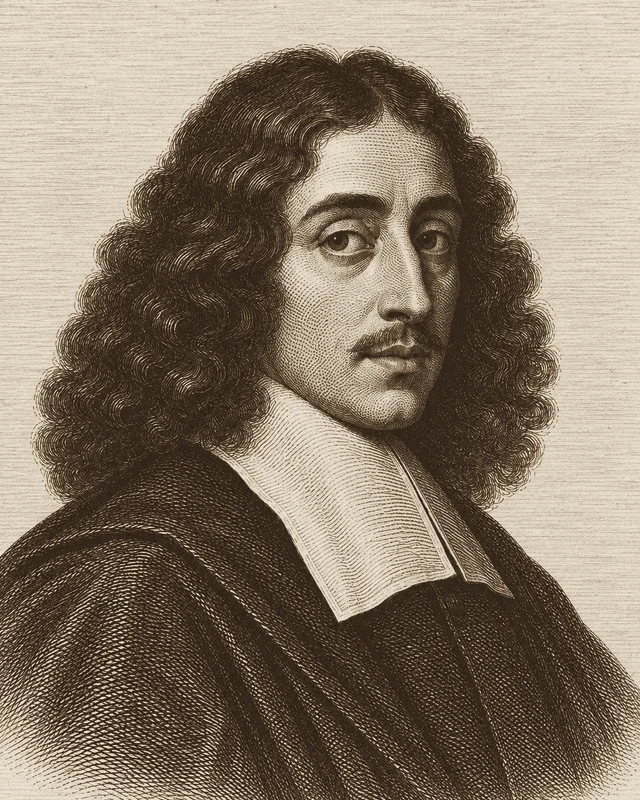
- 1632
He was born in Amsterdam on 24 November. His family were Jewish merchants who had come over from Portugal to escape the Inquisition. Record
Jewish Encyclopedia (1906), 'Spinoza, Baruch' jewishencyclopedia.com · Encyclopædia Britannica, 1911 edition, 'Spinoza, Baruch' Wikisource,_Baruch · IEP 'Spinoza' (Blake D. Dutton) §1 IEP · SEP 'Spinoza' §1 SEP
- Before 1656 (year unknown)
An early biography (Colerus) relates that one evening, leaving the old Portuguese synagogue, he dodged a knife that someone swung at him and kept the coat the knife had pierced. Accounts differ on the place and on how badly he was hurt; Bayle, for example, writes that he was slightly wounded by the knife on leaving a theatre. Tradition
Colerus, The Life of Benedict de Spinosa, English translation (1706), archive.org lifebenedictdes01colegoog ("He kept still the Coat that was run thro' with the Dagger") · Steven Nadler, 'Who Tried to Kill Spinoza?', Jewish Review of Books, Winter 2019 jewishreviewofbooks.com (Bayle 1697: theatre / Colerus 1705: synagogue) · Encyclopædia Britannica, 1911 edition (before the excommunication, dagger)
- 1656
On 27 July Amsterdam's Portuguese-Jewish community excommunicated him (herem). The writ cites 'abominable heresies' and 'monstrous deeds' but does not say specifically what they were. Record
SEP 'Spinoza' §1 ("We do not know for certain what Spinoza's 'monstrous deeds' and 'abominable heresies' were") · IEP 'Spinoza' §1 · Jewish Encyclopedia (27 July, aged 23)
- 1661
He moved to Rijnsburg, near Leiden. Record
SEP §1 ("By 1661 … living in Rijnsburg") · IEP §1 · Encyclopædia Britannica, 1911 edition
- 1663
He moved to Voorburg, near The Hague, and published the Principles of Cartesian Philosophy. Record
IEP §1 (1663 Voorburg, Principles of Cartesian Philosophy) · SEP §1 (completed 1663) · Jewish Encyclopedia (Voorburg, April 1663)
- 1670
He published the Theological-Political Treatise without his name. In the same year he moved to The Hague. Record
SEP §1 ("published anonymously … in 1670") · IEP §1 (1670 anonymous publication, The Hague) · Encyclopædia Britannica, 1911 edition (The Hague 1670–1677)
- 1672
On 20 August Johan de Witt, who had led the Republic, and his brother Cornelis were killed by an angry mob in The Hague. Leibniz noted, as he heard it from Spinoza, that Spinoza meant to go out that night and put up a placard near the scene reading 'ultimi barbarorum' (lowest of barbarians), but his landlord locked the door to stop him. Record
Rijksmuseum, collection note on 'The Corpses of the De Witt Brothers' ("On 20 August 1672") Rijksmuseum · SEP 'Spinoza's Political Philosophy' (rampjaar, the killing of the De Witt brothers) · Leibniz's note (Foucher de Careil 1854) Wikisource · Encyclopædia Britannica, 1911 edition
- 1673
Fabritius, conveying the wish of the Elector Palatine, offered him a professorship of philosophy at the University of Heidelberg, but he declined. Record
Colerus (1706), English translation (Fabritius's letter of 16 February 1673, "cum amplissima Philosophandi libertate") · Encyclopædia Britannica, 1911 edition (offer and refusal, 1673) · The Spinoza Web, 'Ludwig, Karl' spinozaweb.org
- 1675
He finished the Ethics and prepared to publish it, but did not publish it that year. The book did not appear in his lifetime. Record
IEP §1 ("By 1675 it was complete") · Edwin Curley, editor's introduction to Ethics Part I, 'The Metaphysical Moralist' ("Spinoza took steps to publish this work in 1675, though it did not appear until 1677"; letter to Oldenburg, July 1675) pls.nd.edu
- 1676
Leibniz came to The Hague to visit Spinoza and met him. Record
IEP 'Leibniz' ("an excursion to The Hague to visit Spinoza") IEP · SEP 'Leibniz' (18–21 November 1676 — used only for the dates; the SEP wrongly gives the place as Amsterdam, so it is not used for the place) SEP · Leibniz's note ("J'ay passé quelques heures après dîner avec Spinoza")
- 1677
He died in The Hague on 21 February, aged 44. The cause was a lung disease; many records describe it as tuberculosis (consumption). Record
Jewish Encyclopedia (21 February 1677, consumption) · Encyclopædia Britannica, 1911 edition ("Consumption", the day after Saturday 20 February, "little more than forty-four") · IEP §1 (respiratory illness)
- 1677
His friends gathered the Ethics and his other unpublished writings and published them as the Opera Posthuma. Record
IEP §1 ("B.D.S. Opera Posthuma") · SEP §1 ("soon published by his friends") · Encyclopædia Britannica, 1911 edition
- 1678
His posthumous works were banned throughout Holland. Record
IEP §1 ("in 1678, these works were banned throughout Holland") · Encyclopædia Britannica, 1911 edition (banned 1678)