Great Games of Thought
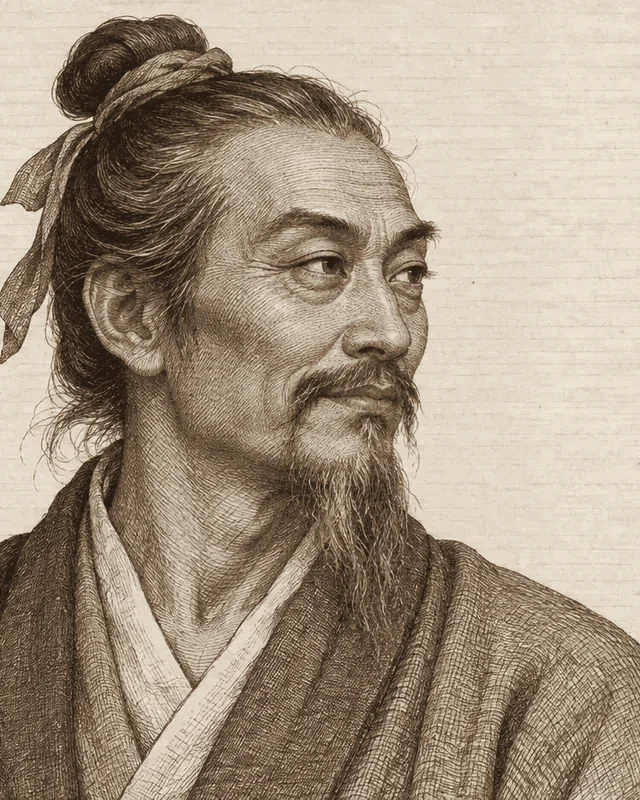
Zhuangzi — an imagined portraitAn imagined portrait

Zhuangzi (Zhuang Zhou)

c. 4th century BCE (his dates are disputed)

Zhuangzi of the butterfly dream

Once I dreamt I was a butterfly, fluttering happily, not knowing I was Zhuang Zhou.
Game 2 · Reconstruction; Zhuangzi 'On Seeing Things as Equal' (Inner Chapters)

Overview

Zhuangzi was a thinker of China's Warring States period; his given name was Zhou (周). Record

In the Shiji, Sima Qian wrote that he was a man of Meng (蒙) and served as a minor official at Qiyuan (漆園) in Meng. Record

Very few facts about his life can be confirmed outside the book called the Zhuangzi. Interpretation · SEP (Chad Hansen)

The Zhuangzi is known for fables such as the butterfly dream, Cook Ding carving an ox, and the gourd that was too big. Record

Scholars regard Zhuangzi, together with Laozi, as a leading figure of Daoist thought. Interpretation · general scholarly view (SEP, IEP)

Timeline

  1. 4th century BCE

    Sima Qian's Shiji records that Zhuangzi was a man of Meng (蒙) and that his name was Zhou (周). Record

    Sima Qian, Shiji, juan 63, 'Biographies of Laozi and Han Fei' / H. A. Giles, Chuang Tzŭ (1889), translation of the Shiji in the introduction

  2. 4th century BCE

    Placing Meng in the state of Song is the view of later works such as Liu Xiang's Bielu; its modern location is disputed. Debated

    Shiji, juan 63, 'Suoyin' commentary (劉向別錄云宋之蒙人也) and 'Zhengyi' commentary / Berkshire Encyclopedia of China, 'Zhuangzi (c. 369–286 bce)' (northeast of today's Shangqiu, Henan) · Giles (1889) notes (today's Anhui)

  3. Late 4th century BCE

    He served as a minor official (吏) at Qiyuan in Meng. Qiyuan is read either as a lacquer-tree grove or as a place name. Record

    Shiji, juan 63 (周嘗為蒙漆園吏) and the Kuodizhi quoted in the 'Zhengyi' commentary / Handian, '漆園吏' · Guoxue Dashi place name '漆园'

  4. Late 4th century BCE

    The Shiji says he was a contemporary of King Hui of Liang and King Xuan of Qi. Record

    Shiji, juan 63 (與梁惠王、齊宣王同時) / Giles (1889), translation in the introduction

  5. Late 4th century BCE

    It is said that King Wei of Chu sent men to offer him the post of chief minister, and that he refused. Tradition

    Shiji, juan 63 (楚威王…許以為相) / Zhuangzi, 'Autumn Floods' (Outer Chapters, 莊子釣於濮水…持竿不顧)

  6. —

    A story tells that his household was poor and he went to the Marquis of Jianhe to borrow grain. Tradition

    Zhuangzi, 'External Things' (Miscellaneous Chapters, 莊周家貧,故往貣粟於監河侯) / Giles (1889) translation

  7. —

    A story tells that he and his friend Huizi debated the joy of fish on a bridge over the river Hao (濠). Tradition

    Zhuangzi, 'Autumn Floods' (Outer Chapters, 莊子與惠子遊於濠梁之上) / Giles (1889) translation

  8. —

    A story tells that when his wife died he drummed on a basin and sang, and that Huizi rebuked him for it. Tradition

    Zhuangzi, 'Supreme Happiness' (Outer Chapters, 莊子妻死,惠子弔之…鼓盆而歌) / Giles (1889) translation

  9. —

    A story tells that after Huizi died, he passed Huizi's grave and said he no longer had anyone to talk with. Tradition

    Zhuangzi, 'Xu Wugui' (Miscellaneous Chapters, 過惠子之墓…吾无與言之矣) / Giles (1889) translation

  10. —

    A story tells that as he was dying, his disciples wanted to give him a lavish funeral, and he answered that he would take heaven and earth as his coffin. Tradition

    Zhuangzi, 'Lie Yukou' (Miscellaneous Chapters, 莊子將死,弟子欲厚葬之) / Giles (1889) translation

  11. Han dynasty

    Sima Qian included a short biography of Zhuangzi in the Shiji. He wrote that his writings ran to more than a hundred thousand characters and were mostly allegories (stories that speak through comparison). Record

    Shiji, juan 63 (其著書十餘萬言,大抵率寓言也) / Giles (1889), translation in the introduction

  12. c. 300

    Guo Xiang of the Jin dynasty (d. 312) cut the Zhuangzi from 52 chapters to 33 and edited it. It is divided into 7 Inner, 15 Outer and 11 Miscellaneous Chapters. Record

    SEP 'Zhuangzi' §2 Evolving Text Theory / IEP 'Zhuangzi' §2 The Zhuangzi Text
Key ideas

The butterfly dream — I and the butterfly, dreaming and waking

In 'Discussion on Making All Things Equal', Zhuang Zhou dreams he is a butterfly and, on waking, asks whether Zhuang Zhou dreamed of being a butterfly or a butterfly is dreaming of being Zhuang Zhou. The original text calls this 'the transformation of things' (物化). Chad Hansen in the SEP reads the story as an example of a mild skepticism: one cannot be sure even of the feeling of having woken to a broader perspective. Interpretation · SEP (Chad Hansen)

Zhuangzi, 'Discussion on Making All Things Equal' (Inner Chapter 2), closing passage / SEP 'Zhuangzi' (Chad Hansen, revised 2024)

The usefulness of the useless

When Huizi smashed a huge gourd because it was too big to be of any use, Zhuangzi asked why he had not thought of making it into a great tub-boat and floating it on the rivers and lakes. 'In the World of Men' contains the saying 'Everyone knows how the useful is useful; no one knows how the useless is useful.' Record · Paraphrase

Zhuangzi, 'Free and Easy Wandering' (Inner Chapter 1), the big gourd · 'In the World of Men' (Inner Chapter 4), closing passage / IEP 'Zhuangzi' (Steve Coutinho), commentary on 'Free and Easy Wandering'

Skill in the body — Cook Ding carving an ox

In 'The Secret of Caring for Life', Cook Ding says that at first he saw nothing but the ox, that after three years he no longer saw the whole ox, and that now he meets the ox with his spirit rather than his eyes. He follows the ox's natural lines and slips the blade into the gaps, so that after nineteen years his knife edge is as if fresh from the whetstone. The SEP cites this passage as an example of the practical skill (know-how) the Zhuangzi holds in high regard. Record · Paraphrase

Zhuangzi, 'The Secret of Caring for Life' (Inner Chapter 3), Cook Ding / SEP 'Zhuangzi' (Chad Hansen), 'Butcher Ding'

Knowledge has no limit

'The Secret of Caring for Life' opens with the words 'My life has its bounds, but knowing has none.' To chase the boundless with the bounded is perilous. Chad Hansen in the SEP sees this passage as one where Zhuangzi's weak skepticism shows clearly. Interpretation · SEP (Chad Hansen)

Zhuangzi, 'The Secret of Caring for Life' (Inner Chapter 3), opening passage / SEP 'Zhuangzi' (Chad Hansen)

In their words

Long ago Zhuang Zhou dreamed that he was a butterfly — fluttering about, a butterfly through and through, pleased with itself and following its fancy, with no idea that it was Zhou. All at once he awoke, and there, plainly, was Zhou. He could not tell whether Zhou had dreamed of being a butterfly, or a butterfly was dreaming of being Zhou.

昔者莊周夢爲胡蝶,栩栩然胡蝶也,自喻適志與,不知周也。俄然覺,則蘧蘧然周也。不知周之夢爲胡蝶與?胡蝶之夢爲周與?

Zhuangzi, 'Discussion on Making All Things Equal' (Inner Chapter 2) · translated from the Classical Chinese by Great Games of Thought Record · Quotation
Everyone knows how the useful is useful; no one knows how the useless is useful.

人皆知有用之用,而莫知无用之用也。

Zhuangzi, 'In the World of Men' (Inner Chapter 4), closing passage · translated from the Classical Chinese by Great Games of Thought Record · Quotation
My life has its bounds, but knowing has none. To chase the boundless with the bounded is nothing but peril.

吾生也有涯,而知也无涯。以有涯隨无涯,殆已。

Zhuangzi, 'The Secret of Caring for Life' (Inner Chapter 3), opening passage · translated from the Classical Chinese by Great Games of Thought Record · Quotation
(Huizi) You are not a fish; whence do you know the joy of fish? … (Zhuangzi) You are not I; whence do you know that I do not know the joy of fish?

子非魚,安知魚之樂?…子非我,安知我不知魚之樂?

Zhuangzi, 'Autumn Floods' (Outer Chapter 17) · translated from the Classical Chinese by Great Games of Thought Tradition

Times and influence

Fourth-century-BCE China, where Zhuangzi lived, was the Warring States period, when many states fought one another. In this period many schools, including the Confucians and the Mohists, argued over the standards of society and the use of words. Sima Qian wrote that Zhuangzi sharply criticized the Confucians and the Mohists.

The Zhuangzi we have today is the 33-chapter edition compiled by Guo Xiang of the Jin dynasty. Scholars hold that Zhuangzi's thought, together with ideas linked to Laozi, later influenced the formation of Chinese Chan Buddhism. Fables such as the butterfly dream are passages that scholars continue to interpret today.

Common misconceptions

Books to read

Appears in