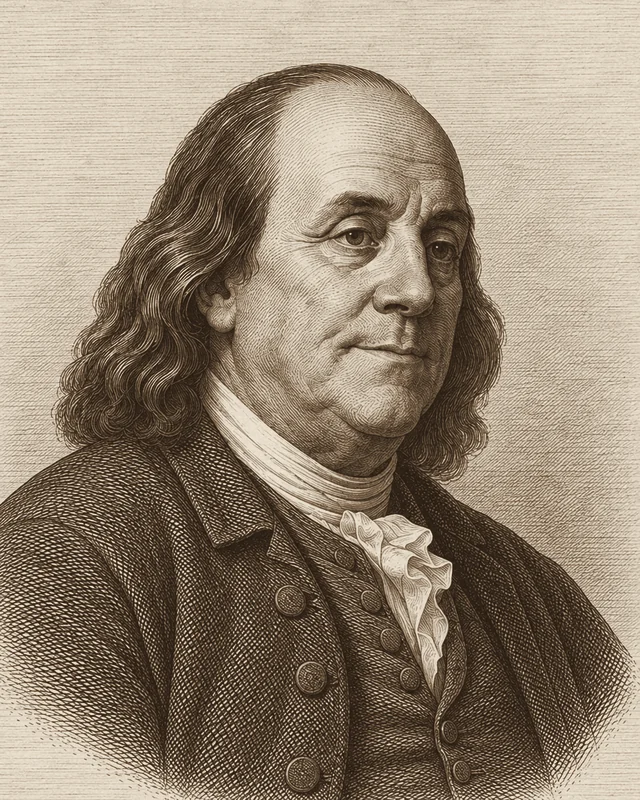
- 1706
He was born in Boston on 17 January (by today's calendar). He was the fifteenth of the seventeen children of his father Josiah, who made candles and soap. By the old calendar (Old Style) then used in the British colonies, the date was 6 January. Record
The Autobiography of Benjamin Franklin (Project Gutenberg #148), lines 287–290, 338–340 Project Gutenberg · The Franklin Institute, 'Benjamin Franklin FAQ' fi.edu · ushistory.org, 'Benjamin Franklin Timeline', 1706 ushistory.org (Old Style date)
- 1716–1718
At ten he left school to help in his father's candle shop. At twelve he was apprenticed to his brother James, a printer. Record
The Autobiography of Benjamin Franklin, line 338 (At ten years old I was taken home) · The Franklin Institute, 'Benjamin Franklin FAQ' (schooling) · The Autobiography, lines 485–486 (signed the indentures when I was yet but twelve) · ushistory.org 'Timeline', 1718
- 1723
At seventeen, with his apprenticeship unfinished, he secretly left Boston and reached Philadelphia. All the money he had was a Dutch dollar and about a shilling in copper. He wrote that he bought three rolls and walked through the streets with one under each arm, eating the third. Deborah Read, who later became his wife, saw him and thought he made a ridiculous figure. Record
The Autobiography of Benjamin Franklin, lines 893–898 · ushistory.org 'Timeline', 1723 · U.S. National Archives, 'Founding Fathers: Pennsylvania' National Archives · The Autobiography, lines 906–918 (a roll under each arm, and eating the other · a most awkward, ridiculous appearance) · ushistory.org edition of the Autobiography, p. 12 ushistory.org
- 1728–1730
In 1728 he set up a printing house with the printer Hugh Meredith. But Meredith's father could not pay all the money he had promised. Then his friends William Coleman and Robert Grace each came to him separately and offered to lend him the money he needed to take over the printing house alone. He wrote in his autobiography that when Meredith withdrew from the partnership, he borrowed half from each of the two friends and took over the printing house on his own. The autobiography dates this to around 1729, but the record ending the partnership is dated 14 July 1730. Record
The Autobiography of Benjamin Franklin, lines 1942–1952 · Papers of Benjamin Franklin, biographical note 'Meredith, Hugh' (withdrew from the partnership, 1730) Franklin Papers · ushistory.org 'Timeline', 1728 · The Autobiography, lines 2244–2262 · National Humanities Center, excerpt of Part 1 of the Autobiography nationalhumanitiescenter.org · 'Franklin's Accounts, 1730' (University of Delaware UDSpace; partnership dissolved 14 July) udspace.udel.edu
- 1732
Under the name Richard Saunders he first published Poor Richard's Almanack. He edited the almanac himself through the 1758 edition, and wrote in his autobiography that it sold nearly ten thousand copies a year. Record
The Autobiography of Benjamin Franklin, lines 3355–3359 · U.S. National Archives, 'Founding Fathers: Pennsylvania' (Poor Richard's Almanac, 1733-58)
- 1748
He published 'Advice to a Young Tradesman' under the name 'an old one'. In the same year he handed over the running of the printing house to David Hall and retired from business. He was forty-two. Record
'Advice to a young Tradesman', Works of the late Doctor Benjamin Franklin (1793), Wikisource Wikisource · History Carper, full text of the 1748 edition historycarper.com · The Autobiography of Benjamin Franklin, lines 4203–4221 · U.S. National Archives, 'Founding Fathers: Pennsylvania' (By 1748 … financial independence)
- 1749
In a letter of 29 April to Peter Collinson in London, he called an electrical device made of glass panes with lead plates attached an 'electrical-battery'. The same letter also describes a wheel turned by electricity (the electrical jack). Record
Experiments and Observations on Electricity (London: E. Cave, 1751), Letter III, dated at the end April 29, 1749 — Project Gutenberg #45515 Project Gutenberg · U.S. National Park Service, 'Benjamin Franklin and Science' nps.gov (coined the terms battery…) · Etymonline 'battery' etymonline.com
- 1750
In 'Opinions and Conjectures' (29 July) he proposed setting up iron rods, pointed like needles, on the tops of buildings to protect houses, churches and ships from lightning. Record
Experiments and Observations on Electricity, 'Opinions and Conjectures', PHILADELPHIA, July 29, 1750 (Gutenberg #45515) · The Franklin Institute, 'Benjamin Franklin's Inventions' fi.edu
- 1752
He is known to have flown a kite to collect electricity from a thundercloud. He made the experiment public in writing only four months later, in October, and did not say that he had done it himself, so the details of the experiment are still disputed. Debated
U.S. National Park Service, 'Benjamin Franklin and Science' (June 1752 · did not publicly mention the experiment until October … some scholars to doubt) · The Franklin Institute, 'Benjamin Franklin FAQ' (1752 kite, not struck by lightning)
- 1758
He printed 'The Way to Wealth', which gathers the proverbs he had put in the almanac over the years into a speech by 'Father Abraham', as the preface to the 1758 edition of the almanac. Record
Internet Archive, bibliographic note to The way to wealth; or, Poor Richard improved (first published in Poor Richard's almanac for 1758) Internet Archive · The Autobiography of Benjamin Franklin, lines 3370–3375 (compiled as the almanac's preface; the Autobiography gives the year as 1757) · Project Gutenberg #43855, text Project Gutenberg
- 1776
He signed the American Declaration of Independence. In 1787 he attended the convention that drew up the Constitution as a delegate from Pennsylvania, and signed the Constitution too. Record
U.S. National Archives, 'Signers of the Declaration of Independence' National Archives · U.S. National Archives, 'Founding Fathers: Pennsylvania' · The Franklin Institute, 'Benjamin Franklin FAQ' (signed … the Constitution (1787))
- 1779
He presented his credentials as American minister plenipotentiary to France and served until 1785. In 1783, with John Jay and John Adams, he negotiated the Treaty of Paris, which ended the War of Independence. Record
U.S. Department of State, Office of the Historian, 'Benjamin Franklin' history.state.gov · U.S. National Archives, 'Founding Fathers: Pennsylvania' (sole commissioner to France (1779-85) … Treaty of Paris (1783)) · The Autobiography of Benjamin Franklin, Gutenberg #148, editor's chronology for 1782 and 1783
- 1789
In a codicil to his will dated 23 June, he left £1,000 each to Boston and Philadelphia. The condition was that the money be lent at 5 percent a year to married artisans under 25 who had completed their apprenticeships, and that it be divided and spent after 100 years and after 200 years. Record
Text of Franklin's will and codicil constitution.org · Boston City Archives, 'Guide to the Franklin Fund records', historical note cityofboston.gov
- 1790
He died in Philadelphia on 17 April, aged eighty-four. Record
The Franklin Institute, 'Benjamin Franklin FAQ' (died at age 84 on April 17, 1790, in Philadelphia) · U.S. National Archives, 'Signers of the Declaration of Independence' (4/17/1790, 84)
- 1990
When the bequest funds ended after 200 years, the Boston fund stood at about $4.5 million and the Philadelphia fund at about $2 million. The remaining money went to Boston's Franklin technical school (founded in 1908 with this fund and a gift from Andrew Carnegie; today the Benjamin Franklin Cummings Institute of Technology), Philadelphia's Franklin Institute, scholarships for students learning trades, and more. Record
HistoryNet, 'Ben Franklin's Gift that Keeps on Giving' (Stephan A. Schwartz, American History, 2009) historynet.com · Mental Floss (Jake Rossen, 20 August 2020) mentalfloss.com · Billy Penn (12 May 2023) billypenn.com · Boston City Archives, 'Guide to the Franklin Fund records' (Franklin Union, 1908) cityofboston.gov · the change of the school's name is from the school's announcement (2022, Benjamin Franklin Cummings Institute of Technology) — Wikipedia used only as a guide