Great Games of Thought
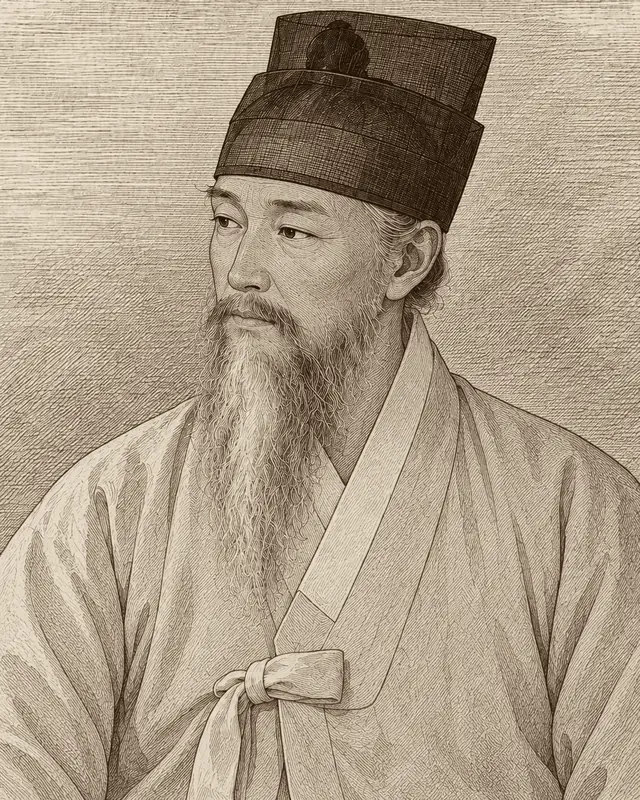
An imagined portrait of Kim Jeong-hui with a long beard, wearing a black woven horsehair cap (tanggeon) and a white robe.An imagined portrait

Kim Jeong-hui

1786–1856

Obituary in the Veritable Records of King Cheoljong, 10th day of the 10th lunar month of Cheoljong 7 (7 November 1856)

Kim Jeong-hui, who said he wore down a thousand brushes

You cannot become a Buddha on the spot, nor catch a dragon with your bare hands. It comes only after painting a lot.
Game 10 · Reconstruction · Record; paraphrase; 題石坡蘭卷

Overview

Kim Jeong-hui was a scholar of Joseon Korea. His pen names were Chusa and Wandang, and he left a calligraphy all his own: the Chusa style. Record

When he died, the Veritable Records, the state chronicle, wrote that he had awakened to the true realm in the cursive, regular, seal and clerical scripts. Record · Paraphrase

In 1840 he was exiled to Daejeong county on Jeju and confined within a fence. It is on that island that he is thought to have painted Sehando (Winter Scene), now a National Treasure (1844 is a scholarly dating). Record

Of orchid painting, he wrote that it becomes possible only after painting a lot, and went on to say that you can do almost all of it up to 9,999 parts, but the remaining one part is the hardest to achieve. Record · Paraphrase

Saying his own calligraphy was not worth mentioning, he wrote that over seventy years he had worn holes in ten inkstones and worn down a thousand brushes. Record · Paraphrase

Timeline

  1. 1786

    He is born. Record

    Encyclopedia of Korean Culture, "Kim Jeong-hui" Encykorea

  2. 1840

    On the 4th day of the 9th lunar month of Heonjong 6, as a prisoner under interrogation, he is sentenced to exile in Daejeong county on Jeju, confined within a fence (wiri anchi). Record

    Veritable Records of King Heonjong, Heonjong 6, 9th month, 4th day: 「鞫囚罪人正喜,大靜縣圍籬安置」 Annals of the Joseon Dynasty

  3. 1842

    On the 13th day of the 11th lunar month his wife, Lady Yi of Ye-an, dies in Yesan. The news of her death reached him across the sea in exile only on the evening of the 15th day of the following month. He set up a spirit tablet and wept, and wrote a text that he sent home to be read before her shrine at the memorial rite. Record

    Collected Works of Wandang (阮堂全集), vol. 7, 「夫人禮安李氏哀逝文」: 「壬寅十一月乙巳朔十三日丁巳。夫人示終於禮山之楸舍」 「粤一月乙亥朔十五日己丑夕。始傳訃到海上」 db.itkc.or.kr

  4. 1844

    He paints Sehando and gives it to his disciple, the interpreter Yi Sang-jeok (pen name Useon), who had found books far away and sent them to him. In the inscription he notes that Yi had sent him books the year before and that year, and writes that while the world chased only power and profit, Yi had not. Record · the year is a scholarly dating

    Sehando, dedication 「藕船是賞」 · inscription 「去年以晩學大雲二書寄來。今年又以藕畊文編寄來」 「世之滔滔 惟權利之是趨」 「不以歸之權利」 · Encyclopedia of Korean Culture, "Sehando by Kim Jeong-hui" Encykorea · "Yi Sang-jeok" Encykorea

  5. 1848

    On the 6th day of the 12th lunar month of Heonjong 14, he is released from exile. Record

    Veritable Records of King Heonjong, Heonjong 14, 12th month, 6th day: 「李穆淵、趙秉鉉、金正喜,放」 Annals of the Joseon Dynasty

  6. 1851

    On the 22nd day of the 7th lunar month of Cheoljong 2, he is exiled again, to Bukcheong. Record

    Veritable Records of King Cheoljong, Cheoljong 2, 7th month, 22nd day: 「北靑府遠竄」 Annals of the Joseon Dynasty

  7. 1856

    On the 10th day of the 10th lunar month of Cheoljong 7, the Veritable Records note that the former Vice-Minister Kim Jeong-hui has died. They say that he made his name young, but met with family misfortune, was exiled south and north, and went through every hardship. Record · Paraphrase

    Veritable Records of King Cheoljong, Cheoljong 7, 10th month, 10th day, obituary: 「前參判金正喜卒」 「早歲蜚英,中罹家禍,南竄北謫,備經風霜」 Annals of the Joseon Dynasty

  8. 1857

    The painter Yi Han-cheol paints a portrait of Kim Jeong-hui. The portrait is designated together with the Treasure "Heirlooms of the Head Family of Kim Jeong-hui". Record

    Korea Heritage Service, "Heirlooms of the Head Family of Kim Jeong-hui" (Treasure) — "the portrait of Kim Jeong-hui painted by Yi Han-cheol in Cheoljong 8 (1857)" khs.go.kr

  9. 2020

    The National Treasure Sehando is donated and enters the collection of the National Museum of Korea (Jeung 10000). Record

    National Museum of Korea press release, "National Treasure No. 180 Sehando, into the arms of the National Museum of Korea" (20 August 2020, on Son Chang-geun's donation of Sehando) museum.go.kr · National Museum of Korea, "Sehando by Kim Jeong-hui" (Jeung 10000, National Treasure) museum.go.kr
Key ideas

The last one part

Of orchid painting, he said you can do almost all of it up to 9,999 parts, but the remaining one part is the hardest to achieve. That one part, he said, does not come from human strength, nor does it come from outside human strength. Reading 分 as one part in 10,000 is an interpretation. Record · Paraphrase · reading 分 is interpretation

Collected Works of Wandang, vol. 6, 「題石坡蘭卷」: 「雖到得九千九百九十九分。其餘一分最難圓」 db.itkc.or.kr

Only after painting a lot

In 「題石坡蘭卷」, before the passage on the last one part, he said of the quality of orchid painting (畵品) that it becomes possible only after painting a lot: you cannot become a Buddha on the spot, nor catch a dragon with your bare hands. To the young interpreter O Gyeong-seok he wrote that even after reaching 9,999 parts the work of the last one part is extremely hard, and added 「努力加餐」. This can be read as a greeting telling him to look after himself, from the "Nineteen Old Poems", while the Korean translation by the Institute for the Translation of Korean Classics renders it as "you must keep striving to the end". Record · another reading exists

Collected Works of Wandang, vol. 6, 「題石坡蘭卷」: 「又多作然後可能 不可以立地成佛 又不可以赤手捕龍」 (before 「雖到得九千九百九十九分」) db.itkc.or.kr · vol. 4, 「與吳生」: 「雖到得九千九百九十九分 其一分之工極難圓 努力加餐可耳」 db.itkc.or.kr · Korean translation (tr. Sin Ho-yeol, 1988) db.itkc.or.kr

No more than three or four sheets

When his son sent a great deal of paper and asked for many orchid paintings, he replied that you cannot paint orchids beyond three or four sheets at a time; the spirit must gather and the circumstances must be in harmony. In the same letter he said the method of painting orchids is close to clerical script, and can be attained only with the fragrance of letters and the air of books. Record · Paraphrase

Collected Works of Wandang, vol. 2, 「與佑兒」: 「蘭法亦與隷近。必有文字香書卷氣然後可得」 「寫蘭不得過三四紙。神氣之相湊。境遇之相融」 db.itkc.or.kr

Only when the cold winter comes

In the inscription on Sehando, borrowing words from the Analects, he wrote that only when the cold winter comes do we know that pine and arborvitae are the last to wither. It is a text that likens to those trees the disciple who did not forget him in exile. Record · Paraphrase

Sehando, inscription: 「歲寒然後知松柏之後凋」 — Analects, Zihan: 「歲寒然後知松柏之後彫也」 (松柏 = pine and arborvitae, as glossed by the National Museum of Korea)

In their words

Even if you reach 9,999 parts, the remaining one part is the hardest to achieve. Up to 9,999 parts, almost all of it can be done. This one part does not come from human strength, nor does it come from outside human strength.

雖到得九千九百九十九分。其餘一分最難圓。就九千九百九十九分。庶皆可能。此一分非人力可能。亦不出於人力之外

Collected Works of Wandang, vol. 6, 「題石坡蘭卷」 — Korean Classics DB, punctuated edition of the Korean Literary Collections db.itkc.or.kr · translated from the Classical Chinese by Great Games of Thought Record · Quotation
Again, it becomes possible only after painting a lot. You cannot become a Buddha on the spot, nor catch a dragon with your bare hands.

又多作然後可能。不可以立地成佛。又不可以赤手捕龍

Collected Works of Wandang, vol. 6, 「題石坡蘭卷」 db.itkc.or.kr · translated from the Classical Chinese by Great Games of Thought Record · Quotation
My calligraphy is not worth mentioning, but in seventy years I have worn holes in ten inkstones and worn down a thousand brushes, and yet I have never once studied the method of writing letters.

吾書雖不足言。七十年。磨穿十硏。禿盡千毫。未甞一習簡札法

Collected Works of Wandang, vol. 3, 「與權彝齋」 db.itkc.or.kr · translated from the Classical Chinese by Great Games of Thought Record · Quotation
With the cangue before me and exile across mountains and sea behind me, my mind was never shaken. But now, at the loss of a wife, I am startled and scattered, and have no way to hold my mind together.

吾桁楊在前。嶺海隨後。而未甞動吾心也。今於一婦人之喪也。驚越遁剝。無以把捉其心

Collected Works of Wandang, vol. 7, 「夫人禮安李氏哀逝文」 db.itkc.or.kr · translated from the Classical Chinese by Great Games of Thought Record · Quotation
Only when the cold winter comes do we know that pine and arborvitae are the last to wither.

歲寒然後知松柏之後凋

Sehando, inscription (National Museum of Korea, Jeung 10000) — quoting the Analects, Zihan: 「歲寒然後知松柏之後彫也」 · translated from the Classical Chinese by Great Games of Thought Record · Quotation

Times and influence

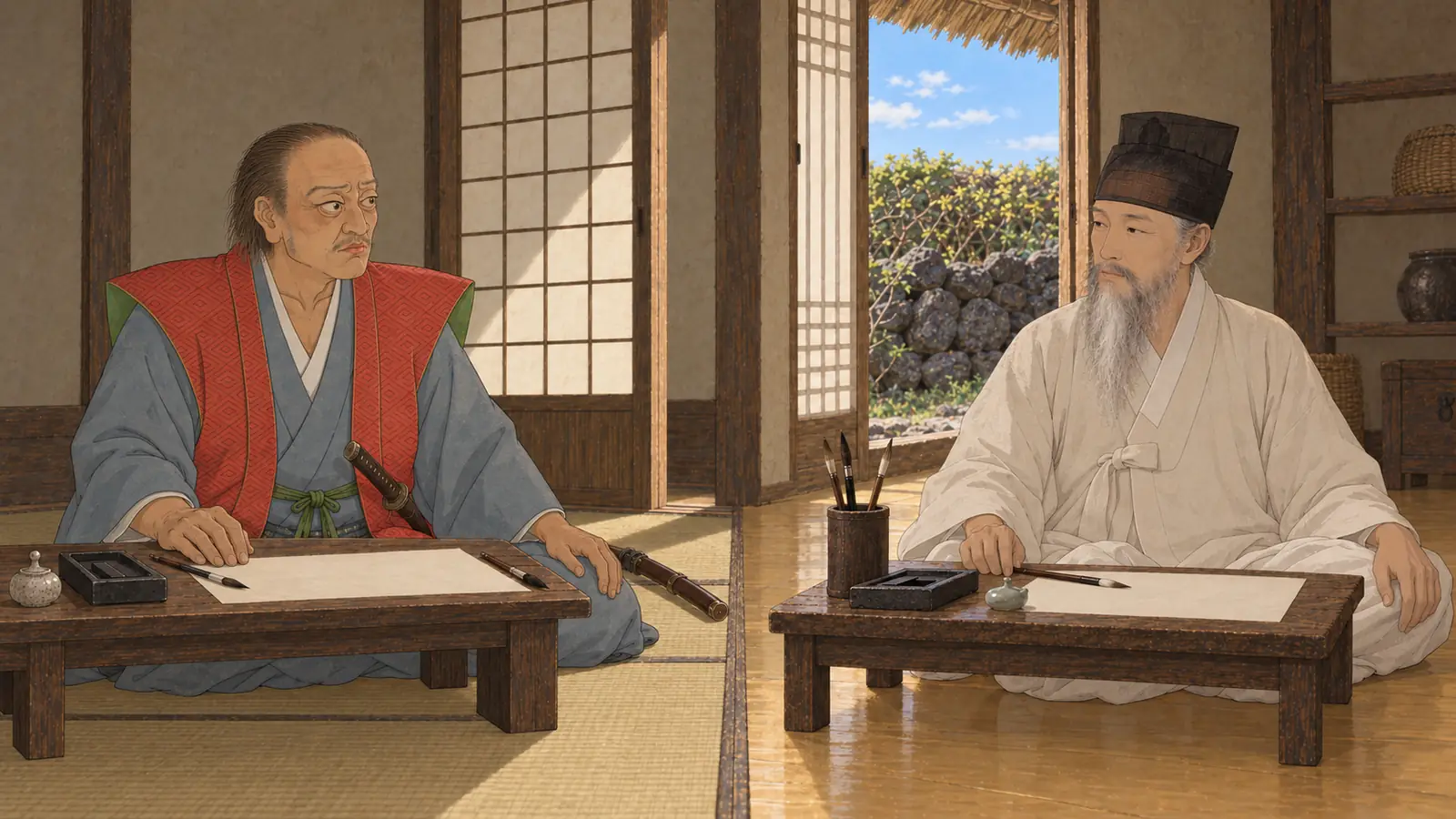
From 1840 to 1848 Kim Jeong-hui lived confined within a fence in Daejeong county on Jeju. During those years his disciple Yi Sang-jeok, an interpreter, sent him books he had found in Beijing, and the inscription on Sehando records this. While he was in exile, in 1842, his wife died, and the news reached him across the sea only a little over a month later.

Sehando is a National Treasure and, donated in 2020, belongs to the National Museum of Korea. The portrait of him painted by Yi Han-cheol in 1857 is designated together with the Treasure "Heirlooms of the Head Family of Kim Jeong-hui". His writings and letters were collected as the Collected Works of Wandang, and anyone can read the original text and a Korean translation in the Korean Classics DB.

With people from other games

Common misconceptions

Books to read

Appears in