Great Games of Thought
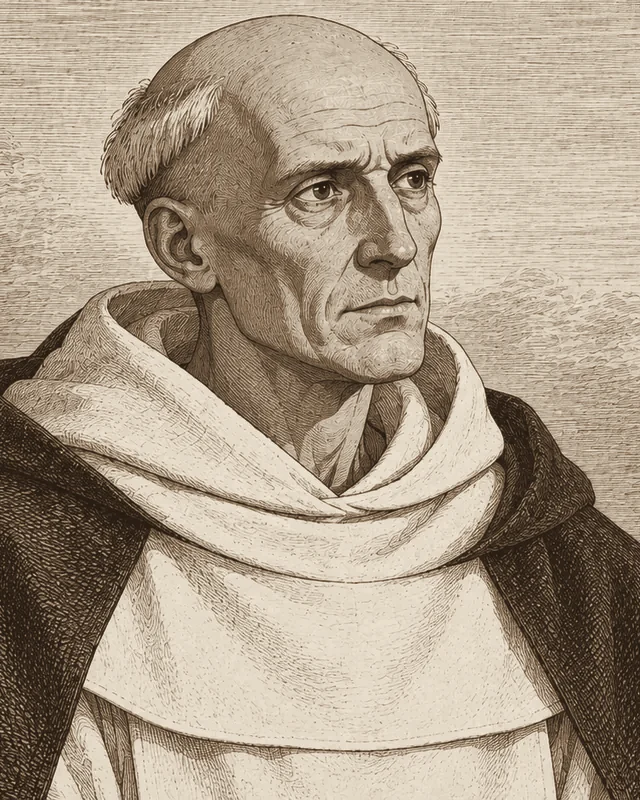
Eckhart — an imagined portraitAn imagined portrait

Meister Eckhart

c. 1260–1328 (before 30 April; some say 1327)

Before 30 April 1328 (some say 1327)

Eckhart, who said let go of yourself

Observe yourself, and wherever you find yourself, there let go of yourself.
Game 7 · Reconstruction; quotation; The Talks of Instruction, ch. 3 (c. 1295–98)

Overview

Meister Eckhart was a Dominican friar born in Thuringia around 1260. Record

He taught twice as professor (magister) of theology at the University of Paris, and left Latin writings and German sermons and teachings. Record

Late in life he was investigated for heresy by the Archbishop of Cologne, and in 1329, after his death, Pope John XXII condemned 28 sentences attributed to him. The bull did not call him a heretic. Record

Letting go of the self and entrusting oneself (gelâzenheit), and the teaching that the Son of God is born in the soul, are counted as central to his thought. Interpretation · SEP (Griffioen)

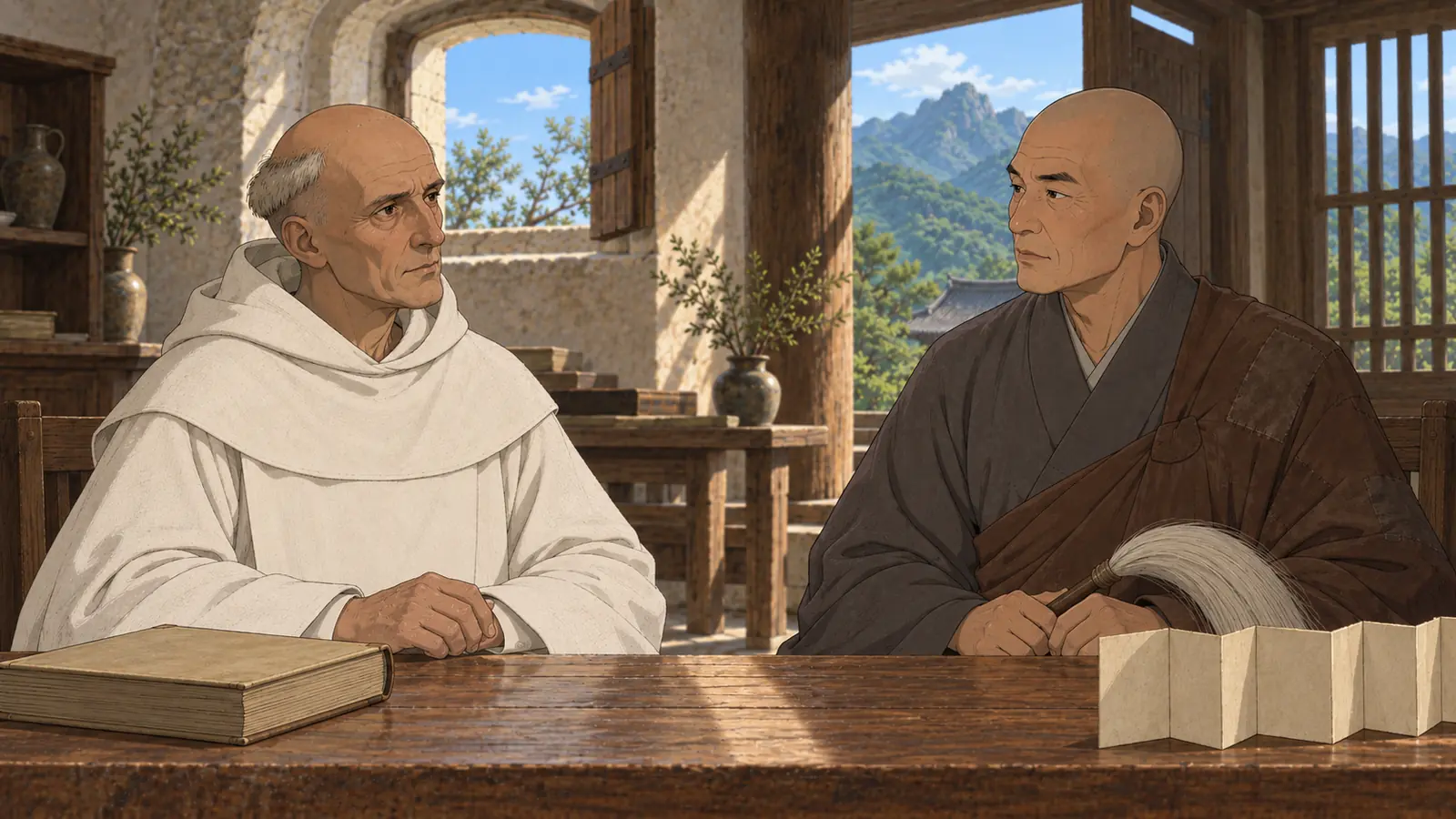
In the nineteenth century Hegel and Schopenhauer read and quoted him, and in the twentieth century studies appeared comparing him with Vedanta and Zen Buddhism. Record

Timeline

  1. c. 1260

    He was born in Thuringia. The village is disputed: Hochheim or Tambach. Debated

    SEP 'Meister Eckhart' (Amber L. Griffioen, 2023) SEP §1 · eckhart.de 'Leben' eckhart.de (Hochheim near Gotha) · Walshe and McGinn, The Complete Mystical Works of Meister Eckhart (2009), introduction, p. 6 (Hochheim)

  2. c. 1275

    He seems to have entered the Dominican friary at Erfurt. There is no record of the exact year. Interpretation · general scholarly view

    eckhart.de 'Leben' eckhart.de (Vermutlich um 1275) · Walshe and McGinn, The Complete Mystical Works of Meister Eckhart (2009), introduction, pp. 6–7 (about 1275) · SEP §1 (late teens)

  3. 1293–1294

    In Paris he lectured on Peter Lombard's Sentences. A sermon for Easter, 18 April 1294, is the first firmly dated record of his life. Record

    eckhart.de 'Leben' eckhart.de (18 April 1294) · SEP 'Meister Eckhart' (Amber L. Griffioen, 2023) SEP §1 (lecturer, 1293)

  4. c. 1294–1298

    While prior of Erfurt and vicar of Thuringia, he left the Talks of Instruction, his answers to the friars' questions. Record

    eckhart.de 'Leben' eckhart.de (prior 1294 · ban on holding both offices 1298) · Walshe 2009, Introduction to Part Two, p. 479 (about 1295–1298) · heading of the original text (vicarius von türingen, prior von erfurt)

  5. 1302

    He became master of theology at the University of Paris and taught as professor. Record

    SEP 'Meister Eckhart' (Amber L. Griffioen, 2023) SEP §1 (1302 magister actu regens) · Walshe and McGinn, The Complete Mystical Works of Meister Eckhart (2009), introduction, p. 7 · eckhart.de 'Leben' eckhart.de

  6. 1303

    He was elected first provincial of the newly created Dominican province of Saxony. The province had at least 47 houses. Record

    eckhart.de 'Leben' eckhart.de (8 September 1303, 47 Männerklöster) · Walshe and McGinn, The Complete Mystical Works of Meister Eckhart (2009), introduction, p. 7 · SEP §1 (at least 47)

  7. 1307

    He also took on the office of vicar general of the province of Bohemia. Record

    eckhart.de 'Leben' eckhart.de (Pentecost 1307) · Walshe and McGinn, The Complete Mystical Works of Meister Eckhart (2009), introduction, p. 7 · SEP §1

  8. 1311

    He was called back to Paris and served a second time as professor of theology. Record

    SEP 'Meister Eckhart' (Amber L. Griffioen, 2023) SEP §1 · eckhart.de 'Leben' eckhart.de (General Chapter of Naples, 30 May 1311)

  9. c. 1313–1323

    There are documents of him carrying out the order's business in Strasbourg (1314, 1316, 1322). Little is known in detail about where he lived in this period. Record

    eckhart.de 'Leben' eckhart.de · SEP 'Meister Eckhart' (Amber L. Griffioen, 2023) SEP §1 (Strasbourg, summer 1313) · Walshe and McGinn, The Complete Mystical Works of Meister Eckhart (2009), introduction, p. 8 (1314)

  10. c. 1323–1324

    He moved to Cologne, the centre of Dominican learning in Germany, and taught there. Record

    SEP 'Meister Eckhart' (Amber L. Griffioen, 2023) SEP §1 (1323–24) · eckhart.de 'Leben' eckhart.de (um 1324 lector primarius)

  11. 1326

    Two friars of his own order denounced him to the Archbishop of Cologne, Heinrich von Virneburg, and the archbishop opened an inquiry. In the defence he submitted on 26 September, he answered in effect: 'I may err, but I cannot be a heretic; the first belongs to the intellect, the second to the will.' Record · Paraphrase

    SEP 'Meister Eckhart' (Amber L. Griffioen, 2023) SEP §1 (the 1326 lists · appearance on 26 September · distinction between intellect and will) · eckhart.de 'Leben' eckhart.de (Responsio of 26 September 1326, German translation of Proc. col. I n.80)

  12. 1327

    After appealing to the pope, on 13 February he made a declaration in the Dominican church in Cologne. As his fellow friar Konrad von Halberstadt read it out in Latin, passage by passage, he rendered each passage into German. It said that if there were errors of faith in his writings and words, he would retract them. Record

    Walshe and McGinn, The Complete Mystical Works of Meister Eckhart (2009), introduction, p. 10 · eckhart.de 'Leben' eckhart.de (13 February 1327, Konrad von Halberstadt, quoting Sturlese) · eckhart.de 'Protestatio vom 13. Februar 1327' (notarial document: unum articulum sive punctum … in materna lingua … de verbo ad verbum exposuit) eckhart.de

  13. 1327

    In the spring he went to Avignon to appeal to the pope in person, and there a commission of theologians appointed by the pope examined his sentences again. Record

    SEP 'Meister Eckhart' (Amber L. Griffioen, 2023) SEP §1 · Walshe and McGinn, The Complete Mystical Works of Meister Eckhart (2009), introduction, p. 10 · eckhart.de 'Leben' eckhart.de

  14. 1328

    He died without seeing the verdict. In a letter the pope wrote on 30 April 1328, he is referred to as already dead. There is no certain record of where he died. Record

    Walshe and McGinn, The Complete Mystical Works of Meister Eckhart (2009), introduction, p. 11 · eckhart.de 'Leben' eckhart.de (papal letter of 30 April 1328; uncertain whether Avignon, on the way back, or Cologne)

  15. 1329

    On 27 March, Pope John XXII condemned 28 sentences attributed to him in the bull In agro dominico. Seventeen were declared heretical; of the other eleven it said they were suspect of heresy but could be read in a correct sense with many explanations. Record

    Papal bull In agro dominico, Latin text (eckhart.de/bulle.htm) (Datum Avinione, VI. kal. aprilis) · SEP 'Meister Eckhart' (Amber L. Griffioen, 2023) SEP §1 · Walshe and McGinn, The Complete Mystical Works of Meister Eckhart (2009), introduction, p. 11
Key ideas

Letting go and entrusting oneself

He says that the reason we have no peace lies not in places or people but in our own will. So he urges us to begin with ourselves and let go of ourselves. Record · Paraphrase

Talks of Instruction, ch. 3 — Middle High German text of the Talks of Instruction (Rede der underscheidunge), ed. Quint, DW V (1963), PDF of the Predigergemeinde Erfurt edition · Walshe 2009, pp. 488–489 · SEP (gelâzenheit)

God is not bound to places

Asked whether it is best to avoid people and stay only in church, he answered 'no'. Whoever truly has God, he said, has him in the street and among people just as in church. Record · Paraphrase

Talks of Instruction, ch. 6 — Middle High German text (DW V) · Walshe 2009, p. 490

A sick neighbour over rapture

He said that even if one were in a rapture like St Paul's, if there were a sick person who needed a bowl of soup, it would be far better to leave that rapture out of love and care for that person. Record · Paraphrase

Talks of Instruction, ch. 10 — Middle High German text (suppelîn, DW V) · Walshe 2009, p. 496

The birth that happens in the soul

He preached that the Son of God is born in the soul. He quoted, as a saying of Augustine, the words: what use is it if this birth always happens, but does not happen in me? Record · Paraphrase

Sermon 101 (German edition numbering; Walshe no. 1) — Walshe 2009, p. 29 · SEP §9 'Birthing the Word and Being in the World'

The one and only now

He said that the now in which God made the first human being, the now in which the last human being will pass away, and the now in which I am speaking are the same in God, and that there is only one now. Record · Paraphrase

Sermon 2 (German edition numbering; Walshe no. 8) — Walshe 2009, p. 79 · SEP ('eternal now')

In their words

Observe yourself, and wherever you find yourself, there let go of yourself; that is the very best.

Nim dîn selbes war, und swâ dû dich vindest, dâ lâz dich; daz ist daz aller beste.

Talks of Instruction, end of ch. 3 (c. 1294–1298) — ed. Quint, DW V (1963) · English adapted from Walshe's translation (2009, p. 489), which reads 'Observe yourself, and wherever you find yourself, leave yourself: that is the very best way'; 'there let go of yourself' is our rendering of dâ lâz dich, translated from the Middle High German by Great Games of Thought Record · Quotation
But whoever truly and rightly has God has him in every place: in the street and among all people, just as much as in church, in the wilderness or in a cell.

Wer aber got rehte in der wârheit hât, der hât in in allen steten und in der strâze und bî allen liuten als wol als in der kirchen oder in der einoede oder in der zellen

Talks of Instruction, ch. 6 — ed. Quint, DW V (1963) · English translation: Walshe 2009, p. 490 · translated from the Middle High German by Great Games of Thought Record · Quotation
If a person were in a rapture such as St Paul was in, and knew of a sick person who needed a little soup from him, I would think it far better that you left the rapture out of love and served the one in need with greater love.

wære der mensche alsô in einem înzucke, als sant Paulus was, und weste einen siechen menschen, der eines suppelîns von im bedörfte, ich ahtete verre bezzer, daz dû liezest von minne von dem und dientest dem dürfigen in mêrer minne.

Talks of Instruction, ch. 10 — ed. Quint, DW V (1963) · English translation: Walshe 2009, p. 496 · translated from the Middle High German by Great Games of Thought Record · Quotation

Times and influence

The Dominican order (the Order of Preachers) to which Eckhart belonged was devoted to preaching and learning, and he taught at the University of Paris and the order's school in Cologne. At that time the Archbishop of Cologne, Heinrich von Virneburg, punished groups he considered heretical (such as the Beghards) by burning and drowning. The papal court was then not in Rome but in Avignon.

Modern study of his German works began in earnest in 1857, when Franz Pfeiffer edited and published 110 sermons, 18 treatises and more. Before that, German idealists such as Franz von Baader and Hegel had taken him up, and the SEP holds that this is how he came to be regarded in the German-speaking world as the 'father of modern speculation'. In the twentieth century Rudolf Otto compared him with Vedanta, and D. T. Suzuki with Zen Buddhism.

With people from other games

Common misconceptions

Books to read

Appears in